
Translated material
Break crooked mirrors

The other day, an anti -plagiarism study was laid out in open access, conducted on data from the scientific electronic library Elibary.ru [1], which revealed 70,407 cases of duplication of publications [ 2 ] in Russian scientific publications. Detailed information about the study is given in [ 3 ], and a significant part of the collected texts is examples of unethical duplication. What do the received numbers mean and what to do to universities, authors and magazines with this information?
The study turned out to be unprecedented, there are no analogues in the world yet. But not because in the world there is no unscrupulous duplication of articles or unscrupulous authors. The uniqueness of the study is due to the features of the NEB base, which for a long time was characterized by a low level of requirements at the entrance - Russian scientific journals of various levels were unloaded there. So so far it is impossible to reliably say whether the domestic situation is better or worse in the parameter of the number of duplicate publications regarding other countries. Yes, another key point: Western studies usually compare duplicate in bibliography, and in this study, a comparison went on the texts of articles.
It is important not to forget that not every duplicate article is bad. There are bona fide duplication associated with the translation into another language, the expansion of the reader audience (when one text is published, for example, in sociological and medical journals). However, all such cases are distinguished by the presence of a link to the previous publication, such materials do not mislead regarding the novelty and originality of the text.
Unscrupulous duplicate publications appear for specific reasons. For example, the author wants to create an illusion of increasing scientific knowledge, “wind up” scientific indicators, deceive the employer or granter (having reported one article instead of several) ... And all this ultimately leads to distortions in meta -analytical research, in scientific indicators, to unnecessary overload of editors and reviewers and violates copyrights.
The statistics of the appearance of duplicate publications shows that their intensity correlates with an increase in the requirements of universities for the publication activity of their employees. That is, in some cases, the appearance of such texts can be regarded as a kind of result of a provocation on a crime from the education system. Having no resources to write full -fledged scientific articles, the authors forced to choose the path of least resistance, reporting with duplicate articles. This, of course, does not justify, but explains what happened.
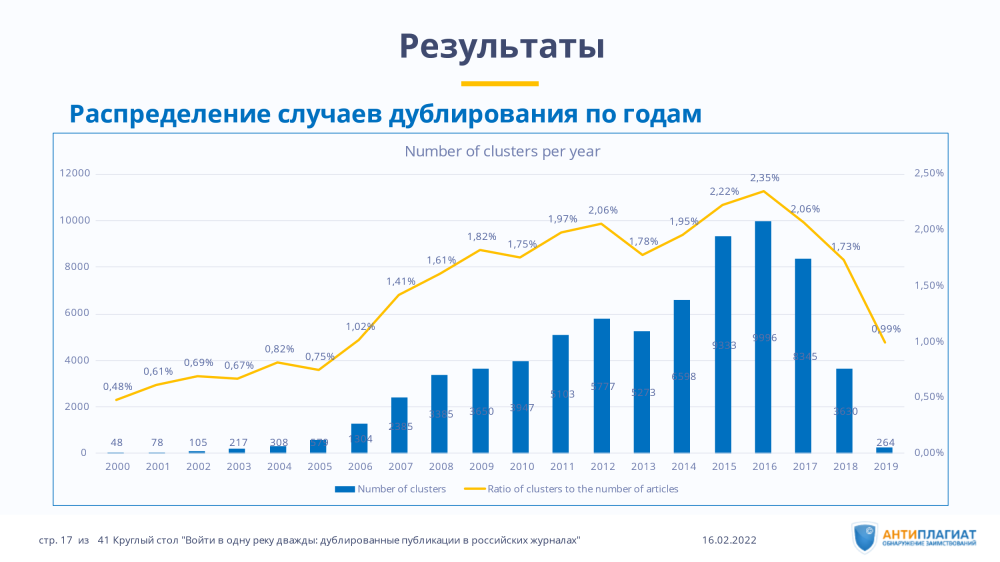
At the same time, we see some decline in the number of such articles since 2017. Perhaps it is due to the fact that this year the efforts of the Ethics of Scientific Publications in Russia for the first time introduced the practice of retraging articles containing duplication, plagiarism, falsification and factory. Perhaps this is the case when the lower civil initiative worked more efficiently than state mechanisms. Repeated analysis will confirm or refute this hypothesis (Fig. 1).
I note that not only scientists and teachers are the initiators of the appearance of such duplicate articles - sometimes magazines, experiencing a shortage of materials, publish their favorite texts from other publications without informing the author of it. In this case, the material is quite easy to retract (indicating as the basis of the article a violation of the ethics of scientific publications by the magazine), since the agreement with the author was not concluded.
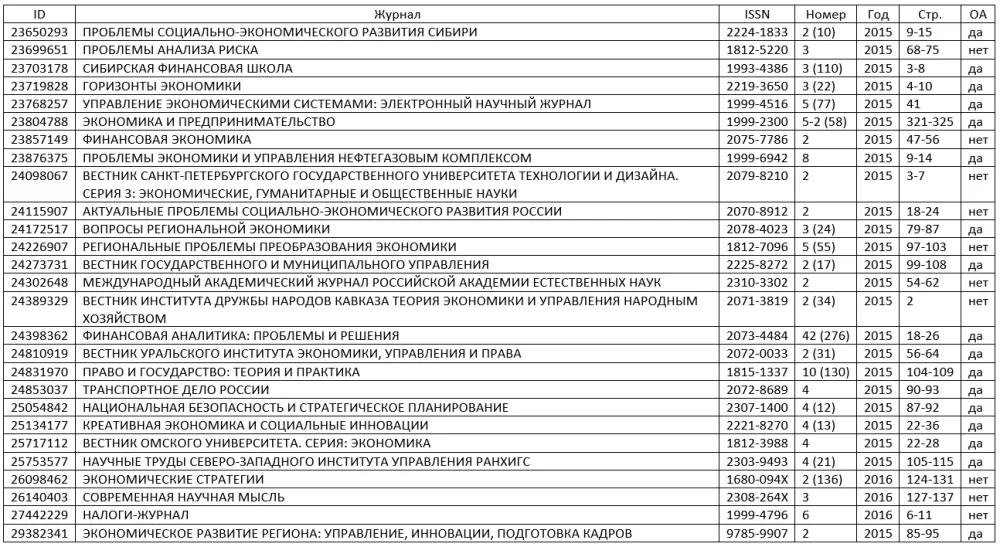
I will give two cases as an example of unscrupulous duplications identified during the study of “anti -plagiat”. The first - twenty -seven articles with an average intersection of a text of 83.55% with one total co -author - S. A. Vladimirov. All articles are published in various scientific journals, in 6 out of 27 articles there are co -authors. Since the texts of all 27 published articles differ slightly, cases of co -authorship can be attributed to the ascribed or gift authorship, that is, to violations of scientific ethics (Fig. 2).
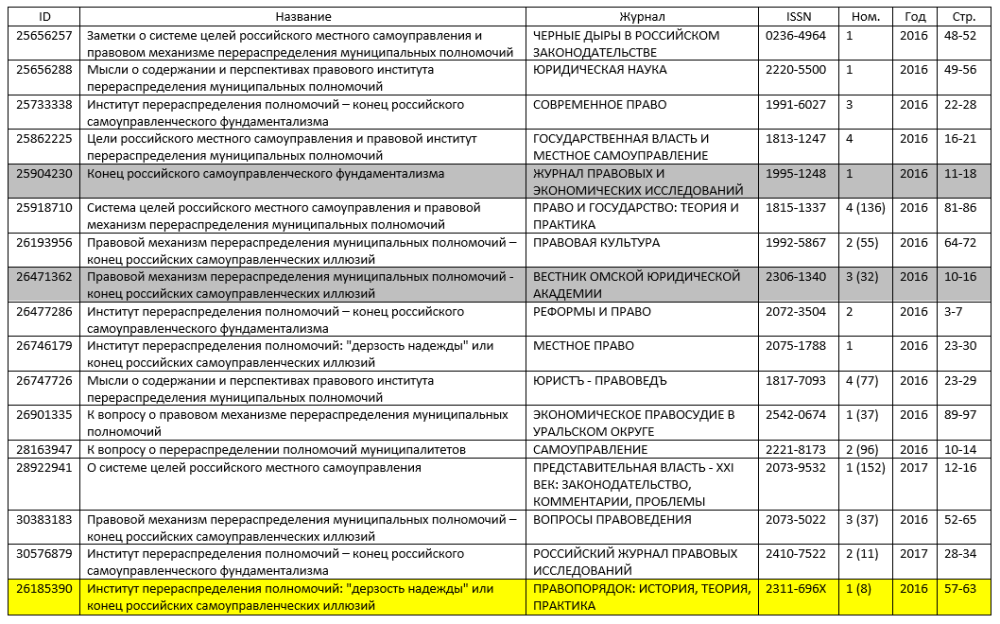
And another case. Sixteen articles with an average intersection of text 89.43%. All articles have one author - S. G. Solovyov, they are published in different magazines, two of them were published in 2017, the rest - in 2016 (Fig. 3).
What conclusions should authors, magazines and universities should draw when analyzing 70 thousand identified cases of duplication of articles?
Firstly, it is worthwhile to thank the authors of the study. The work on identifying duplications had to be carried out for a long time, and the data obtained - serious assistance and support for everyone who is interested in improving the situation in Russian science and education.
Secondly, it is important to carefully analyze the cases regarding you personally (if you find your name in this base), your universities or magazines, to understand what is behind them. The responsibility is unacceptable to transfer from a person to a car. Trust, but check. Computer search and comparison reveals only the volume of the text, but the interpretation and analysis remain behind a person.
Thirdly, confirmed unscrupulous duplicate publications should be retracted. This will be useful immediately in two senses: it will demonstrate the healthy attitude of all actors (the error made is corrected) and will help reduce lectricon distortions.
Fourthly, it is important to realize that everything will work with open data-from Dissernet to the compilers of universities, magazines, etc. If universities and magazines on their own initiative will not be engaged in retraining of duplicate publications, then this will be in a certain way to characterize them: they are either indifferent to their own reputation, or the science as such, information noise created by the science, created, created by the science. duplicate texts, various kinds of distortions.
Fifthly, if you are a representative of the university who make managerial decisions and the names of your employees are in this database, then it is worth answering the question “Why?”. Why in the university entrusted to you the situation on violations of the ethics of scientific publications is just that, and not the other? What motivates your employees to unethical behavior? Is the ethical? Suppose if one employee writes ten bad articles, and the other one good, with whom will you extend the contract and who will pay for publications?
Sixth, in no case would have unfolded punitive campaigns against magazines, authors and universities that have been into this base. On the one hand, this is only the peak of the iceberg, we still do not know much about other publications, educational institutions and authors; On the other hand, it is important to remember that the purpose of such studies is not a punishment, but a correction of errors.
And the Last but not the Least. In the modern world, people require high social competencies in many and many areas. If you are a parent, then you have to understand health and education, if you are a publisher or author, to independently monitor updates in international standards, changes in practices. But, in my opinion, it is harder for the parent, because the Council for the Ethics of Scientific Publications, “Dissert”, the RAS Commission on Combating the Falsification of Scientific Research, the Society of Scientists, the RINC and many other projects and initiatives that promote the development of the civilized scientific sphere in our country can come to the aid of the parent and publishers. Improving the situation with the ethics of science and publication ethics is the task of the entire community. Let's work on it together.
Anna Kuleshova, sociologist, member of the RAS commission on counteraction
falsification of scientific research and ethics of scientific publications