
Translated material
The choice of Europe
These days, Europe chooses an OSCE representative on media freedom.
The event, of course, is somewhat less significant than the election of the US President and even the elections of the President of Ukraine, but certainly more significant than the elections of the Moscow City Duma. Even for Muscovites.
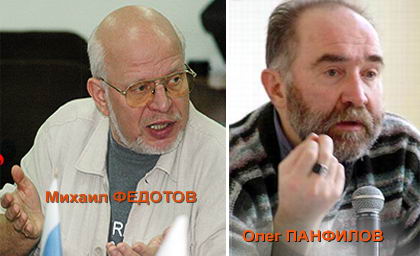
Six OSCE member countries nominated their candidates. Of these, two work in Moscow. Moreover, in one building at the address: Zubovsky Boulevard, house 4. This is Mikhail Fedotov, secretary of the SDR, which Russia was nominated, and Oleg Panfilov, the head of the Center for Extreme Journalism, which was nominated by Georgia.
It is difficult to imagine more dissimilar people. Panfilov, citizen of Tajikistan, a typical grantist law enforcement officer, “jackling” at the most indecent embassies. And Fedotov, former Minister of Press of the Russian Federation, Extraordinary and Plenipotentiary of the Ambassador of Russia to UNESCO, Doctor of Yu.N., Professor, Head. The Department of this very UNESCO, Secretary of the SDR, and, finally, the most important thing is one of the authors of the current media law (without any jokes and reservations, one of the best in the world). Such a choice is proposed to Europe. I don’t know the other four candidates, and I invited these two 11 years ago, I know well, so I know well and I think that voting on these two candidates will be a kind of test for Europe.
Any vote is a test. If this is, of course, an honest vote. I think that the OSCE will be able to honestly count 56 pieces of paper with the will of the participating states.
What is this choice and what is the unique intrigue of this particular vote?
A person who is chosen for such a position, firstly, should have professional experience and a reputation in the field of media and journalism and, secondly, to be able to defend the freedom of the media without regard to authorities, pressure and possible troubles.
As for professional competence, I think that the potential of both of our candidates could be evaluated “excellent”. Panfilov clearly has the most experienced experience in organizing all kinds of monitoring in different countries, the experience of human rights. But Fedotov, as an organizer, is at least no weaker. And of course, the co -author of the Law on the media that has passed the test of time understands the problems of media and journalists.
So in the first “round” in terms of competence, I would not dare to give preference to any of them.
The second component of the “professiogram” of this position lies in the field of such characteristics as fundamental, sequence and uncompromising in defending freedom of the media in all 56 well -heart -aimed countries without exception.
Panfilov is a typical “stubborn” human rights activist with all professional deformations inherent in this family of classes. Well, these people do not want to enter the position of bosses to whom journalists interfere with their investigations, get confused under their feet when serious people are busy with business: they’re drank loosa or make a career. And when someone of the most retreating is overlapping oxygen, such panfilovs run up, which also have to be dealt with. In general, he is a vile person, which he rightly wrote on this just the most honest and moral “Moscow Komsomolets”.
From Mikhail Fedotov there is no need to wait for such stubbornness. It is no accident that he was also nominated in past elections to this post, such “democratic” countries as Belarusian, Kazakhstan and Russia. This time only Russia. You say: what about co -authorship in writing the most democratic law on the media? Is it true. Was. 18 years ago ... I am actually convinced that for this now during his lifetime (as long as possible) Fedotov together with Eskin and Baturin (not to the one who had a wife, and who was with Yeltsin an adviser, and now he works as an astronaut), they deserved a plate with the inscription: “One of the authors of a good media law, which could create freedom of speech in Russia, lives in this house, but did not do it from unnecessary from Russia Co -authors circumstances. "
But it was 18 years ago. These years have changed many. And in the completely unexpected side. Some "transformations" resemble the plot of Kafka's story of the same name. Then, 18 years ago, and Pavlovsky had just begun his mutation from the former dissident in what he is now. And Surkov has not yet become a "perinol" in all respects.
For the past 10 years, Mikhail Alexandrovich Fedotov tried to carefully integrate into power (for example, unsuccessfully tried to get into the Public Chamber) and simultaneously built the Union of Russian journalists there. The latter, I must say, he practically succeeded.
In this matter, there was no public shame. On February 4 of this year, the UN report was obvious to the Government of the Russian Federation on the state of human rights in our country. The Russian government delegation specially brought Fedotov with him to protect the government point of view. What he did by declaring from the UN stands about guarantees of freedom of speech in Russia and the rights of journalists that they can protect in the courts. Dozens of killed Russian journalists did not hear these words. Hundreds of thousands of our living colleagues did not learn about them, since NTV and many other independent media were destroyed by that time without any law and with the complete impossibility of judicial protection. The few Russian human rights activists who present at the same time were convinced for some time that Fedotov reports on the situation in some other country.
So in the case of the election of Fedotov, one can imagine the positions from which he will defend the freedom of the media and the rights of journalists.
I obviously cannot make the exact forecast of the chances of both candidates for the election. But I would venture to assume that both have them. In any case, to go to the second round.
Panfilova is well known in Europe, especially in the eastern. And this gives some chances. Those CIS countries that its center will monitor, of course, will be against him, because not the journalists whom he protects, but the authorities, whom he annoying.
Fedotov’s chances are guaranteed voices of Belarus, Kazakhstan and Central Asia. In addition, I cannot completely exclude the technology of “shrederization” of European officials, on whom the fate of voting depends. The Russian authorities brought a hand on this, and some Europeans - pockets. Sometimes it turns out. The post of an OSCE representative on media freedom issues is, of course, not the fate of the pipe, but in case of victory, this story can be inflated as another milestone of getting up from the knees, since some pauses arise in this fitness. Football players and singers do not give the continuity of the process, but then he goes into their hands. And you can’t come up with the best PR for the advantages of “sovereign” democracy.
In addition, with all the fact that there are no special levers in the hands of the OSCE representative, it is still better to have “manual” than one that will be “wrong” marks to put and “denigrate”. So some resources to support their Kremlin can allocate.
In general, this whole story once again shows the incredible fragility of an unprecedented and in some way a fantastic project to create a single European space, where Türkiye and Russia along with all the republics of the former USSR are included along with “geographical” Europe.
Behind this vote is the grunt of the “European old people”, who are no longer enthusiastic about such geographical innovations as the expansion of Europe to Kushka and Vladivostok. Behind him is the irritation of Turkey, which, having removed the national and dressing up in a European suit, is 80 years old on the verge of Europe and is ready to turn around and go under a pen with Russia to create some unknown Eurasian space (God forbid!).
The OSCE with its three “security baskets” is generally perceived by “entering Europe” as a load, and the most “nasty” is the “third basket”, full of universal human values and other dope, which was invented by the old masters of the European house in order to offend beginners in vain. In this sense, the new “walkers to Europe” resemble students who have come for a diploma, who for some reason are forced to study.
How much can the European space of "alien" cultural and political material can contain? How much is it able to digest it and at the same time not only not to degrade, but also to get an impulse from this variety, to perceive this variety as a good and wealth? These questions and moods are today for every election in Europe. How Europe will react to the test that my two friends from Zubovsky set her, we will find out the other day.