
Translated material
The limits of the possible
In society
 The limits of the possible
July 19, 2012 Alexey Makarkin
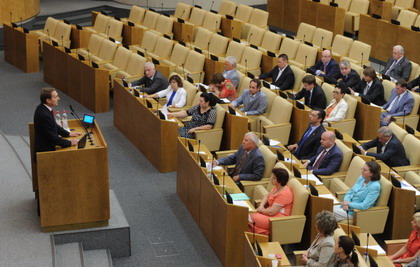
The last week of the work of the State Duma showed that in politics, power at the moment can do everything. Can adopt the discriminatory law on NPOs. It can return to the Criminal Code a slander, which only last year was expelled from it. And this is not the limit - if the Kremlin would have decided to take even more stringent measures, then they would go through the parliament in which the United Russia “voting machine” acts.
The fact is that the people are silent. Only a clear minority of Russians have any relation to NGOs or published in the press or network. For the rest, these are very abstract concepts, from which Nizhko is not cold. So the population does not listen to liberals acting with protests. As, by the way, the Communists with the patriots and the Socialist -Revolutionaries, who have chosen their targets for joining the WTO - an organization that for most Russians is no different from FAO or Unido.
Russian society, contrary to those who are still about its collectivist (or, as it was fashionable to say in the 90s, cathedral), is extremely individualistic. People mainly act on the principle of "each for themselves." This is not a product of the “dashing 90s”, which are customary to write off many, if not all the problems facing society. Even in the Brezhnev years, official ideologists unsuccessfully denounced philistinism and things, while dreaming of escaping to Kapstran and return from there with a tape recorder, in a fur coat or sheepskin coat from the sale and with Parker as a presentation for the authorities. The 90s only abolished the official ideology, and everyone was exposed to the well-known “double bottom” of the system.
At the same time, modern Russian individualism is rude - it is not balanced, not “ennobled” by developed civil society. The volunteer movement (which has been perfectly in Krymsk), fundraising for the treatment of sick children or other noble goals, other vivid examples of civil action are significant, but only the first “sprouts” of a new society, the formation of which takes time.
The problem is that if the individualism of Russians is now beneficial to the authorities, then in the foreseeable perspective the situation may change. The flip side of social passivity is a rigid upholding of their rights, even if they are violated by the authorities, for which the offended voted yesterday. The individualist is not inclined to minimal victims, not like "sweat, blood and tears." In the early 90s, he was in a state of psychological shock and often on the verge of survival at the same time-and therefore the authorities managed to carry out market reforms. People who were throwing from one work to another or even dropped their hands were not up to the struggle. And the most active part of the society, capable of showing leadership qualities and novels with others, took up self -realization using a lot of new opportunities (in business, art, politics, etc.) - and had nothing against the authorities. In addition, there were hopes for a miracle that life in the near future would return to a “normal channel”. Now the situation is different - the most resource public groups are increasingly diverging with the authorities, and society is unlikely to comprehend a shock that deprives its ability to action. And the Russians no longer count on a miracle.
Today, the “simple Russian” willingly agree that the NPOs receiving Western grants threaten state security and they must be branded as “foreign agents”. But tomorrow the same Russian is deprived of the manual due to him, and he runs to look for social activists who would help him write a statement to the Strasbourg court, since he did not find truth in the sovereign Russian justice. At the same time, he is completely not interested in whose money the computer on which his application will be written, or the printer on which it will be printed, will be written - the Western Fund or the State Department itself will be written.
And if millions become “offended”? It is already clear that an unofficial taboo has been removed on unpopular social measures that acted during the parliamentary and presidential election campaigns. Tariffs are increasing. A bill on payment by the owners of apartment buildings of major repairs has been submitted to the Duma. By the way, the adoption of this law had to be postponed until the fall, since the United Russia did not want to vote for it before the regional elections (they feel well the limits of the possible and fundamental difference between “political” laws and “social”). In addition, they want to work it out in order to give him a more acceptable look for voters. The problem, however, is that the population does not trust the authorities when it comes to any new searches, even if they have their own logic (normal when the owner himself pays for the repair). No matter how much he tell him about transparent schemes, he still suspects that he will be deceived and the money will be stolen.
And then pension reform rises on the agenda - it is impossible to put it off endlessly, taking into account the current state and especially the prospects of the Pension Fund. Various ways of tightening pension legislation without a formal increase in retirement age are now discussing. But any attempt to touch the usual benefits - whether it is an increase in the length of service necessary to receive a full -fledged pension, or reducing the number of prematurely retirement - will be perceived by society very violently. Let us recall the monetization of benefits, when discontent managed to “fill” only with large monetary injections - but now the financial resource has been very exhausted. And pensioners will no longer be able to make gifts.
All this can make society more susceptible to the arguments of the opposition, which has at least the advantage that is not responsible for the policy pursued and can be sweeping power. However, now the opposition has no miraculous ways of painlessness of social problems. So even if she turns out to be in power, she will have to pursue a policy diverging with social expectations. And the Kudrinsky gloomy dilemma “either increase taxes or reduce costs” can by that time turn into an even more sad “both at once”. But this is another story.
So the political limits of the possible one for the authorities are poorly combined with economic expediency, which requires decision -making that can cause strong discontent in the pro -government electorate. Of course, the situation can temporarily correct the rapid growth of oil prices, which will once again revise unpopular plans and delay the reforms. But, firstly, this option is far from guaranteed-rather the opposite. And secondly, this is still not a way out, but further planting on the needle, the rejection of which will be all the more painful than later it begins.
Photos of RIA Novosti