
Translated material
Penguins are sensing prey
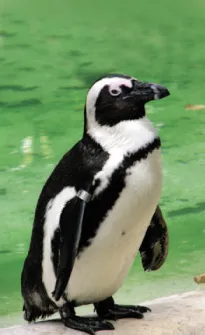
Penguins are predators, they hunt fish under water, and very efficiently. How do these birds manage to quickly find prey? For a long time it was believed that the penguins feel poorly and should comb the ocean until they see the jamb of their favorite sardines or anchovies. Meanwhile, the closest relatives of the penguins, infuriates and strokes, have an excellent sense of smell, which helps them find even a small jamb of fish among the ocean spaces. At the same time, they focus on two types of odors. First of all, these are strongly smelling sulfur -containing organic compounds that are rich in planktonic organisms. When Pisces eat plankton, these compounds fall into the water. Birds fly on the smell of fish oil, which oozes from wounded or dead fish - they do not disdain such prey. So, when the Petrel proudly cuts, it does not just fly, but sniffs the fish over gray from foam by the sea.
But the worse the penguins who hunt in the same places and the same fish as their flying relatives? The question of their sense of smell began to find out the specialists of the University of Cape Town under the leadership of Professor Peter G. Ryan. Scientists worked with African penguins of the SPheniscus Demersus. A large colony of these birds lives on the island of Santa Cruz, or a bird island, in the bay of Nelson Mandeles. Near the paths along which birds go from nests to the sea and back, the researchers installed Petri cups with a weaker solution of dimethyl sulfide (VHI) - 1 micromol per liter. Along the penguin routes at a distance of 3 m from each other, the flags were stuck, which allowed to mark the speed of the birds. It remained only to hide and observe. If the wind conveyed to the penguins the smell of VMS, they clearly slowed down and passed the distance between the two flags not in 18-19 seconds, as usual, but in 14-15, as if sniffed.
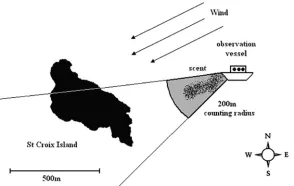
After making sure that the penguins feel even a faint smell of VHI on land, the researchers moved to the experiments on the water. On a small vessel, they went out into the sea and 500 m from the bird island from the wind -to -the -winded side poured 2.5 l of vegetable oil overboard, into which they added money or fish oil. The experimenters worked on days when the wind speed did not exceed 20 km/h, and the height of the waves was 2 m. Due to strong coastal currents, the oil spot drifted and dispersed for half an hour, and all this time observers from the side of the vessel were counting the penguins that appeared within a radius of 200 m.
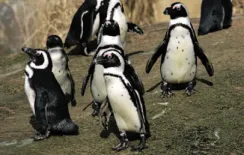
Scientists worked from April to June. This is a troublesome time for African penguins - they feed the chicks and are concerned about taking fish as soon as possible. The smell of VHI undoubtedly attracted them. Within 20-30 minutes, the number of birds in the area of the fragrant spot increased continuously, the smell of VHI attracted 2-3 times more birds than an ordinary oil spot. Given that African penguins swim at a speed of about 1.2 m/s, in half an hour they can overcome about 2 km. Apparently, from such a distance, they feel the marvelous aroma of plankton eaten by fish.
Interestingly, the smell of fish oil did not attract at all, although it did not scare away. This is the smell of dead or wounded booty, and penguins eat Only kiss and fresh, and do not torment it, but swallow it entirely. If the sea smells of fish oil, it means that there are either scum, or does not hunt a penguin, but another predator. In any case, there is nothing to do Penguin in such a place.
Natalia Reznik
Literature: Kyran LB Wright, Lorien Pichegru and Peter G. Ryan “Penguins are Attracted to Dimethyl Sulphide at Sea”. The Journal of Experimental Biology, 2011, 214, 2509-2511, DOI: 10.1242/JEB.058230