
Translated material
House for crystal
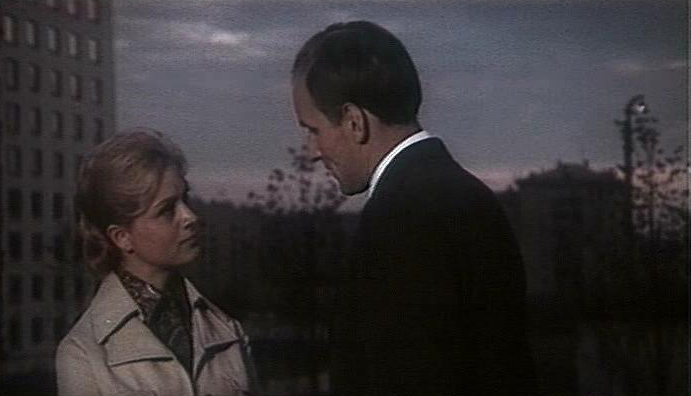
The fourth session of the Moscow program through the eyes of an engineer will be held in one of the first buildings of post -war Soviet modernism - the Palace of Pioneers on the Sparrow Hills. Strange, all of itself, “foreign” Protromblor Gerasimov (yes, here they really mutter between software replicas) will be shown after a lecture on Soviet experiments in the field of housing construction. You can register for a show and lecture here .
"Love a person" (1972)
Director Sergey Gerasimov
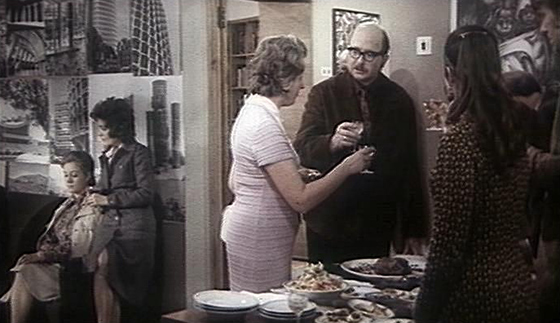
The beginning of the 70s. In the frame - pleasant people and modern buildings. Silent conversations, laughter and modest secular entertainment - architect Alexandra Vasilievna has a party. Among the guests is the young architect Kalmykov. He meets Maria, a student of Alexandra Vasilievna. Kalmykov is demanding and fundamental. Maria too. Several remarks - and he will invite her to get married and leave with him to Siberia - to build new cities.
“Love of a person” closes the cycle of journalistic films begun by the painting “People and Beasts”, in which Sergey Gerasimov tried to give a portrait of a man of the 60s and 70s. Thoughtful, problematic tapes intended for an intelligent viewer. This is not a movie that immediately comes to mind when you think about the Soviet classic. Moreover, this is not the movie that you want to constantly review.
It seems to be everything you need in place. The remains of the 60s are on the screen. Some guests speak English, brilliant people drop witty comments, the action is interrupted by a large documentary about Mexico, then-a cartoon about the fight against architectural excesses. Heroes laugh amicably. An elderly lady reads a poem in French. All this usually looks so great in Soviet films - just recall “July Rain” or “Ilyich’s outpost” Khutsiev. But if the heroes of Khutsiev seem as natural as possible, then Gerasimov immediately catches the eye of a certain deliberation of what is happening in the frame. And they joke and laugh here at once and on command. But in life it does not happen. Even constant muttering does not save, which should give the believableness to the rather flaps of the characters.
 © Cinema Studio named after M. Gorky
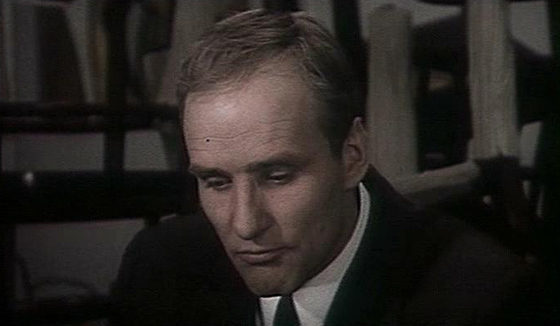
For the heroes of the same Khutsiev, the connection between the Soviet (namely Soviet) everyday life and the entire previous cultural tradition - from ancient Greeks to German philosophy is very important. They are sure that they are the heirs of all human history, and therefore their reality is spiritualized initially. Foreign guests or renaissance paintings falling into the frame serve only one of the evidence of this. There is no such problem for Gerasimov. In a strange way, what is happening in his film resembles a sort of ... playing a foreign movie. All his signs are parties, villas villas, conversations in other languages and traveling to other countries, a secular chatter - everything is in front of us, reproduced and placed in proper places. The opened door expressively divides the hero's face into two parts. French verses are read with a special expression. Alexandra Vasilievna walks around the apartment like Anna Pavlovna Sherer in her salon. But this parade does not move anywhere. Even the endless reflection of the heroes does not seem to be real, especially since, in essence, “to love a person” is a thorough story about the best struggle with the best.
So the ideal movie of import substitution might look. Everything is like in Europe, everything is like the Swedes, French or Italians, but only homegrown. And in this regard, the filming of Gerasimov turns out to be a strange ancestor of all these endless “first Russian blockbusters” and “first Russian horror films”.
But there is no thin one without good. The failures of the film in the eyes of history often turn out to be his virtues, and “love a person” accurately captures the screening of eras. The time of dreams has passed. In their place - fantasies about comfort, cottages and abroad.
 © Cinema Studio named after M. Gorky
Palace of Pioneers on the Sparrow Hills
The protagonist of “Love a Man”, architect Kalmykov, is an innovator who dreams of building comfortable glass houses in the Far North. Its prototypes could well be the authors of the Palace of Pioneers on the Vorobyovy Mountains - Igor Pokrovsky, Felix Novikov and others. And the show of the film will be held in the lobby of the concert hall with completely transparent walls.
This building is one of the manifestos of architecture of Soviet modernism and changes that came in the country in the late 50s. The story of his appearance is an adventurous. Firstly, it is very symbolic that one of the first buildings in the new spirit was the palace for children-after all, it is difficult to redeem adults, new values must be vaccinated from infancy. Secondly, the venerable architects were deliberately removed from the design process, giving way to a team of young innovators-we can say that they “planted” a new architecture; The method is very Soviet. Finally, the building after construction was visited by Nikita Khrushchev in 1962. The Secretary General spoke approvingly - and thus legalized the aesthetics of modernism. In general, a happy Soviet childhood coincided with the childhood of a new, modernist, architecture.
How does the Palace of Pioneers work? Several pavilions with different functions line up like pioneers on a ruler, led by a counselor - a concert hall. The horizontal splashing of the building becomes a metaphor for horizontal relations between people who have come with a thaw. The area in front of the pavilions is irrigated by scattering pedestrian paths. This is a protest against the adult regime and against the regime in general, a symbol of children's spontaneity. Finally, there are a lot of glass in the pavilions, they are transparent. Children have nothing to hide, there is no need to hide - but was it not about this transparency at that time and adults?