
Translated material
Average ball
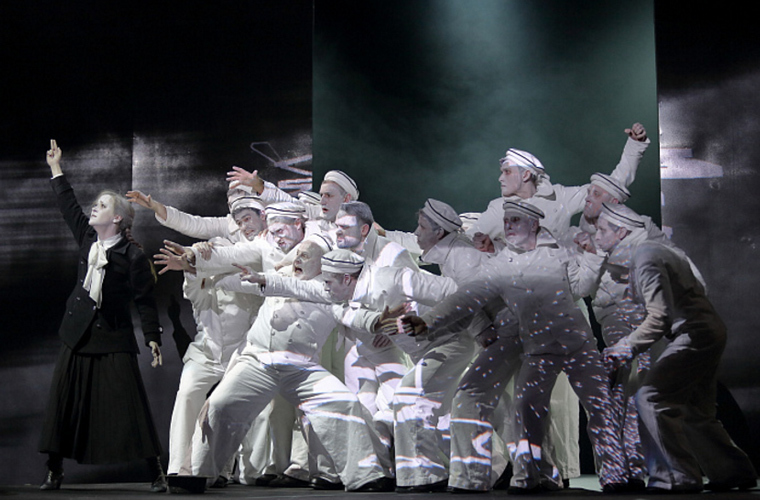
The new performance of Viktor Ryzhakov has three names: “Optimistic tragedy. Farewell ball. Revolutionary concert. " It looks solid, mysterious on the postish cabinet. Something of this is about the play of Vsevolod Vishnevsky, something about the plan, something about the genre, but closer to reality, in fact, the simple-minded definition of the “concert”. In each announcement of the premieres, they will certainly indicate that the “deconstruction of the myth” will be made, and here without deception, everything is honest (“naval tradition!”-they would specify in the play): all literally for separate concert numbers are deconstructed. The semantic "strands" were abolished by the mandate of the Council of People's Commissars, signed by Comrade Derrida.
The concert on the Alexandrinsky scene is stern and puffed, his conceptual prologue was created on a scope, simultaneously reminiscent of a reporting celebration in the State Kremlin Palace and the opening of some Olympiad. Star presenters (era Ziganshin and Arkady Volgin, hinted about the waters of the sticks and, it seems, quarreled a little due to replicas) replace the unsinkable wwoods of Tchaikovsky (in the exclusively male composition of the snow-white, but a few well-fed-fired troupe, the pleasantly fired Sergey Mardar rush, the superheroes from the Marvel comics, led by the head of the head Spider-Man and Captain America. But, dancing, elegant schoolgirls of the oldest times are seeded on stage (white aprons, golfs and bows are extremely go to former ballerinas, especially bearded), special forces and Chernobyl liquidators step on their heels. But all of them are easily overshadowed by the parade of crocodiles gene (the scenery and costumes of Mary and Alexei Tregubov are habitually impeccable and witty).
In this vigor of the heroic carnival there is no reason not to appear to revolutionary sailors. And they appear, breaking on the stage through the black opening in the wall - from head to toe, either with dust, either lime, or comedian flour. Pale -faced dead with a characteristic gait of dilapidated zombies. They are probably happy about the Alexandrinsky stage, they are not the first: and it’s not at all the legendary “optimistic tragedy” by Georgy Tovstonogov, but in the latest tradition and Valeria Fokina, an expert on the living dead of classical literature (here not only the Alexandrinsky “double” is remembered, but also the famous “Numer in the hotel of the city of City N ” and the long -standing “Bobok” - with the opening tombs - with the opening tombs - with the opening graves and disassembly of homegrown nosefirates). In the last year’s “war and the world”, set by Viktor Ryzhakov in the BDT, heroes with tanned faces also appeared, but there it looked somewhat violent, but in Alexandrinka it was a sweet thing. It is said - to the morgue, which means to the morgue. However, perhaps this is a matter of personal taste: the Tolstoy heroes, surrendering to me, are still stored, but the revolutionary sailors of Vishnevsky are already irrevocably. For a long time forgotten and handed over to the museum.
Everything else that happened in the play is, strictly speaking, compote. Even if pineapple.
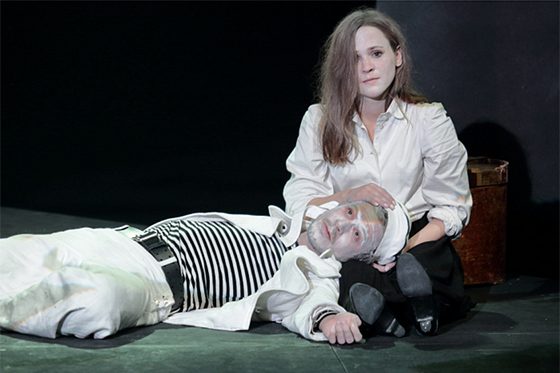
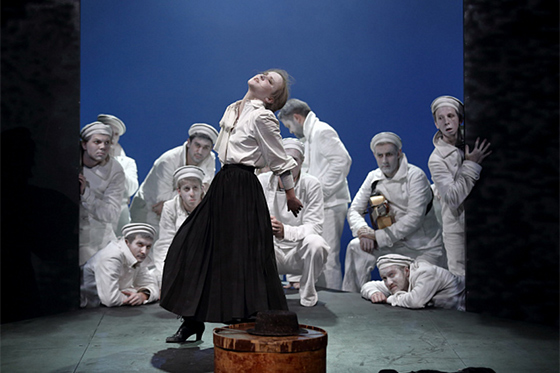
The commissar who appeared to the “white walkers turned out to be a young lady. The cold -eyed party valkiers, intelligent ladies in the service of higher purposes or brilliant predators creaking with black leather leather jackets (is there a sadomasochist shade suitable for the Marvel Black Widow, known to us by theatrical and film, all the side. Yesterday's gymnasium with complicated braids, an ideological child in a white blouse with a bow, armed with a hat cardboard (instead of a revolver - two fingers and the word “shot”) leads into the battle and on the ball. The highly spiritual squeak of the heroine Anna Pancake is touching to the extreme - and does not remind Sonya Marmeladov, played by an actress in last year’s “Crime and Punishment”. There was no trace of monotonous virtue - the role was played by the actress on dizzyingly cool turns, it really is worth looking at (and she will add steel ringing in the intonation of the commissar, be trustworthy).
Here is the way this role is invented and made, perhaps, indeed, work on deconstruction will be found without effort. To participate in a farewell ball, the commissar prepared several impressive numbers. In one, she appeared Lisa Khokhlakova from the “Karamazov brothers” (leaning under the character of the party young lady a complex psychopathological basis and struggling the audience with a monologue about a torn child and pineapple compote). In another, where there was a puppet theater, Malvina turned around - the Bolshevik propaganda, which the sailor Alexei was subjected to, aka Pierrot (Tikhon Zhizhevsky), turned out to be amusing and edifying demagogy, being spoken by a girl with blue hair. With a gymnasium past, the commissar parted the song of Vertinsky “This is nonsense, this is a dream, is it a dream? ..” And even, not good, she tried to look into the future, declaring herself “Marilyn, the heroine of suicide and heroin” (everything broke down on Voznesensky completely). In this game of contexts, in the artistic “loosening” the foundations of the character of the Soviet theater pantheon, a kind of vibrant meaning was squeamish - albeit as much as you like.
 © Alexandrinsky Theater
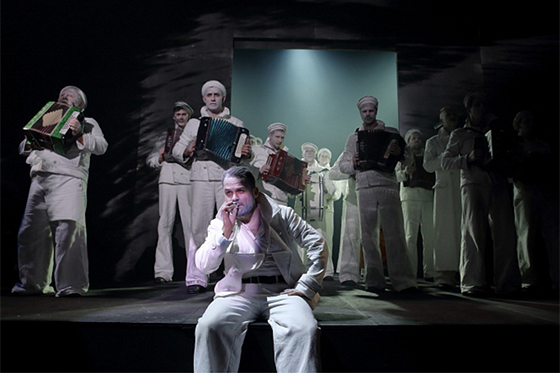
Because everything else that happened in the play is, strictly speaking, compote. Even if pineapple. The “Revolutionary Concert” compiled numbers of a variety of quality-from brilliant, witty and directly luxurious to ridiculous, archaic-sentimental and completely failure. When the choir of dead sailors, stretching the harmonica, struck the “Time” , turning the classic hit “Pink Floyd” into the left march, this was so many shameless anarchist freedom that Prince Kropotkin would envy. And when the sipper - enchanting Dmitry Lysenkov - suddenly appropriated a text about the “working tradesman”, who “in other Russian fellow citizens is in love,” and from “shaking lice, a man, get out of his gap,” unexpectedly dashing pirouett turned to “Blessed, who visited this world in its moments of fatal and“ live only so that it is necessary to make immense requirements for life, All or nothing ”, having finished Blokovsky“ Listen to the Revolution! ” - it was no weaker (whether he was sipper at that moment - not a fact at all). However, having cleansed the old pathos to the point that he sparkled as a brand new, unrecognizable actor immediately winked at the public: “Or maybe I was trembling?” Or maybe not, and when it was closed “near Utesov” “near the Black Sea ...” - he also did not run, but barely pulled a cheerful poem monologue about the nature of the syphilis or an even more unnecessary verse about Evpatoria - he was unambiguously.
Valentin Zakharov, who served on the stage with a gloomy leader, suddenly exploded from the place in the quarry with the Shnurovsky “apple” - a dangerous person, the leader as is. Alexander Lushin (Bering - with an officer's dagger in a temple), Dmitry Buteev, Anna Herda and other sailors flashed with rapper talents, pleasing to the chorus “Optimism is not visible in this tragedy, / everyone sucked into the pole of the cataclysm,” the talented self -sufficiency of these numbers threatened to exhaust the agenda of the day, making the continuation of the day Excessive performances.
 © Alexandrinsky Theater
A lot of numbers seemed to be a “revolutionary concert” just as a tribute to the marine theme: both the Magomaevskoye “Oh, Sea, Sea, Sea”, and 5'nizz “Sailor” Ivan Efremov, and the solemn exit of the “old sailor” Arkady Volgin, who conquered the “Baclan and the Former Sailors and the Lebedes) and the Laza Amosov. The attempted to share some unintelligible pathetic memories, but suddenly changed their minds (this is nonsense, is this a dream, is it a dream?).
In general, the story with Paphos in the performance came out as a ridiculous: exposing the old cannibalic revolutionary pathos, the authors of the performance caught up with a new, naive and sentimental one, then suddenly (after a completely amateurist booth number with a “optimistic” scene about prisoners of executed officers) they remind us with a sad voice that it was not good to kill (if anyone had been jailing), then They force Era Ziganshin to become the mother of a dead sailor and enter into a dialogue with his beloved son. It is good that Tikhon Zhizhevsky heroically sacrifices himself, ironically heaving an awkward scene with the help of “mother” Freddy Mercury. Because Ziganshina is not for this in the play. Ziganshina is there - because no one except her, with such a merciless sobriety and slightly surprised disgusting the actress, who “always keeps itself in the string”, will be able to pronounce the memorable Rozanovskoye: “Rus faded in two days. At most - in three. Even the “New Time” could not be closed as soon as Rus' closed. <...> There was no kingdom left, there was no church left, there was no troops left, and there was no working class. What is left? In a strange way - literally nothing. ”
 © Alexandrinsky Theater
 “So let them portray this“ nothing ”” - as was said in another play. However, no, they did not portray. The meaning, which began to pulsate with the advent of the commissar, was helplessly lost among the "sea figures" and other optional decorations of the performance. Almost the most saturated, the "native" episodes from the "optimistic tragedy" of Vishnevsky turned out to be vigorous. “Deconstruction” was limited to simple irony (as we recall, in principle, very overestimated) and what the philosopher called “sluggish omnivorousness”. To make “insoluble contradictions” of plays and history intelligible with the help of theatrical means is a task that itself remained unresolved. The “farewell ball” turned out to be similar to the “war and the world” of the BDT not only by the white faces of the actors, but also by the final extinction of hope of the meaning to the finale. Once again, everything was reduced to the melancholy "here are some people who lived and then died." In Kubrick in Barry Lindon it was said this: “The above characters lived and argued in the reign of King George III; Good or evil, beautiful or ugly, rich or poor - they are all now equal. " And the Moryak rappers contributed to the topic: "None of them survived to communism, / Everyone got a deadly enema." And you can’t argue.
On September 30, Colta.ru holds a unique lecture marathon “New Hope. Culture after the 17th. " Join! You can read about the marathon here , buy tickets - here .