
Translated material
Move on
In the opposition
 Move on
October 18, 2013 Denis Bilunov
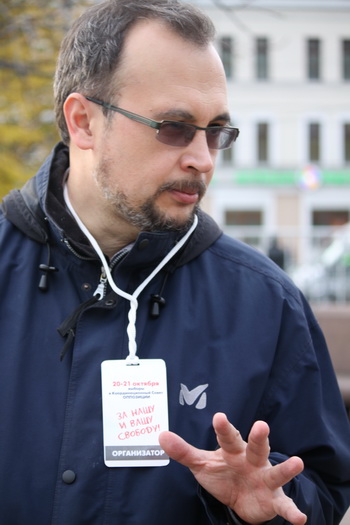 The case of Kirovles, which in the summer of this year suddenly became a starting point for the bright and contradictory Moscow mayor's campaign, is closed. Alexei Navalny remains at large, but he himself will now not be able to take part in the elections organized by the regime of Vladimir Putin: according to the freshly received law, this is hindered by the accusation of the Kirov city court. The most popular opposition leader in Russia is replaced by power beyond the legal political space for many years.
Is the opposition in these circumstances to continue to make attempts to enter this space? In 2014, elections to the Moscow City Duma are coming. If the opposition candidates manage to at least repeat the result of Navalny, then a fairly large faction can be formed in the capital's parliament - up to 10 (out of 45) deputies. Opponents of participation in the elections believe that even their most favorable result will not contribute to systemic changes, but will only serve the interests of the authorities that need democratic decorations and seeking to direct protest energy in a safe direction for themselves. Typically, this point of view is accompanied by suspicions of personal selfish motives for “going to power” and personal accusations of collaboration.
There is a certain logic in the arguments of modern “rejection”, but their main problem is the inability to formulate and, moreover, to implement their own program. It is more or less obvious that her three whales are a massive failure to appear for elections, street protest and building alternative legitimacy. But, firstly, although the passivity of voters in Putin Russia is really progressing, only one who has access to the media with a multimillion-dollar audience will be able to convincingly convert it into his political resource. So far, such access implies a contract with the authorities. Secondly, the most impressive modern examples of street protest are associated precisely with Putin’s elections (I doubt that there are many adherents of the “Biryulevsky model” among the “rejection”). Finally, thirdly, with regard to alternative legitimacy, the contradictory experience of the KS indicates that this, in my opinion, is still not really in demand by society.
In these circumstances, the refusal to participate in the elections in general and to participate in the elections to the Moscow City Duma in particular looks like a manifestation of weakness and unbelief in its own forces. It is natural that Navalny, barely leaving the court building in Kirov, has already published the text in which a clear accent on the elections was made: “ I can’t run. But participation in the elections is not only "to be a candidate."
Navalny is the rights that the elections in the correct organization of the case, regardless of the outcome, have a powerful mobilization effect on society. Navalny has already proved that it could be a "right organizer." After his mayor's campaign, many of those who had long waved their hands on the polls changed their point of view. In order not to lose this potential, you need to start active training now.
However, repeating and even more to improve the “mayor” result of Navalny in 2014 will be completely difficult. Three months ago, consolidation took place around the obvious leader, who was a candidate from the opposition. Now, the team of candidates will become the center of attraction, most of whom, most likely, will not be widely known even among potential supporters. Formally, this center was created by a coalition agreement, which was concluded by the “People’s Alliance”, RPR-Parnas and the party on December 5. But how exactly the formation of the team of candidates will take place and how the work of the general headquarters will be organized - these are still open issues, the solution of which remains less and less time.
However, to concentrate all the attention and resources in the elections (especially only in the Moscow elections) would be different extreme. It is fundamentally important to maintain a process in the “swamp case” in the center of public attention and achieve the liberation of the accused - at least on compromise conditions, as happened in Kirov.
In addition, there is a whole range of organizational and information tasks facing the opposition - from supporting interregional interaction to reaction to relevant events. Now these problems are solved disparate and spontaneously (or are not solved at all). Unfortunately, the concept of the coordination council is greatly compromised by the practice of its first convocation - but the objective need for such an organ will remain until the political system in the country will change.
In any case, it seems indisputable that the path to democratic transformations in Russia is inextricably linked with the political structuring of civil society. Everyone who would like to move along this path must be ready to spend their strength, time and money on it.
Photo by Maria Olendskaya/Hedgehog