
Translated material
The heroine of the image
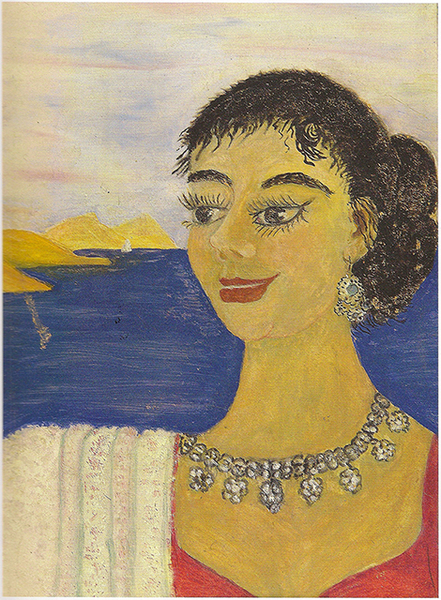
On September second, it takes ninety years since the birth of Olga Sergeyevna Seversva. She died on July 13, not having lived until this day for a month and a half. Bright, beautiful, charming, temperamental, perky, noisy, cheerful, eager, capricious. The personality is absolutely extraordinary, she attracted and fascinated, admired her and fell in love with her, it was simply impossible to remain indifferent to her. It is not surprising that Olga Sergeevna was a favorite model of artists, among which are such luminaries as Robert Falk, Nathan Altman, Sarra Lebedeva, Vladimir Weisberg. The swimmer and scuba gear, she drove in Koktebel on Windsurf, was friends with the deltaPlainers, dogs were not translated in her house and not only: I remember distant times when they lived in Koktebel and donkey. In Olga Sergeyevna, the blood of ancestors - zoologists and travelers played, and, as soon as it became possible, she went to Madagascar, to Kamchatka, to Armenia. And last summer I traveled on an eco -mobile for Crimean goats and with youthful carelessness and frivolity waved from conversations about the “worldwide suse”.
There were many wonderful people in a close circle of her communication, and I have no doubt that there will be many memories of Olga Sergeyevna, a genuine man-orchestra. I want to write here only one line, about what was the subject of our endless conversations with her in the last thirty years, after the death of my beloved aunt Irina Oddemskaya-a longtime, since the late 1950s , the girlfriend of the Seversky-Gabrichevsky house. For although I knew Olga Sergeyevna from my very birth, in childhood she was afraid of her sharp comments and only over the years was able to appreciate her kindness and generosity and made friends with her very much. We were especially brought closer to the history of the State Academy of Art Sciences (Gakhn) - the most important center of research of art in 1921-1929 . In these classes, Olga Sergeevna was a recognized pioneer. And I want to write about the truly invaluable contribution that she made - with her certificate, with her memories (today accessible in “oral history”), her public and exhibition activities - in the development of Russian humanitarian science.
Olga Sergeevna from a family of hereditary zoologists. Her great-grandfather, Nikolai Alekseevich Severstsov, traveled to Tien Shan and Pamir, studied Turkestan, he is the son of the hero of the war of 1812; another great -grandfather, Sergey Alekseevich Usov, is the founder of the zoo and archaeologist, art critic, friend of Lev Polivanov, the godfather of Andrei Bely; In the 1880s, the scientific and literary color of Moscow gathered at the “Usovsky Thursdays”. Her grandfather, Alexei Nikolaevich Severstsov, is the founder of the evolutionary morphology of animals. Olga Sergeevna grew up in the famous apartment at Mokhova at the Zoological Museum of Moscow University. From the apartment it was possible to directly enter the museum, and his night visits were the theme of her colorful stories about childhood, who surrounded extraordinary details.
Olga Sergeevna’s mother, Irina Konstantinovna Lozina-Lozinskaya, is a psychotherapist, daughter of a famous St. Petersburg doctor who worked in the Putilov (Kirov) factory, her lump brothers-Alexei Lozin-Lozinsky, poet; Vladimir, poet, archpriest, canonized Orthodox martyr. Soon after the birth of Olga Sergeyevna, the parents divorced, and a huge role in her life happened to play aunt who lived in the same large professorship, Natalya Alekseevna Seversova. Her husband was an art critic, philologist, philosopher Alexander Georgievich Gabrichevsky, son of bacteriologist George Norbertovich Gabrichevsky.
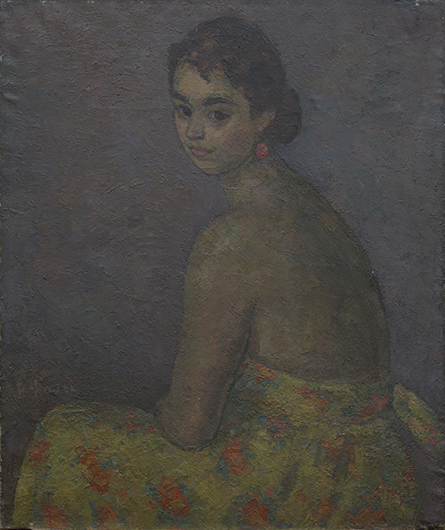 © Family collection R.R. Falk. Portrait of Olga Seversva. 1950–51
Until 1970 - the year of the death of Natalia Alekseevna - their house was the focus of the intellectual and cultural life of Moscow. Here in 1920-1921 Vasily Kandinsky, Gustav Shpet, Robert Falk and others violently discussed with Alexander Georgievich the creation of Gakhn (Rakhn); The brothers Mikhail and Fedor Petrovsky came here; Here Alexander Georgievich played four hands with Henry Neigauz and Vasily Zubov. In August 1940, Marina Tsvetaeva and her son Mur stopped in this apartment, Anna Akhmatova came here, there were Sergey Shervinsky, Alexander Rumnev and many others. The list of friends of the house is endless, especially since after the war, along with the Moscow apartment, the place of noisy and funny meetings was the generous, hospitable Koktebel House of the Gabrichevsky -Seversovs. Close friends of Maximilian Voloshin, in the 1920s they were his permanent guests, and since the late 1940s , against the backdrop of toughening repressions, they began to live in the Crimea for a long time in their own house, where Natalya Alekseevna began to intensively engage in painting.
The witness and permanent participant of their Moscow and Koktebel life, in incomplete forty years Olga Sergeevna turned out to be the mistress of the orphaned house. Thus began the new stage of her life - a long -term length of her memory, dedicated to preserving memory and continuing the life of the house, serving him and the circle of his friends. From year to year on the sixth of February - on the day of memory of Natalia Alekseevna - she invited guests to her. More than one generation was replaced by her noisy, funny table, and even the very recently, when there were already few those who knew this feast during the life of the “old people”, Olga Sergeyevna literally surrounded new acquaintances, was fond of them and carried away more and more new people with her stories, fascinated and infected her extraordinary energy. The power was given to her by a clear understanding that it was not so much about family history as such as “great history”, about the history of culture and art of Russia. Missed through the fates of several generations of her family, she began to glow with new colors.
The house and circle of his friends were a spiritual community, a living organism, which existed according to its own laws, amazing against the backdrop of gray Soviet everyday life with its extraordinary brightness. He showed that, in spite of everything, a successive connection with the past of Russian culture was not interrupted, with its so-called silver age, and through it-from the university environment that gave rise to the famous circle of Nikolai Stankevich of the 1830s . After all, the mother of Alexander Georgievich, Elena Vasilievna Bodysko, was the niece of his wife and pupil of Alexander Vladimirovich Stankevich, the younger brother of Nicholas, and her children who had lost her father grew up in his Moscow mansion in Chernyshevsky Lane (today he was returned to the name of the 17th - XVIII centuries - Voznationsy - in honor And the summer was held in his Voronezh estate New Kurlac.
It is to Alexander Vladimirovich Stankevich - the famous Westerner, critic, the biographer and publisher Timofei Granovsky, the passionate collector - the Gabrichevsky brothers, and their knowledge and admiration for Italian art, rises, but also - wider - openness of the culture of European and world, ancient and modern, in which they felt at home. Until the revolution in the Stankevich mansion, there was a bust of George Norbertovich Gabrichev’s work Rodin and the workshop, made after the death of the scientist by order of his widow. Today he meets us in the gallery of the art of Europe and America of the 19th - XX centuries , but his path could not do there without adventure. When in the early 1920s the owners were asked to free the mansion in Chernyshevsky Lane (solemnly renamed Stankevich Street) and some Soviet institution entered there, the bust was thrown out of the window, but, fortunately, he fell on a soft land to the garden and did not break. Alexander Georgievich had to overtake the thresholds of museums for a long time before he managed to give a bust to the Museum of New Western Art - despite Rodin’s work in Russia, they are a rarity. And this is only one episode of hundreds, only the story of Olga Sergeyevna out of a thousand.
As an art critic, Olga Sergeevna Seversva taught at the Schukin school, she worked in the Tretyakov Gallery, but the main thing of her life - the work on preserving, studying and publishing a family heritage - she carried out completely herself, putting her entire indefatigable energy and her (far from non -sinusive!) Means. And numerous friends at home helped her. Thanks to personal connections (Olga Sergeevna was, for example, in good relations with Irina Alexandrovna Antonova) she managed to associate state and other social structures with her projects. Thus, exhibitions were prepared at the December evenings at the Museum of Fine Arts, in the Tretyakov Gallery (an exhibition dedicated to the 100th anniversary of Gabrichevsky, in 1992); Exhibition "Art with scientists" at the Museum of Personal Collections (2005); A large exhibition of painting by Natalia Alekseevna Seversova in the State Central Museum of Modern History of Russia (2007), organized by the Gallery of Polina Lobachevskaya. And this is just the top of the iceberg! After all, there were apartment exhibitions at Richter, and exhibitions at the Koktebel House-Museum Voloshin, and a very recent one, under the name “A.G. Gabrichevsky. Gahn ”, in February 2019 in St. Petersburg, in the All -Russian Museum of Pushkin on the Moika. And around all these exhibitions there were solemn and scientific evenings, concerts, seminars, conferences, publications, films, interviews! You might think that behind all this was a whole museum or research institute. If…
The situation, of course, is not the only one and to all of us quite familiar, but nevertheless she cannot but surprise. After all, we are talking about the preservation, study and publication of a unique cultural heritage, which allows, on the example of carefully preserved family history, to trace the continuity of the intellectual and artistic development of Russia for one and a half centuries. In the understanding of this, Olga Sergeyevna was deeper and more distinguished than many.
Dmitry Vladimirovich Sarabyanov once noticed that the art history in the Soviet era was more fortunate than philosophy or stories that were completely defeated. In this comparison, perhaps he was right. However, as it turned out at the last Sarabyanovsky Congress in December 2020, the young generation of art historians very critically perceives Soviet art history, realizing that if you leave the purely actual knowledge of Russian art, it is not able to stand up to the world. But the knowledge of Russian art was mainly isolated, completely divorced from the European and world context. This situation, about which young curators complain about today, was the result of a long process. At the end of the XIX - beginning of the twentieth century, the question of the place of Russian art in the history of European art was interested in Alexander Benois, but Igor Grabar quickly monopolized it. The first approach was artistic, and the second - ideological; On the second path, of course, Soviet art history went in the future, with whom Olga Sergeevna, who graduated in the 1950s in the historical faculty of Moscow State University, was familiar with firsthand.
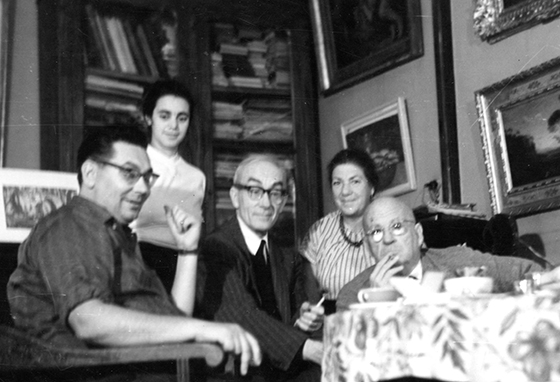 © Family collection in the Gabrichevsky apartment on Mokhova, 1960s. Right to left: A.G. Gabrichevsky; N.A. Severstsova; G.G. (Yuri) Gabrichevsky; O.S. Severtseva; HE. Stukalov-Gogodin
But in her house, on Mokhova and in Koktebel, a different atmosphere reigned, free from all and all kinds of ideology - an atmosphere of art and creativity, which was remarkably described by Mikhail Vladimirovich Alpatov. Here are several excerpts from his memories published in 1984: Gabrichevsky:
“He needed that art surround him, entered his life, arose in his eyes so that he himself feels like a participant in his formation and being. Hence his attraction to poets, artists, architects and musicians who willingly reciprocated him. Not because he taught them, but he always understood them. Hence his rare interest in modern art among art historians. To those manifestations, which, it would seem, are incompatible with the idea of high classics. <...>
There was a time when I came to Gabrichevsky just in order to breathe in the air of art. <...>
Whatever he did <...> - a piece of blue sky always sparkled over him, he never left the idea of great, high art as the extent of artistic perfection, as the limit of human daring. He did not know alone what true art was, but the majority was ready to change him just for the sake of a more prosperous existence. It was impossible for Gabrichevsky. He himself never proclaimed this. But this was precisely what was the most precious in him, it most attracted people to him, inspired them with confidence that through him they find access to something truly high and genuine ” [1] .
Since the 1970s, Olga Sergeevna has been collecting such personal evidence and wrote memories herself. What are her stories about how in the early 1950s their house turned several times into the workshop of the young and then unknown Anatoly Zverev!
Understanding that history is primarily people and their fate, and leaving others to engage in “smart conversations”, Olga Sergeevna regularly dumbfounded guests with her unexpected “discoveries” of related and friendly ties, cultural, intellectual and social contexts, which academic science in its conceited pride often simply ignores. Offering, for example, to think about the fact that the artist Lyubov Popova was a philosopher, a classmate of Gabrichevsky and subsequently, like him, a member of Gakhn Pavel Popov, and her husband was also his classmate Boris von, or that most friends of the house, theorists and art historians were children of university professors of natural sciences.
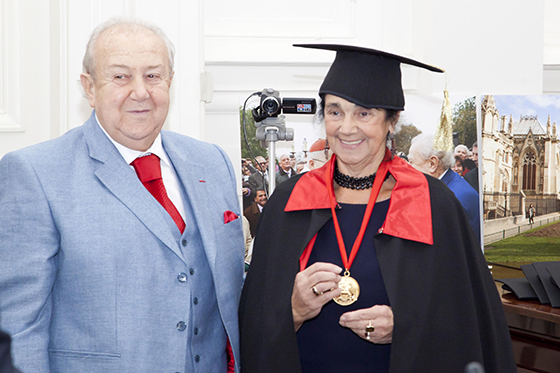 © Andrey Yagubsky O.S. Severtseva is an honorary member of the Russian Academy of Arts. Together with Z.K. Tsereteli. October 19, 2019
All this introduced a live note in the history of art, which in its academic research, in search of objectivity and scientificity, often prefers to resort to simplified dry and abstract schemes. Regarding the Soviet period of history, this objectivity is given to us, however, with great difficulty, because between it and our modernity there is no genuine gap and the concept of “Sovietness” with the whole train of meanings and connotations did not go into the distant past. Nevertheless, today, when we are finally separated from the events of the first post -revolutionary years, we can, we can, think, throw off the usual ideological shores and try to combine historical and scientific knowledge accumulated in recent years, with a living tradition, transmitted to us by direct witnesses and their descendants, who are becoming catastrophically less and less! We really need this, since we are constantly faced with the lack of an acceptable conceptual apparatus to describe Russian art and culture of the first half of the twentieth century. By inheritance from the researchers of the second half of the twentieth century, we got beautiful, but long -working concepts, such as, for example, “avant -garde”, while we still do not know how to come to the concept of “classics” so important for understanding the Soviet era. That is why it is very important for us today to be able to hear what Olga Sergeyevna testified about.
Everyone knows the attachment of Gabrichevsky with his classes by Renaissance and Goethe to the world classic. Thinking about his distinction from him, Alpatov (who was ten years younger than Gabrichevsky and was his student in the very beginning of the 1920s , when Alexander Georgievich was a novice teacher of the university) noted: “Gabrichevsky felt his belonging to a different generation” [2] . And he compared his contribution to modern culture with the one that he left ... Stankevich in the Russian culture of the beginning of the last century [3] . Alpatov was obvious rooted to the classic of Gabrichevsky in Russian Westernism of the 19th century. This nuance is not always clear to us. From this, it seems to me that today is our inability to evaluate the significance of the unprecedented publishing program of commented translations of treatises on the theory and history of architecture, which was carried out in the 1930s at the All-Union Academy of Architecture under the general leadership of Gabrichevsky (Alberti, Vitruvius, Palladio, Barbaro, Vignio, Shuazi, etc.). Modern historians of architecture rightly indicate its unobvious practical, pedagogical and construction value in the context of the Soviet 1930s . Perplexing about the reasons for the emergence of such a program that is not relevant and architectural needs, they recall the Decree of the Central Committee of the CPSU (b) “On Architectural Education”, the general process of mastering the classical heritage, inspired by Stalin's tastes, and reform of higher education.
However, this completely amazing and unique publishing project, the brainchild of Gabrichevsky and his friends, was not born in response to a request from above. Это был старый, возникший еще в первые годы революции в недрах Наркомпроса замысел, сформулированный уехавшим в 1922 году в Германию другом Габричевского Евсеем Шором (философом, переводчиком и издателем, сыном известного пианиста Давида Шора) и тогда еще визированный архитектором Иваном Жолтовским. Унаследованный ГАХН, он постепенно сошел на нет в 1920-е годы . В начале 1930-х годов, в общей атмосфере обращения к классике и благодаря протекции Жолтовского, он был извлечен на свет божий и реализован филологами и философами, смещенными со всех должностей и жившими в ожидании ареста. Занятие искусством Ренессанса давало им возможность уйти в защищенную парой цитат из Энгельса и казавшуюся неподконтрольной советской власти идеальную область искусства как высшей свободы — в пандан к волошинской Киммерии.
В этом утопическом проекте — давшем замечательные и вполне реальные плоды, которым не было равных в то время в Европе, — отразилась трагедия Габричевского и людей его круга. Алпатов писал, что в его судьбе было «нечто эпически русское: многообещающие богатейшие всходы и урожай, побитый градом и морозом» [4] . Действительно, после ликвидации ГАХН в конце 1920-х годов Габричевский лишь периодически оказывался на преподавательской или иной официальной работе; из теоретических работ, написанных в годы работы в ГАХН, было напечатано очень мало, и постепенно его деятельность свелась в основном к занятиям историей архитектуры и переводам. Сам он как-то признался композитору Николаю Каретникову, что «на самом деле не реализовался» [5] . Явный автобиографический подтекст имеет описание Леонардо да Винчи в статье Габричевского, написанной для знаменитого двухтомного сборника теоретических фрагментов Леонардо, вышедшего в 1935 году в издательстве Academia . Он до сих пор переиздается, чаще всего в неузнаваемо исковерканном виде, где полностью отсутствует как имя Габричевского (ответственного редактора), так и его статья о Леонардо — теоретике искусства. В самый последний момент она была изъята из готовившегося издания, поскольку ученый был (во второй раз) арестован. Верстка статьи сохранилась в библиотеке верного друга и сподвижника Василия Зубова, а машинописная копия ее под другим названием — «Леонардо и искусство» — в архиве Габричевского, который хранила Ольга Сергеевна. Габричевский писал в этой статье, что положение Леонардо «на грани двух эпох, двух стилей роковым образом отразилось на его исторической роли, которая оказалась ничтожной по сравнению с его одаренностью и глубиной поставленных им проблем, отразилось на его личной судьбе, судьбе неудачника, изгоя» [6] .
Статья Габричевского о Леонардо опубликована была впервые в сборнике работ ученого «Морфология искусства» в 2002 году. Вышедшая тиражом в 2000 экземпляров в московском издательстве «Аграф», книга эта давно уже стала библиографической редкостью. В ней впервые были собраны работы Габричевского 1910-х — 1960-х годов по философии, теории и истории искусства, основная часть которых не была опубликована при жизни ученого. Это результат колоссальной работы с семейным архивом сына Ольги Сергеевны, Федора Стукалова-Погодина, — работы, которая, думается, не получила в свое время должного признания, в то время как весь этот том (а особенно изданные в нем философские работы 1920-х годов) для многих стал подлинным откровением. Этот сборник — поистине поворотный пункт в нашем знании о теории искусства в России 1920-х годов и о роли и месте Габричевского и ГАХН. В 2010–2011 годах мы живо обсуждали с Федором необходимость нового, исправленного и дополненного, издания текстов Габричевского, но в июне 2011 года его не стало.
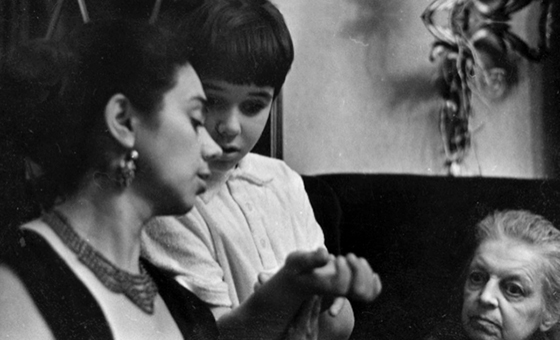 © Семейная коллекция О.С. Северцева с Федей, И.К. Северцева (урожд. Лозина-Лозинская). 1973
Публикация теоретических трудов Габричевского 1920-х годов сопровождалась архивными исследованиями и собиранием свидетельств и мемуаров друзей Дома. Этим занималась Ольга Сергеевна. Причем речь шла не только и не просто о реконструкции его жизненного и творческого пути, но о восстановлении правды, что, как известно, много более трудная и менее благодарная задача. Начать с того, что нужно было восстановить имя Габричевского как ответственного редактора всей серии книг по теории и истории искусства, вышедших в рамках программы Всесоюзной академии архитектуры, и автора всех анонимно опубликованных предисловий «От редакции». Подтверждение этого факта Ольга Сергеевна получила от известного латиниста Федора Александровича Петровского. И так по крохам приходилось собирать все.
Особо важной стала работа Ольги Сергеевны с материалами трех арестов Габричевского, хранящимися в архиве КГБ-ФСБ (1930, 1935 и 1941 годы). Она смогла почерпнуть в них важную биографическую информацию о Габричевском, его друзьях и коллегах, но самое важное — на их основе она смогла сформулировать ответ потомкам Густава Шпета, ставившим Габричевскому в вину то, что он остался в живых. С присущим ей бойцовским темпераментом Ольга Сергеевна не побоялась публично пойти против «всеобщего мнения». Собранные документы она опубликовала в сборнике материалов к биографии Габричевского, вышедшем в серии «Российские пропилеи» в 2011 году. Среди этих материалов, наверное, самая замечательная и эмоционально сильная часть — переписка 1942–1944 годов между Александром Георгиевичем, сосланным в Каменск-Уральский и затем в Свердловск, и остававшейся в Москве Натальей Алексеевной — подлинный «роман в письмах». В течение многих лет Ольга Сергеевна готовила к изданию воспоминания Натальи Алексеевны. Будем надеяться, что в ближайшее время они будут наконец опубликованы.
Особый свет на судьбу Александра Георгиевича проливает судьба его младшего брата Евгения, который пошел по стопам отца, учился биологии у деда Ольги Сергеевны, Алексея Николаевича Северцова. В 1924 году Евгений уезжает на стажировку в Нью-Йорк к знаменитому Томасу Ханту Моргану, а через три года возвращается в Европу и работает в Пастеровском институте в Париже. Однако в то же время стремительно прогрессирует его душевная болезнь. Евгений все больше оказывается подвержен приступам паники, уже не в состоянии регулярно заниматься научной работой и уезжает в Мюнхен, где живет вся его эмигрировавшая из России семья — мать, самый младший брат Юрий и две сестры, Елена и Ирина (старший брат Александр был единственным из Габричевских, кто остался в Москве). Смерть матери в 1930 году становится, очевидно, последней каплей, и Евгений оказывается в психиатрической клинике под Мюнхеном, где он проведет весь остаток жизни — до 1979 года. Здесь он посвятит все свое время живописи и создаст удивительные по красоте и выразительности произведения. Их выставка в «Красном доме» в 2016 году (которая была показана также в Лозанне и в Нью-Йорке ) стала гвоздем выставочного сезона в Париже. С каким воодушевлением Ольга Сергеевна включилась в подготовку этой выставки, со всей своей — всегдашней — щедростью делясь материалами семейного архива и воспоминаниями! С какой радостью на свои деньги приехала на вернисаж в Париж!
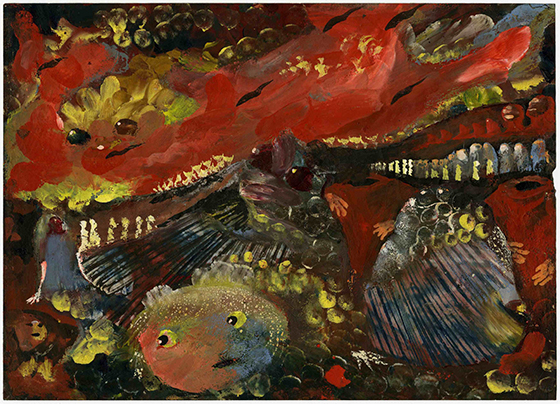 © Galerie Chave, Vence Е.Г. Габричевский. Without the name. 1942
В 2018 году мне довелось побывать в клинике под Мюнхеном — одной из самых больших в Германии — и ознакомиться с материалами пребывания там Евгения Габричевского. Они свидетельствуют о страшной силе впечатления, которое произвели на него, тогда еще совсем юного, события времен революции: гибель Николая Алексеевича Северцова, брата Натальи Алексеевны, с которым очень дружили братья Габричевские (в октябрьские дни 1917 года он вышел на улицу в форме офицера и был убит у самого подъезда своего дома), поездка в переполненном солдатами вагоне и т.д. etc. И в 1930-е годы под Мюнхеном, ничего не зная о судьбе старшего брата, он боится за него, чувствует страх — именно тогда, когда тот арестован. В годы войны, когда Александр сослан на Урал, а находиться в немецкой психиатрической клинике становится смертельно опасно, Евгения несколько месяцев прячут, и он проводит дневные часы в подвале, где создает серию рисунков с зажженными свечами. Лишь в 1960-е годы самый младший брат Юрий сможет приехать в Москву из Америки и привезти Александру несколько работ Евгения. На расстоянии судьбы братьев переплетаются и сходятся в общей для них всепоглощающей любви к искусству на фоне страшных событий ХХ века.
Один из самых проникновенных текстов, опубликованных в «Морфологии искусства», к которым очень любили возвращаться Ольга Сергеевна и Федор, — речь, с которой Габричевский выступил сто лет назад, 11 декабря 1921 года, на заседании, посвященном памяти его профессора, историка греческого искусства, археолога, директора Музея изобразительных искусств имени императора Александра III Владимира Мальмберга. В ней он назвал своего учителя «героем образа», объясняя свою мысль пониманием героизации в античном мире как особого рода культурно-религиозного творчества, в ходе которого человек осознает свою включенность в пантеон великих образов, «не только символизирующих собою живую преемственность культуры как чего-то единого и непрерывного, но и реально присутствующих в качестве подлинной сущности в каждом творческом проявлении современной жизни». Эта героизация, продолжал он, «предполагает систематический культ образа как основной категории национального духовного творчества» [7] . И если нам удалось проникнуться духом этого рыцаря образа, завершал свою речь о Мальмберге Габричевский, значит, «героизация состоялась, потому что мы все его любили» [8] . Эти слова в полной мере относятся к Ольге Сергеевне Северцевой — хранительнице Дома и героине Образа.
[1] М.В. Алпатов. Жизнь искусствоведа. Страницы воспоминаний. Панорама искусств — 7. — М.: Советский художник, 1984. С. 170–206 . Здесь: с. 202–203, 204.
[2] Там же. С. 202.
[3] Там же. С. 206.
[4] Там же. С. 203.
[5] Александр Георгиевич Габричевский. Биография и культура: документы, письма и воспоминания / Составитель О.С. Северцева. — М.: РОССПЭН, 2011. С. 699.
[6] А.Г. Габричевский. Леонардо и искусство // А.Г. Габричевский. Морфология искусства / Составление и примечания Ф.О. Стукалова-Погодина. — М.: Аграф, 2002. С. 650.
[7] А.Г. Габричевский. Памяти В.К. Мальмберга // А.Г. Габричевский. Морфология искусства. Ук. Op. С. 719.
[8] Там же. С. 723.