
Translated material
It says
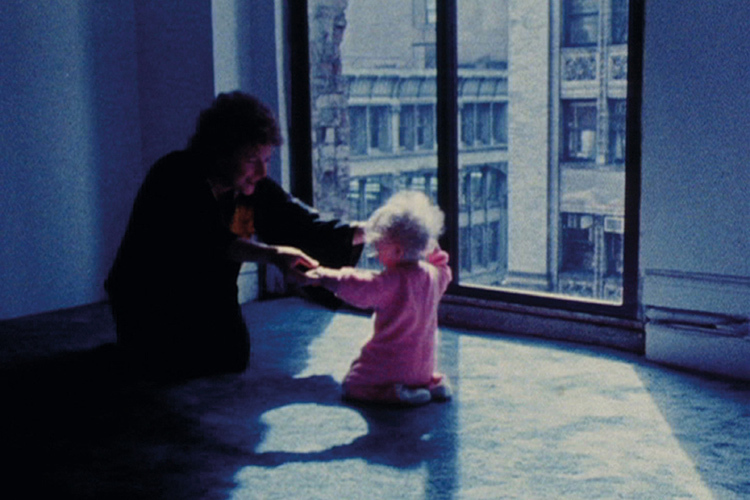
On June 23, 26, 30, July 7 and 14, the Moscow Museum will host shows of one of the programs of the MMKF media fork “Talking Cinema” (curator - Alexei Artamonov). The main conflict of the program is a clash of visual (moving or static image) and verbal (text), one way or another, occurring in all works. Maxim Semenov and Gleb Naprenko offer two complementary views on the nature and significance of this dialogue.
Maxim Semenov
The first is an image. It moves, changes, obeys the laws of installation, disappears and appears. The second is a voice. Although the voice does not necessarily belong to a person. It may turn out to be the noise of the wind or the sound of rain, a roar or a cry. Their imposition gives a movie.
Many people think that the voice comes from the image. They support each other, trying to convince us of the reality of what is happening on the screen. A person opens his mouth, and we hear: "A". Or "Hello." Or "Hands up!"
But this is not always the case. A voice can completely deny the image, or argue with it, replace it, or give it a special structure. The same with the image. Initially, it does not need a voice, but it may well obey him, fall into his slavery. However, their union, fastened by the will of the author, is capable of miracles. Transforming the reality of the film, expanding its boundaries, this union creates a poem, familiar and at the same time unlike those that are known to us from elegant literature.
This is a story about three poems created by voice and image.
The first poem. A whirlwind of sensations. Flapping shots with children, women and trees flash on the screen. Water flows over the stones. Children's concert. Bearded men walk along the street. Cities: Moscow, Rome, New York. The image becomes blue. The boy stood on his head. Girls play the violins silently. Someone looks into the camera. Winter has come.
Sometimes mysterious interpreters appear in the frame. Extracts from the diary, random passages that do not explain anything, only set the tone. Sometimes joyful, sometimes gloomy. All these endless people. Do they know about loneliness in the city? Can a living soul be found among them?
Monument to Mayakovsky. The head of Koloss Konstantin. Flowers in the field. Flowers in the room. Street musician.
A voice is heard behind the scenes. The author's voice. He reads poems. Everyone is sleeping in verses, and only the director in his room does his mysterious work. And for sure: multi -colored pieces of chronicle now and then break off to show the audience the work of the author at the mounting table.
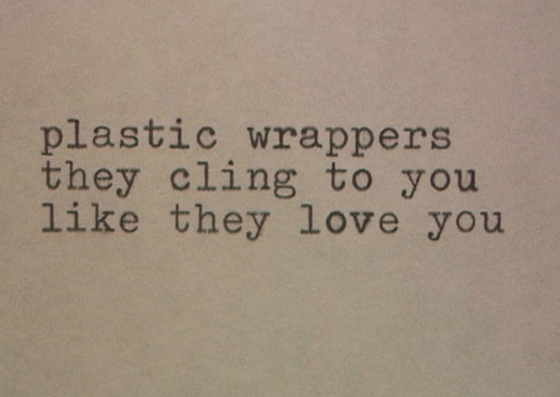 Frame from the film "Unauthorized Personnel from the Life of a Happy Man"
All this diversity is “non -reversed personnel from the life of a happy person” by Jonas Mekas. It is most seductive to call them the accumulation of sentimental memories, and the viewing of this film is compared with the journey through someone else's memory. Alien children, other people's friends, other people's picnics and trips to rest. Porridge from home video of an outsider.
But this is not so. The director’s voice behind the scenes rises against this approach. Events have gone long ago, the memory of them was erased. Only the fading beauty of the frame remained. Touched from context, it means only what it means. Nothing else. And only the author’s voice directs our attention, giving the stream of images a certain shape and mood.
The author’s lyrical presence is what turns a huge accumulation of frames into a film. He makes a fragmentary and subjective very personal, understandable to every viewer. This is probably the real poetry.
Otherwise, Alena Kavalier was built. There is also a lot of personal in Paradise, it also has a lot of poetry, and the author’s voice enriches the image.
Here are the guests, instead of a flower, laid on some plant. Behind the scenes, Cavalier recalls the almost mystical feeling that he experienced during the first communion.
Here is a beautiful girl. It is transferred with the author of quotes and associations on ancient and biblical topics. Get up and go. Akhillesov heel. A wonderful catch. Colossus on clay legs. The loins of Jupiter. Traders in the temple ... This is a game, but it is conducted with the most serious expression on the face. This seriousness is so great that it begins to look after it ... Not even irony, but some special form of fun. Something similar moved the medieval authors - like what Kiprianov Svetai wrote, in which a huge number of biblical characters gathered for a fantastic feast of a certain King Joil in Kan Galilee.
As a feast of Joil, a whole heap of mythological and biblical characters acts in Paradise, including Calipso, Isaac, Odysseus, Satan, Jesus Christ, Athena, Savaof, Job, a long -suffering and prodigal son. However, Odyssey is played by a small red robot, Athena is a figure of owl, and Christ - which Cavalier is not at all the Son of God, but simply a good person - a cup.
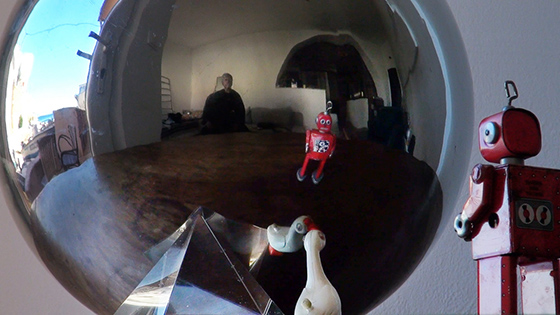 Frame from the movie "Paradise"
The contrast between objects and their roles, between the image and voice creates a strange feeling, as if you were watching a children's game. Actually, “Paradise” is a serious reflection and game at the same time. Even a set of heroes hints not only on an exalted tradition, but also at the program of the classical gymnasium in which Latin is studied, the Law of God and Greek classics. Turning to talk about the nature of Paradise, Cavalier remembers: in order to enter the kingdom of heaven, you need to turn around and become like children.
And, most importantly, the Cavalier method works. Playing his sacred allegories through a robot, owls and a groove goose and baking a small dead peacock, he suddenly finds the necessary, very human and very accurate intonation. The madness and foolishness of his film is sacred - regardless of the true state of affairs in the heavenly office.
Although the conclusions that Cavalier comes to is very simple, as in any mystical story, the search for answers here is much more important than the answers themselves. And when a small red robot crawls out of the watermelon on pebbles, and the voice behind the frame begins to pronounce the monologue of Tsar Itaki, you are at least for a minute, but you begin to believe that in front of you is Odysseus, who knows the nature of immortality.
The third poem is the most radical. In front of the viewer-modernist buildings, unremarkable rural areas, mountains, forests, a river, a sawmill and French meteorologists, filmed on an expired 16-mm film using experimental rolled cameras.
There is a voice here too. The image is voiced by fragments from the "catacombs of Molussia" - the only novel of the German philosopher Gunther Anders. In most of the excerpts, some olo and Yeguss conduct quite red conversations among themselves. This is the film by Nicolas Rey “Otherwise, Molussia” (more precisely “Anders, M Olussien” , where the German “ a nders” is a transparent hint of Gunter Anders).
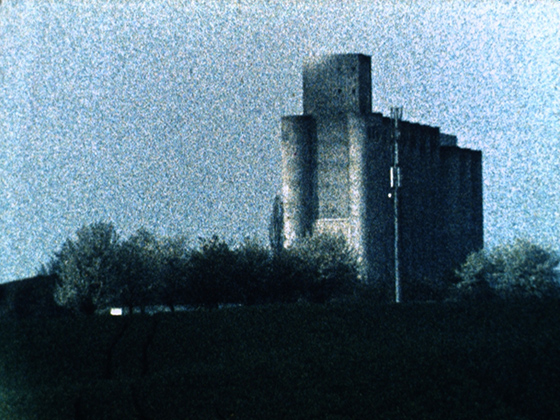 Frame from the movie "Otherwise, Molussia"
The film Rhea consists of nine coils of film of different lengths, which can be shown in random order. Fragments of Anders are recorded on eight coils, the ninth serves as an interlude.
Anders Roman, written in 1932-1936, tells about the state of Molussia, in which the dictator Burra comes to power. Hitler was the prototype of Burra, and therefore can be seen in the film Ray political message. The dictatorship and inequality are against the background of indifferent nature. The decaying film as a world, undersized by evil. Dull rural landscapes talk about fascism, modernist houses refer to social experiments of the 20th century. Yes, all this is possible. But not at all. Probably, “otherwise, Molussia” refers to the type of paintings, any interpretation of which remains completely on the conscience of the interpreter. But, as in general in poetry, the general mood here is more important than specific details.
Most of the dialogues between Olo and Yegussi resembles excerpts from the works of Plato, while Ol belongs to the role of Socrates (and some of the parables discussed by the heroes are quite abstract). Structurally, they are no more important than rural species, fog or sudden faith of the camera, which sometimes gives the film a rather comic shade.
The landscapes removed by the ram only enhance the connection with the dialogs of Plato - for example, with the "Fedon", where the conversation is conducted by the stream for singing cicades. And although the picture of Ray often becomes a little alarming, looking at the fragile beauty of the frame, at all these endless meadows and herbs, sometimes I want to repeat after Socrates: “... the breeze here is cool and very pleasant; He echoes the choir of cicada in a summer lady. And the most successful is that there is so much grass on a canopy of the slope - you can lie down, and it will be very convenient for the head. ”
Gleb Napapenko
The picture is always more than it seems: it is only a cover. The look is looking for refuge in the picture. But time resists any possibility of asylum. Time can appear as the history of mankind, country or one person, it can be a duration, it can act as a diachrony, a gap between the two moments of being. But always, when a picture, an image, a frame promise refuge, a sound and a word, existing in time, invade our consciousness and prove to us that any refuge from us will eliminate that it is impossible to hide. This is one of the leitmotifs of the Talking Cinema program.
For Unabobar at STEMPLE PASS, James Benning, a meeting with linear technical progress is unbearable. The drama of Unabobert becomes the drama of the impossible struggle with this time created by industrial civilization. If earlier the time was sewn by repeating production cycles of agricultural labor and religious rituals, then the time of capitalist increase in profit and industrial development of nature is an irreversible time, time, ideally fixed by the non -normal eye of the digital chamber. The film consists of four half-hour shots of one landscape: hills, forest, ravine, hut-at different times of the year, accompanied by reading diaries and interviews with a hermit terrorist. The reassurance of the static personnel of nature is pregnant with violence. The desire of Unabobert to find a shelter, an attempt to tear off and break the time invading his life, turns into an interruption of life of people, the victims of Unabobar, whose dates of life ending the film.
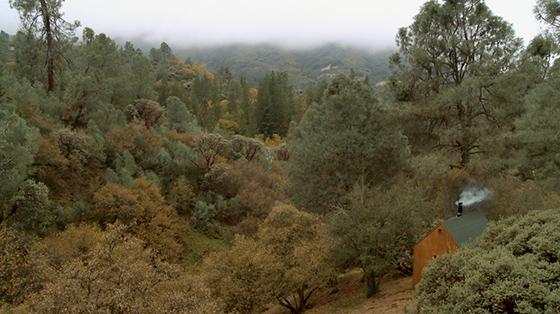 Frame from the movie "STEMPLE PASS"
UNAMBER here is opposite to the lyrical hero of the “non -HEARD FROM FROM THE LIFE OF THE HAPICAL Man” by Jonas Mekas, who reviews his movie day -items at the end of his life: intimate meetings with friends, random scenes on the street, moving images of the city and nature. Mekas takes pain that the irreversibility of time brings to the images of happiness captured on the film as the necessary part of this happiness - as an immanent fragility to him. He also builds his personal shelter - but does it more cunningly than Unabber: Mekas founds this shelter in the very elusion of a flowing moment.
But the story is not only invading as an unstoppable stream that takes away precious moments: it freezes in the real load of its constant presence. In the film, Nicolas Reia “Otherwise, Molussia” modernity, filmed on an expired film, is immersed in the thickness of historical time. On the film covered with glare and grains, we see today vaguely and, as if from afar, as if through all the centuries of stories that led to it, discarded and forgotten - but frozen in our gaze. The present, turned into eternity, is the eternal modernity of fascist anti -utopia: behind the scenes, fragments from the anti -fascist novel Gunther Stern (Anders) “Katakuba of Molussia” (1932-1936) are read. The story here ended, although its presence gravitates over every moment. The origins of this world are forgotten, and the loss of these origins is the necessary prerequisite for the existence of the subject in it (including the subject of resistance): “We are all illegitimate”, the phrase in one of the fragments of the film sounds. And it is not for nothing that “Molussia” does not have a certain beginning and end (it is transferred each time a rebuild of nine fragments), and the behavior of the film chamber obeys the wind to the winds of the wind. But this wind is not the wind of a free romantic nature: nature in the film is not a space of lost authenticity, the territory of a pre -capitalist lifestyle and production, as was the case in the modernist paradigm and how the Unaberter dreamed. It is processed by industrial machines and interspersed with highways and power lines. Nature is only a silent part of the modern homogeneous world that hides violence, class struggle, political manipulations and conformism.
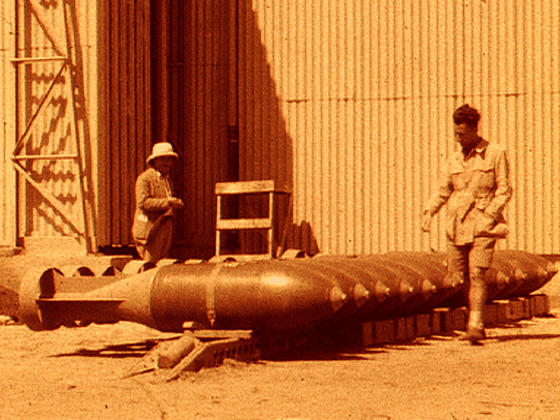 Frame from the film "Country of Barbarians"
Invisible, supplanted from the field of view and memory of the nightmare of historical facts - the main flesh of another anti -fascist (and anti -colonial) film of the program - "Countries of the Barbarians" of Yervant Dzhanikyan and Angela Ricci Lucca. One of the key phrases of this cinema, which goes on the wake of almost not documented on the film in Ethiopia, unleashed Mussolini and accompanied by the use of chemical weapons of mass destruction, is a quote from the writer Italo Calvino about the deche: “He started so many murders from which there were no photographs left, but the latest photograph was photography. murders. " This aphorism rhymes with the statement from “otherwise, Molussia”, stating that materialism is studying invisible, seeming self -evident, like air, things - for example, the work of workers, which becomes noticeable only when it disappears during the strike.
The paradox of the “Talking Cinema” is overcoming the shackles of evidence with means of cinema - this art of evidence. But for such overcoming, a voice is necessary, speech is necessary - speech that replenishes the invisible. It is difficult not to recall here about today's Russia, where obvious truths - for example, the truths about the war in Ukraine or about the economic crisis - are replaced and replaced by other "evidence" of the most sedative. But the call for speech in the “talking cinema” has a wider tragic meaning: we exist in an eternal attempt to oblivion, oblivion of the personal, oblivion of the political, but this attempt to speak out, enter into a relationship, does not allow us to be completely forgotten - and at the same time does not guarantee access to any truth. She only undermines our peace, equipping us and dooms in search.