
Translated material
Coincidence in time
The principle itself is to take any year and build a story about different people and communities that exist synchronously-not at all new, although the last decades have been going through the rise in popularity among authors and readers: from “in 1926” Hans Ulrich Gumbrecht (1997) to “1913. Summer of the whole century ”Florian Illyesia (2013). The centennial line is located between the dates of the release of the German (2017) and the Russian (2019) publications of “Time Cometes” by Daniel Schonpplug - about how two dozen characters, from America to Russia, lived, comprehended, reacted to peace between the last days of October 1918 and the beginning of the next decade.
It can be said that any historian does something similar to the extent that he gives the priority to the chronological facilities before the thematic - combining through the synchronia what is happening at the same time, including not only the different participants in the action unknown at this moment, but also what remains unknown to them and, at least outside their conscious efforts at the time of their production, so that the result of these actions and actions becomes completely, completely, completely. otherwise in relation to ideas, intentions, dreams or fears.
A synchronistic table is caused by a completely different effect: it itself is neutral in relation to the connections between the events that are included, except for the single absolutely necessary, uncertain (canceled only with the very principle of the table) of the foundation-simultaneousness, the basis for being in one moment of astronomical time. At the same time, the acting or undergoing themselves are able to live at all in different times, conducting their own chronology.
To build a plot, based on a year, is an opportunity to move in completely different directions: from the incommensurability, of the different times of existence, accidentally connected in the same calendar date up to the mercy - through the intertion, collision in one place and one time, which becomes symbolic years or decades later, from physical coexistence in the same city in mutual anonymity - to a meeting under the cover of one magazine.
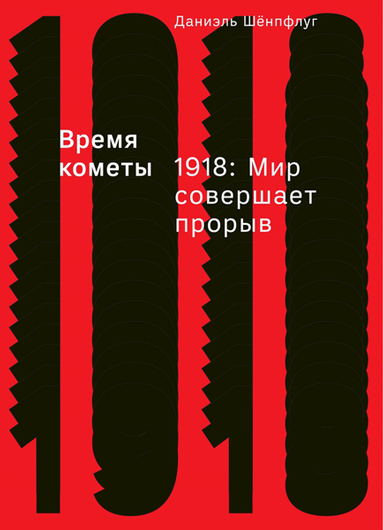 © AD Marginum Press, Museum of Modern Art "Garage", 2019
In the case of the “time of the comet” of Schonpplug, we are talking not only about a single calendar time, but also about staying in great historical time. Two dozen characters of his book-from Walter Gropius, the founder of Bauhaus , to Nguyen Tat Thane, years later, who became known as Ho Shi Min, the Crown Prince Wilhelm Prussian and the Lord Maur Cork Maxwini-turn out to be not only an external look, but also connected in the experience of a single event-the end of the war, that special interval between that special interval between that special interval between that special interval between the end of the war, that special interval. A truce announced from 11 o’clock on November 11, 1918, and by signing in Versailles a peace treaty.
The moment of signing becomes the final time of “return to reality” and the separate time: everyday life returns, from the ordinary hope of the everyday life of fears, but the time between the special, suspended, the moment when the previous course of things has stopped, the new one has not yet begun (or at least it seems so): the new contours of reality must be determined here. Some worry about this moment, which stretched for months as a time of possibilities (for some, those who are provided to them when they can affect the future order of things, when it is important to make it possible; for others - the capabilities that are collapsing, not dependent on them, but those with whom they need to do something), others live this long moment as the only one who could feel who they wanted to be; Then the order of things will return, and in this order they will have to get used to the previous way to live, from which they were seized by the war and mesh, a truce and returning to which some want, and some simply do not think about it, but, having discovered themselves in it, will be unable to live:
“What could one day and one hour mean? The onset of a ceasefire defined by the negotiators at their discretion, it seemed that for a moment millions of human destinies connected together. But this moment combined such different experiences and events: while some are joyfully hugged, while others are looking at the future with despair, the war in many corners of the world continues, and often they do not even know that a historical document has been signed in the compire. One day and one hour. The historical moment on November 11, 1918 was distinguished by an amazing coincidence at one point and at the same time - a variety of points of view, after which the story will again decay into countless personal, not interconnected stories ”(p. 65).
From this moment, the heroes will go further along their own paths, each in his own time - but behind them will remain the general historicity, the reality of coexistence, including one from which one wants to exclude the other.
And there is another dimension in this book, giving it a special interest: built both in letters, diaries, and in memoirs, it reproduces, following the installation principle, these retrospective judgments that the reader trusts as a “image of time” in order to show how our knowledge based on other sources speaks of the incorrect memory or direct distortions made. memoirist. The text about the past turns out to be working not only with the materials of the “same past”, traces left at the very moment of passing time, but also with the memory of it - he does not build a simple opposition “through a century”, but holds with strokes placed with brief signs of recalling and processing the past, the whole century between.
Few are able to resist the temptation to summarize, read morality. So here Schönpplug comprehends the “gap” as a breakthrough time, which ultimately leads to the present - as to the best world. So, as if he sees this as an excuse for the illusions and hopes of his heroes. But even if we consider our world the best in comparison with what was before the Great War - what about another war, located between the truce of November 11 and modernity? After all, if the reality surrounding us (and approved by the author) - at least in its best manifestations - to consider the result of efforts, intentional and non -mentioned, heroes of the book, then will it not be equally fair to consider them the result and other? It seems that this is the best way to cancel any meaning in history is to try to justify the efforts, hopes and dreams of the past by their result, moreover, which is reduced to the blessing given by the cash order. And - completely independent of how someone relates to the cash, because this means determining the meaning of the past, irrevocably gone and former unique, the only worried, in relation to the current, cash, which is destined to become the same past: that is, to give too much, absolute value to itself - at the same time by another land of consciousness, remembering their own temporality. In the end, most of the heroes of the book was radically different: there were already deaths, they already happened - it remained to justify them, try to act so that the whole past was not meaningless.
Daniel Schönpflog. Comete time. 1918: The world makes a breakthrough / Per. With him. I.S. Alekseeva. - M.: Ad Marginem Press, Museum of Modern Art "Garage", 2019. 264 pp.: Ill.
Subscribe to the COLTA.RU channel in Yandex.Zen to miss nothing