
Translated material
"Sapsan" in modern Russia
In the economy
 "Sapsan" in modern Russia
April 5, 2010 Alexey Makarkin
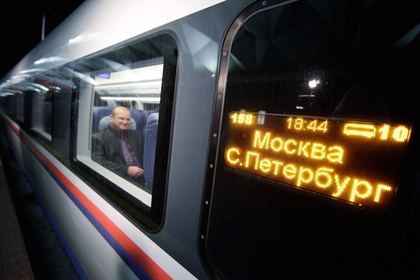 Recently, I happened to make two trips to Sapsan - from Moscow to St. Petersburg and back. The novelty of Russian railways looks great. Spectacular design from Siemens, unusual for our paths. High speed and at the same time lack of noise inside the composition. Convenient chairs - four in each row (unlike six aircraft). Polite, well -trained conductors. Clean toilets. Convenient transitions from the car to the car. Special places for the disabled - as is customary in Europe. In general, a new train is a European in Russia, which allows you to get from Moscow to St. Petersburg faster than from one end of the capital to another through the center - taking into account the notorious Moscow traffic jams.
I forgot to mention another dignity of Sapsan - the price of tickets. On the train, as in an airplane, two classes are business and tourist. A ticket to a business class-with hot meals, video equipment and sockets for laptops-costs really considerable (by my standards) money, and the tourist class is very inexpensive. My ticket cost only 2.5 thousand rubles one way.
I’m only afraid that the inhabitants of villages, villages and towns, past the “sappan”, will not understand my last phrase. “Only 2.5 thousand” - for them “as many as 2.5 thousand”. Monthly income of many local residents will be enough for just 3-4 trips on a luxurious train. One can only imagine how they escort the composition in which they will never go. It is not surprising that Sapsan causes local residents severe irritation. This train runs along the October Railway since mid -December last year, but numerous cases of attacks on it who throwing stones and ice are already recorded on it. One managed to catch - he broke the glass in the car. Competent people note that attacks are carried out on deaf sections of the road - so this is not a consequence of minute emotions, but completely conscious, planned actions.
At the same time, the matter is not only and not so much in the social envy of the poor (and rich for the poor in this situation is often not the notorious oligarch, but an ordinary Moscow middle class for which a new train is available). She, of course, is, but secondary. There are two main reasons, both are quite rational and associated with one circumstance - the lack of a special line for a new train, the construction of which would cost a considerable amount. The first reason is the huge speed of Sapsan (now it is 200 kilometers per hour in most sections, its increase is expected in the future) causes fear in people. It is well known that in Russia the railway tracks are not fenced, but in order to cross them according to all the rules, you often need to go a considerable distance. Therefore, people often run around them in wrong places, which is relatively safe when ordinary low -speed electric trains or commodity run on the road (although dramas occur from time to time). In the current conditions, it is dangerous not only to cross the paths, but also to walk along the sidelines. The detained thrower of the ice motivated his act by the fact that he was thrown away from the paths by an air wave.
The second problem is not so dangerous, but everyday. Due to the introduction of a new express, a number of familiar trains were canceled. First of all, the low -proof, but cheaper "youth", on which you could get to two capitals with relatively minimal costs. As well as several local electric trains, for example, Tver-Torzhok, on which residents of the district center and neighboring villages went to the regional city to work. Of course, you can go by bus, but it is not a secret that many employees saved on tickets and, therefore, drove hares. In addition, the new train schedule does not correspond to another schedule - school. It is clear that far from every station there is a school-especially now, when they were reduced in rural areas due to a decrease in the number of students. Previously, schoolchildren used the usual daily electric trains to return home, now they have to wait for the evening. In the West, there are school buses for such cases. But in modern Russia, there are fewer opportunities even for the functioning of ordinary regularly worn buses.
It is well known that Russia is a country living at several speeds (in a social, and not in a railway sense). Those who live at the lowest speed are not able to use the modern benefits of civilization, and recent oil well -being has little affected their lives. Even in relatively prosperous Moscow, many pensioners get on the bus, then transfer to the subway for the only purpose - to go to the market where you can save a hundred rubles (good, travel for them is free). The choice between convenience and cheapness for them is obvious - what can we say about the province. So a morally outdated train with smoked dirty vestibules and antediluvian seats for a significant part of Russians is immeasurably closer than an inaccessible train created according to European standards.
Now the implementation of European principles on the railway has turned into serious social problems and the growth of protest moods. In some way, the example of Sapsan is relevant for Russian modernization in general. The bet on innovative development is vital for the country if it wants to be competitive on an international scale. Therefore, it is necessary to introduce new technologies, the feasibility of which, however, is incomprehensible to people who would prefer a small (but very significant for them) increase in pension or benefit. The priorities of this part of society - by the way, are very politically loyal, until it comes to strong stimuli - fundamentally diverge from the agenda of the day of the most dynamic, modernized Russian layers, whose representatives drive high -speed trains. Such a dissonance is one of the main challenges that are relevant to modern Russia.
So far, the authorities have found a way to solve the problem of Sapsan. At the end of December, Prime Minister Vladimir Putin allocated a billion rubles for his protection-to install video surveillance cameras throughout his path. It is also assumed to create special groups of railway workers, which will have to go to the place in the case of emergency. It is clear that, first of all, this refers to a terrorist threat, but, apparently, simple provincial offended attackers are also taken into account.
Author-First Vice President of the Center for Political Technology
Photo by RIA Novosti