
Translated material
Without the right to vote

Kafka is primarily a common and inanimate name. “This is all some kind of kafka,” we say about the day spent in the passport office, clinic or any other GBU. Kafka is at the same time a character of pop culture, do not believe- just Google IT : Schoolchildren in the relevant VKontakte communities do not joke about any writer than the author of the “process” and “transformation”. As for the real man, Franz Kafka (born in 1883, died in 1924), then we know not so much about him. The playwright Valery Pechekin, who at one time rewrote the poem of Ovid for the Gogol Center, the comedy of Shakespeare and the script of Lars von Trier, made the writer a character of his new play, which is called Kafka. The text cannot be called strictly biographical - if only because the author from time to time collides in the forehead with his heroes.
Pecheikin ends the play with a mention that "the notes of Kafka's voice have not been preserved." Probably, not least thanks to this circumstance, Kirill Serebrennikov made the protagonist of the performance silent: when his character needs to say something, artist Semyon Steinberg only moves his lips. Sometimes we never hear words, and sometimes the writer's replicas are voiced by other actors - as on the recording of the film a cinema. The director considered it wrong, incorrect, but if you combine the physics of one artist with the voice of another, you can get a new person who does not exist in nature-and why not become Franz Kafka?
In order to repeat the fate of Gregor Zamza, Kafka does not even have to turn into an insect.
Whoever casts his vote by Kafka, there are still few words in his role. There is a much more talkative character in the play - someone Otto Peak, a journalist and biographer of the writer, performed by American Odin Byron (in line with Steinberg, who, by the way, Chichikov in Serebrennikov’s “dead souls”). Peak is not just a narrator, he has a character: this is a cheerful, slightly cynical person, a gambling and conscientious researcher; Franz Kafka causes great interest in him, but not sympathy.
The frequent motive of Serebrennikov’s performances is disappointment in family values. Although this, of course, is too softly said. Family hell is a suitable expression. Swims-experts torture the child ("man-podushka"). Husbands pound wives (oddly enough, “a summer night”). The kids grow up stupid and evil ("perone", "dead souls"). The wedding inevitably turns into a farce (“three-nasty opera” and again “dead souls”). Kafka would definitely not object to such a “blasphemous” image of the family: all the short life of the writer carries the load of relations with the authoritarian father, and the echoes of this experience are noticeable in the unfinished novel “America” and especially in the textbook “transformation”. The play of Pecheikin did not just get remarks from this short story - the playwright identifies the Franz Kafka family with relatives of Gregor Zamza.
In order to repeat the fate of the second, the first does not even have to turn into an insect.
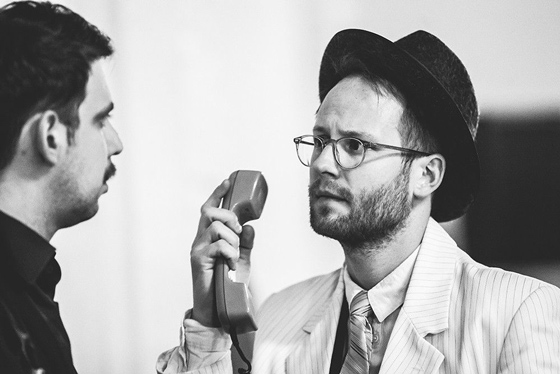 © Gogol Center
Kafka is not fantastic metamorphoses, but just normal things - family, work, public order are afraid. The world of norm in the first act of the performance is represented by the father, mother, bride and couple of comic cousins. Mother begs the offspring to hurry up with marriage: this conversation seems appropriate to her even when her son is found standing on the table, flattened along the wall, like a beetle. The father teaches an adult Franz and demonstrates complete indifference to his writings. All these are the excellent roles of the older generation of the troupe: Kafka's mother is Irina Vybornova, an actress with an amazing timbre and a wonderful sense of humor, his father is Oleg Gushchin, who came out to be realistic and frightening. Young artists play the peers of Kafka - earthly, vulgar, puffing health: this is the bride of Felicia Bauer, the addressee of the famous letters of the writer (Svetlana Mamrecheva), and two cousins - Franz (Anton Vasiliev) and Villem (Sergey Galakhov), dumb and even more dumb. In the second act, the macabr thickens and acquires more textbook forms: we see Franz as a small official in the insurance department and get acquainted with typical Kafkian characters - multi -line bureaucrats and their victims.
For normativeness, an expressive metaphor was invented - a window from which dazzling sunlight pours: Kafka screams from pain whenever his mother pulls out heavy curtains. Going to the service, he again and again goes out the window, each time making a deadly jump - this scene is fixed: the physical action is repeated several times in a row along with the text accompanying it. Serebrennikov, out of habit, acting in the next performance both as a director and as an artist, put a lot of effort into scenography. Looking at the “dance” of tall white screens, which are about to encounter the hero from the stage, or at the neon-free “K” of the writer and his two sign characters, which is burning on a white background, you might think that we are in front of us-a self-sufficient installation, inspired by Kafkian motifs.
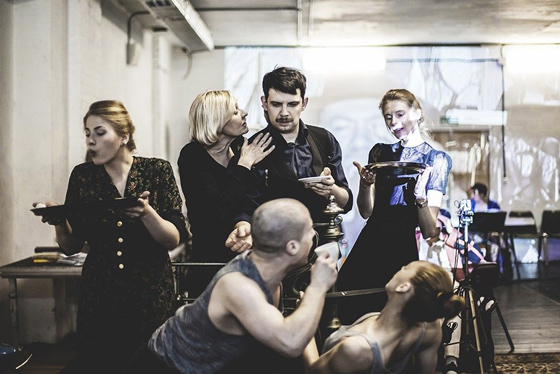 © Gogol Center
A month and a half before the premiere of Kafka, Maxim Didenko released Pasternak in the Gogol Center. My sister ”, showing the three hypostasis of the poet - a child, an old man and a young man. An elderly Pasternak reads poetry, Pasternak-boy sings, but the man is silent, communicating with the world with the help of gestures, acrobatic tricks, in short, the whole Arsenal Physical Theatre . This character’s incarnation is played by the dramatic actor Mikhail Troika, and probably the accidental similarity of his Pasternak with Kafka Semyon Steinberg is now obvious: both writers, people of the word, who were deprived of the right to vote on the stage. The plans of the Gogol Center include four more performances about the writers of the 20th century: if the capital characters are silent there, this will definitely require a separate understanding.