
Translated material
Without a face
The main result of the Moscow Film Festival, which pretends to be a festival - it's time to change all
Laureates of the 38th Moscow Film Festival are named. At the closing ceremony, the chickered President Nikita Mikhalkov finally appeared (before that he left the hospital to present the documentary project “Act of Magnitsky. Behind the scenes”, “exposing” both Magnitsky’s most and the reasons for the sanctions against Russia- read the analysis of the film in Novaya Gazeta ). The main star of the ceremony (in the absence of others) was the 39-year-old Uruguayan actress Natalia Oreiro, who arrived on the Russian premiere of the documentary “Our Natasha”. Our Natasha shocked the audience with a frank outfit and sang a song from the series "Wild Angel". The first lines of the song are translated approximately: "I swear that I myself do not know what I want." Despite the visibility of the holiday (here you can argue “about tastes”), the sensations from the festival itself remained joyless.
The MMKF competition is practically not attended by the public, and there are so few journalists at the press conferences of the vast majority of films that it is embarrassing to the authors
Of course, the MMKF for Sinefils is still an opportunity to watch many of the important films of the season, winners of Cannes, Venice, Toronto, Berlin, a traditionally strong documentary program. But the films of these special programs, collected by Andrei Plakhov, Peter Shepotinnik, Stas Tyrkin, are usually in small halls. You can find interesting paintings in the competition. In Novaya Gazeta, we talked about two main laureates: the Iranian daughter (main prize) and the film “37” (prize for directing - Puk Granden). But it has long been widely known: the MMKF contest is practically not attended by the public, and there are so few journalists at the press conferences of the vast majority of films that it is embarrassed to the authors.
One of the organizers of the festival admitted that it would be correct to cancel these press conferences, but it was not possible-at all large festivals they are ...
At the MMKF there is, as it were, everything that is at other large festivals. Including a considerable budget and sponsors. But this is "as if" every year more and more obvious.
It seems that the festival pretends to be a festival.
Rare large directors and famous cinema figures come to Moscow - usually present a retrospective and receive a prize "for contribution to world cinema." This year, the Spanish classic Carlos Saura and the British director Stephen Frirs, who was promptly handed the Laureates, was the British director, Kirill Razlogov quickly handed the award in the small hall.
The press here works in difficult conditions. The press center includes volunteers who are not able to clearly answer any question. The TASS correspondent was forced to write about hellish torment, which she underwent in her attempts to break into the closure ceremony. From the press service, she was filtered to the directorate and even to the general producer Vereshchagin. “Without tickets for the closing ceremony of the 38th MMKF were journalists of leading Russian socio-political publications,” the news agency said. But if the festival cannot invite journalists, it arranges a broadcast (in Cannes the Big Hall of Debusses is allocated for the press, the press center is broadcast in parallel. Yes, recently, the closure ceremony on the monitors could be viewed in the foyer of Pushkinsky).
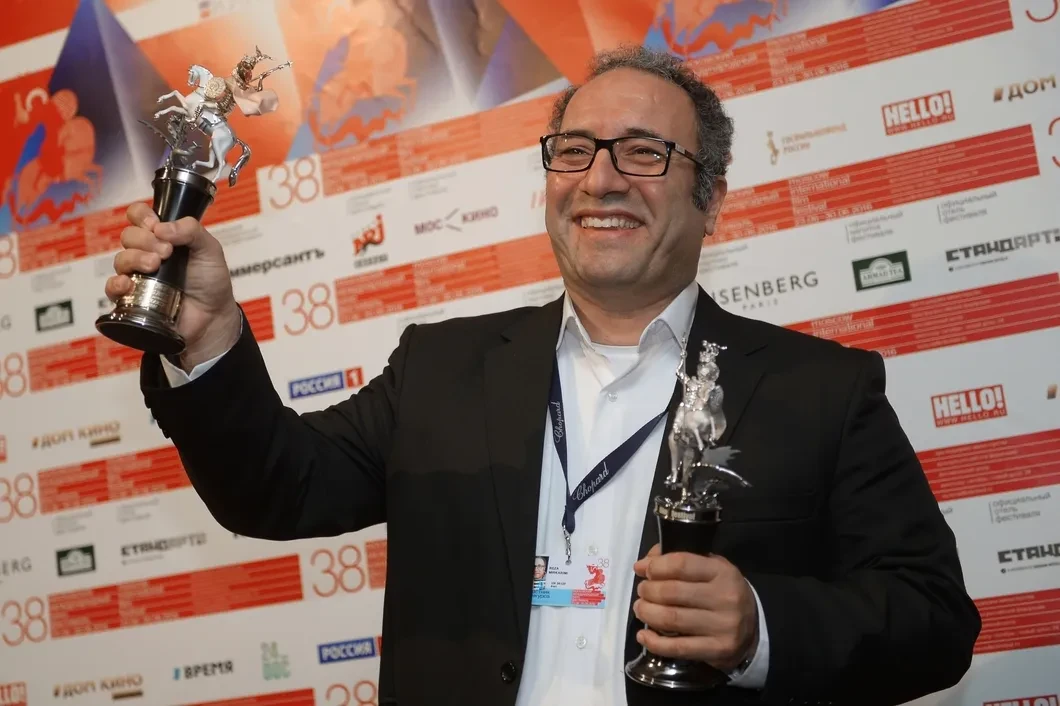
Yes, the Moscow viewer could see Cannes prize -winners at the Moscow festival. To join, so to speak, to the semantic and artistic breakdowns of world cinema. But for the most part, these films are bought and will be released. What can not be said about the winners of the MMKF. Here, for example, the Iranian “daughter” of Reza Mirkarimi, awarded the “Golden St. George”. Who in Russia will see this truly festival cinema, exploring the problem of non-communalness, internal gaps in the family? A few years ago, Mirkarimi had already received the Grand Prix of the Moscow Film Festival for the film "Easier." Have you seen him?
The problem of the MMKF is not in a “weak competition”, not in “uninteresting, outdated cinema”, as journalists like to write. And first of all-in a shortage of interest, the energy of the organizers to make their forum a truly living, demanded public. Make his organization. The consequence of this is the lack of an environment, a festival atmosphere, intelligible rules.
Yes, and the city itself does not notice, does not know that it turns into the "capital of cinema." Muscovites and MMKF practically do not intersect. The festival does not have its own development program, the vector of movement. What cultural hierarchies does he establish? Who is it oriented to?
The best films of the actual world cinema, like in Cannes, participate in his competitive program? He is focused on social and political aspects, as in Berlin? He is busy with the study of problems, the creatures of life in the countries of Eastern Europe, as in Karlovy Vary? It seems that he cannot find a place on the festival map. In addition, in connection with the sanctions, in a situation of a growing distance between Russia and the outside world, a festival without renewal, without the energy of fresh ideas more difficult. But it is unlikely that its leaders understand this. “Yes, this is one of the most difficult festivals,” says President Nikita Mikhalkov to reporters. “But we stop depending on visiting stars.”