
Translated material
With a soul
The story of Lady Macbeth of the Mtsensk district - about Kupchikha, who poisoned her father -in -law and strangled her husband - could happen where and anywhere. Human passions boil everywhere. Having chosen for the opera the plot of Leskov’s story, Shostakovich probably focused, first of all, on the universal and generally understandable essence of this terrible story. However, I dare to assume that the issues of sexual relations, as well as the problems of adultery and promiscuity, were no less exciting Dmitry Dmitrievich in their youth than his independence in life and self -realization in a dangerous (as it soon became clear) profession of the composer.
Perhaps no one managed to condemn the picture of a frantic “fuck” like Shostakovich in a symphonic anthrax to the third picture with purely orchestral agents so accurately, dynamically, dynamically and physiologically. The first edition of the opera is more risky and frank in the sense of the libretto. And more democratic in the musical language. True, the democracy in fact is imaginary-since the existential abysses, which are through these “mind-tsa”, are even worse and deeper. It is precisely the combination of the horror of being, revealed in the muddy boiling of insatiable passions, and democratism of the opera language, and makes Shostakovich's creation a masterpiece. But on domestic scenes, this opera is usually put somehow shy, obscuring the most provocative moments, with an eye on decency, local customs and the shy tastes of the majority. Whereas Shostakovich's opera is primarily about sex; About the dark and insurmountable call of passion that turns people into poorly thinking monsters.
 © Stefan Bremer
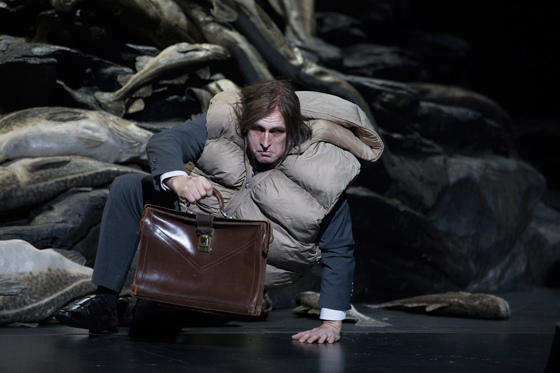
The question is whether Katerina justifies that this irrational power that does not succumb to the arguments of reason has mastered it, each director decides for himself. Norwegian Ole Anders Tandberg, who put the first edition of Lady Macbeth for the Norwegian opera, and now practically unchanged, with the same executive composition, who has moved to the stage of the Finnish national opera, unconditionally stands to the side of Katerina. For him, she is a victim of family violence, which takes revenge on humiliation of brutal mother-in-law and recoups on a worthless man-impotent man, bred in the image of an extremely rash-imprisoned accountant with a worn portfolio and adapted icicles on the forehead.
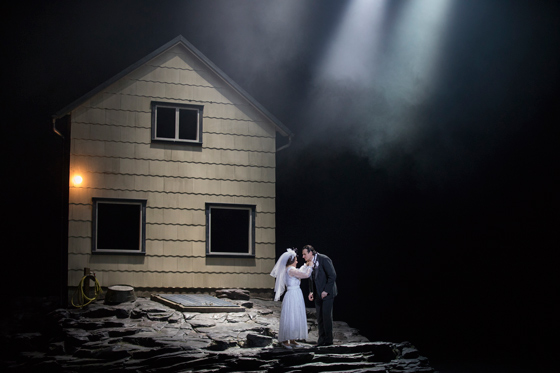
Tandberg honestly tells his directorial story on the canvas of the original libretto. But it places it in a different natural, cultural and historical environment. The scene of his performance is a deserted homeless island in the middle of the cold North Sea: such apparently invisible in Norway, and in Sweden, and in Finland with Estonia-the island life is well known to Nordic people. On the black basalt rock is a lonely farm where the Izmailov family lives. Around - no blade of grass, no flower; Only a gloomy dark sky, merging with the sea, and a rocky breed, strata piercing up. Instead of a mill - a small fish processing factory. Instead of bags with flour are slippery fish.
 © Stefan Bremer
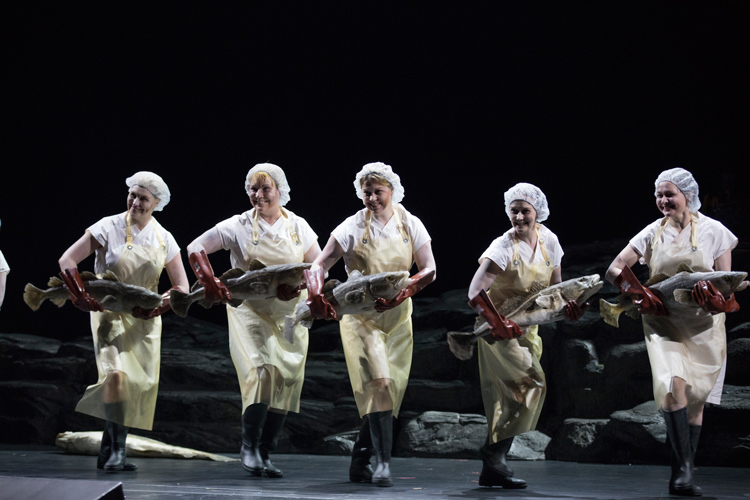
Fishes are large and small gradually filling the scene. They sleep in the fish, sit. Katerina and Sergey throw fish into each other like pillows. Factory workers with meaningless smiles on frozen faces take out fish, cradling in their arms, like babies. Dressed in aprons, shower caps and rubber gloves, they seemed to have left the fabric of Munka: black dumps of eye sockets and mouths, shadows under the cheekbones. The owner Boris Timofeevich is an untidy man in a shoveted scales of a jacket, from whom, it seems, he carries a fish spirit - appears, holding the tails of two fish. Yes, and walks with them along the stage until he poisoned him with “fungi” Katerina.
The subject environment is extremely scarce; Fish carcasses are endowed with the functions of any household item. Even Super Zanveza is designed in the same “fish” style: even before the performance, the audience has pleasure in all details to consider the required increase depicted on it in a thousand -class increase. The red and white color scheme of the abstract picture, at first glance-with flower connects, with a closer examination, turns out to be fish guts, fluffy scarlet gills and a whitish fish bubble, stained bloody specks.
 © Stefan Bremer
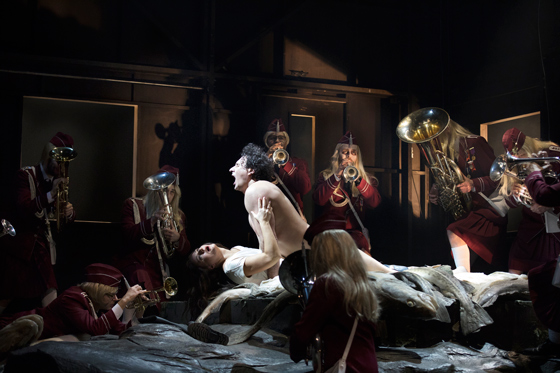
Fish is primarily a phallic symbol in the play. Not a single act of violence, which there are plenty there, can do without fish. Boris Timofeevich is walking, habitually forces Katerina to oral sex, and does it so ordinary that it becomes clear - this is not the first time. The scene of the group rape of Aksinya (Paulina Linnosaari) was extremely harshly: the unfortunate with laughter is carried on the floor, like a rubber doll, using fish for their gross sexual games as a phalloimitator.
The stage design, invented by the scenographer Erind Birkeland, is functional, concise and expressive: the rock and the house rotate in the turning circle, then showing the audience two external walls of the house, then turning to the hall in the inside. The notorious cellar, in which lovers hide the corpse of Zinoviy Borisovich, for the first time in my memory is where it should be, at the rear end wall of the house. And when a tappy peasant (Roland Liiv) folds his wings, puffs of smoke that mimic the stench of decomposition rise from there.
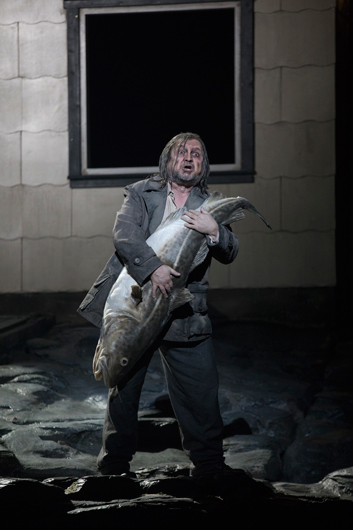 © Stefan Bremer
The harsh Nordic atmosphere of the performance does not contradict the spirit of the opera Shostakovich - on the contrary, reveals the main accents. You can’t say this about the musical component. The singing composition is heterogeneous; The main parties were quite satisfactorily performed by the soloists of Helikon-Opera Svetlana Creator (Katerina) and Alexei Kosarev (Sergey). Lviv bass Alexander Teliga (Boris Timofeevich) did not always break through the orchestra. I remembered the thick and delicious bass timbre of Hakeki Aalto in the Party of the quarterly and piercing tenor Miki is scolded in the Zinovy Borisovich party. In general, the Finnish ensemble of singers coped, of course, not counting the completely understandable flaws in the pronunciation of the Russian text. But the interpretation of the conductor of the St. Petersburg training of Oleg Kaetani - if you can name the interpretation of the exact reproduction of notes, the inflexible rhythm and the complete absence of the space of freedom for soloists - seemed quite banal.