
Translated material
Vereshchagin. 20 years later
I have a personal story with Vasily Vasilyevich Vereshchagin (1842-1904): in 1997-1998, I was tried for him. For several years in the magazine "Spark" there was a section "Golden mean": on a turn in the middle of the magazine, a reproduction of the masterpiece of the Tretyakov Gallery was published, and I composed 40 lines of commentary to it. And it so happened that in the polemic enthusiasm about the picture of Vereshchagin “Apotheosis of the War” I wrote that, they say, its author was “the first Russian necrophil”. (This is a personal evaluative judgment.) But the grandson of the artist was alive, who also wore a loud surname Povleako. (As the employees of the Tretyakov Gallery assure, Alexander Sergeyevich is still alive, send him hello to him.) The Russian court could not help but accept the lawsuit from Palevko himself, and we began to sue.
For six months it took the fact that my opponent proved that he was really a grandson. Our lawyer with a “spark” is a man of many talents Evgeny Danilov (now, alas, the deceased) assured that this was almost impossible, that parish books were hardly preserved. But the books still survived. And we moved to the debate on the merits.
The plaintiff and his lawyers, amazing an article about necrophilia from the Great Soviet Encyclopedia (Wikipedia have not yet been), proved that such a word is regarding Vereshchagin - to put it mildly, a lie and she brought incredible suffering to the plaintiff. For our part, we carried Erich Fromm, as an icon, Adolf Hitler and the clinical case of necrophilia, in which the author, a well -known German sociologist, interpreted the term “necrophilia” a little wider - as a desire for death and admiring it.
In neighboring rooms, people sued because of the inheritance or because they did not repair the refrigerator under the warranty-we argued about the high. Experts from Povyako were famous art historians, employees of the Tretyakov Gallery. The only person who agreed to speak on my side (although I turned to several fashionable philosophers) was the professor of Moscow State University Mikhail Mikhailovich Allenov, for which I am still deeply grateful to him. He wrote an essay in his characteristic graceful manner that the artist is a public figure and, exposing his works in front of the viewer, should be ready for different points of view, not always political correct.
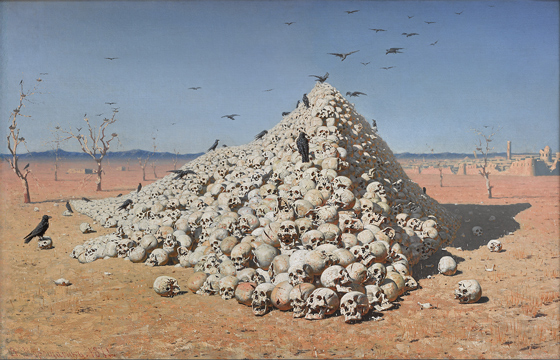 © Tretyakov Gallery V.V. Vereshchagin. Apotheosis of the war. 1871
On history, everyone was promoting as best they could: several articles in legal magazines and the plot in the program “Man and Law” came out. Our young judge admitted that she went to the museum to see Vereshchagin's works. Lawyer Evgeny Danilov in his final speech was the height of eloquence and iron legal logic. Nevertheless, we were found guilty with a “twist” and obliged to publish a refutation. Well, pay the plaintiff a certain amount as compensation for suffering. The city court, where we all, of course, filed an appeal, showing more than usual, 40 minutes, left this decision in force.
Now I understand that I was fabulously lucky with all this story. It happened at the most liberal time, we were disheveled, but the amount of payments was small. Significantly less than that of Yuri Samodurov and Lyudmila Vasilovskaya for the exhibition “Caution, Religion!”. I did not have to go into emigration, like Avdeya Ter-Ogaganyan, the real prison term did not shine, like Pussy Riot , I did not encounter a wide public hatred, which the poet Anna Alchuk fell out and which she could not survive.
20 years have passed. On the agenda - an exhibition of Vasily Vereshchagin. It will be large: 500 works from 20 museum and 4 private collections. We will see the most famous series of the artist - Turkestan, Balkan, Indian, Japanese and Palestinian. The video test, released by the GTG, lists new, not taken into account, not taken into account by the Ipostasi Vereshchagin: surrealist, reporter, scenographer, man of the world-and this is, in addition to the usual Vereshchaginsky role of the battalist-pacifist.
Has my opinion changed about the artist over 20 years? Now I see incomparably more than his advantages. First of all - human; God with him, with art.
The life of Vasily Vasilyevich Vereshchagin was so saturated with events, so many memories left about him - and he himself wrote excellently - that if he wanted to find many examples of his peace -loving temper and, say, a rebellious nature. He was born in Cherepovets in the family of the leader of the nobility. At the age of 8, he was given to the Cadet School, after 10 years he released the best student and was supposed to become a naval officer, but wrote a request about the resignation and entered the Academy of Arts, where he studied for three years. A little later, he will study at the Academy of Fine Arts in Paris for several years. The next two decades will become a series of dangerous, often military travels: the Caucasus (1863, 1865), Central Asia (1867–1868, 1869-1870), India (1874-1875, 1882), Russian-Turkish war (1877-1878), Syria and Palestine (1884), Russia (1888), US (1891, 1902), the Philippines (1903), Japan (1903), Russian-Japanese war (1904). On the latter, as you know, he died.
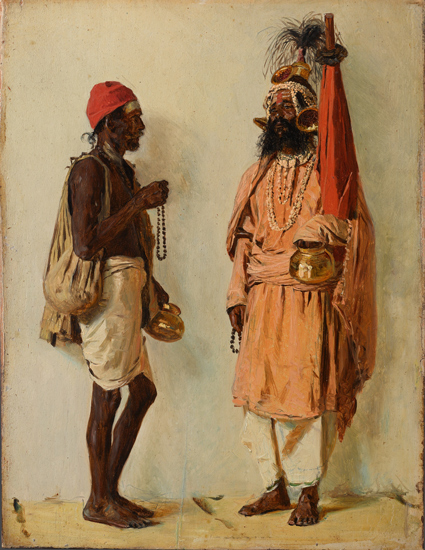 © Tretyakov Gallery V.V. Vereshchagin. Two fakirs. 1874-1876
Of the wanderings, he brought sketches, sketches that he turned into giant canvases in his workshop in a rather short time. He was interested in war, colonial conquests, exotic life of inaccessible countries.
In the 1860s, he lived in Munich, then moved to Paris for 14 years, in 1891 he finally settled in Moscow. He was married twice, had five children, from whom the son Vasily lived until old age.
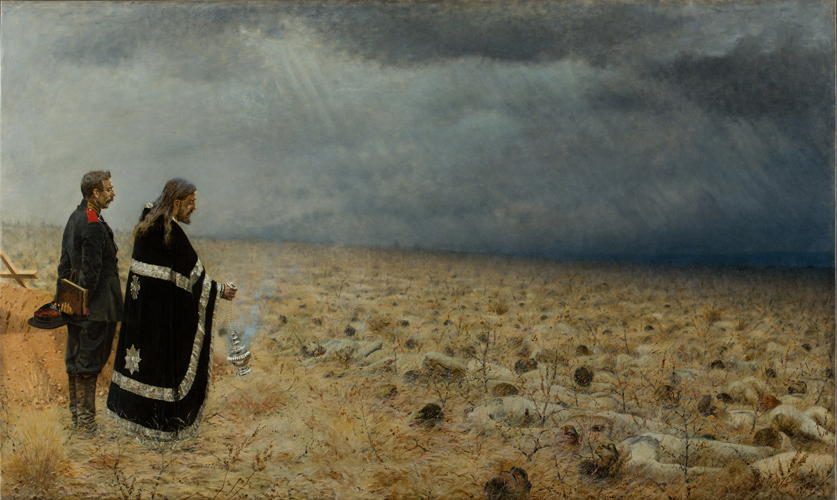
Vereshchagin in many matters was a pioneer: he reformed the battal painting, showing the most unsightly sides of the war - the transformation of people into cannon fodder. This is that in 100 years military reporters will catch, winners of World Press Photo . In some of his epoch-making canvases (for example, in “Panichid”), Vereshchagin rose to the universal, piercing generalizations from the fixation of events.
He was the first to begin to arrange the international tour of his exhibitions, completing them with grandiose auctions, and sought to sell more than one picture, but immediately a series. He held more than 70 (!) Personal exhibitions. He was the first to take care of the exposition design: he hung the eastern carpets and fabrics for the entourage, arranged household items, used electric lighting, musical accompaniment. It turned out to be bestseller exhibitions. In New York Lee, in Chicago or in London and Paris-there were always queues on them. In the field of art management, Vereshchagin overtook the time for at least half a century.
He collected enormous information and in his paintings sang art of a non -European circle - an ethnic from Central Asia to Japan and the Philippines. This whole world was not barbaric for him, but to others, with his values and achievements. This was also a new approach - eliminating the discrimination of regional cultures, which had poured out in a hundred years in the creation of a museum of non -European art on the embankment of Branley in Paris.
Judging by the numerous memoirs, Vereshchagin was an educated European, a brave, unbending person, a consistent atheist (for this separate respect), a convinced pacifist (refused the “golden sword” for participating in the Russo-Turkish war), did not enter into creative alliances for the sake of financial benefits (man abused by the partnership of mobile art exhibitions, although he was friends with Stasov, it was friends with Stasov He abandoned the professorship of the Academy of Arts), did not try to please the imperial court in the hope of a profitable sale.
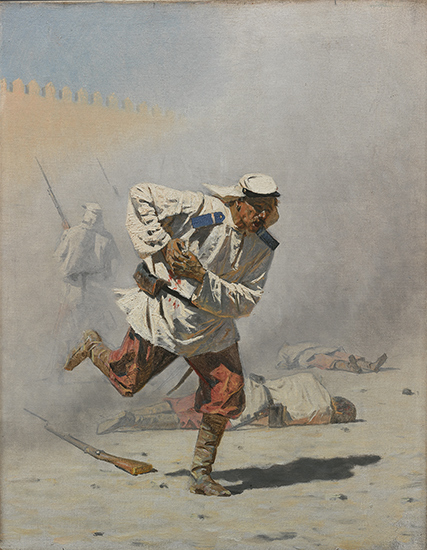 © Tretyakov Gallery V.V. Vereshchagin. Deadly wounded. 1873
I write the same 40 lines today, I would do without accent words such as "necrophilia". They, like a flash, blind the reader. I would write more streamlined about the obsession with Vereshchagin by war. During the siege of Samarkand in 1868, he did what others refused: “When the corpses of the murdered people and horses, who rotted under the very walls, threatened with diseases and literally poisoned the air, almost no one of the soldiers wanted to touch these corpses representing some kind of jelly,” I pushed the bayonet and pushed the dead from the walls. ” During the Russo-Turkish war, he sent the moneylender with the horse bypassing, and he hurried and walked around the field dotted with corpses, knee-deep falling into the rotting human flesh.
The Vereshchagin family paid dearly for this obsession with the war. It is impossible without excitement to read the memories of the artist’s son-like them, children, said goodbye to his father before his departure to the Russo-Japanese War. Vasily Vasilievich was 60, he had a young wife, three children and a large economy. The financial situation of the family was far from brilliant. The wife, Lidia Vasilievna, was so against this expedition that she did not even come out to say goodbye to him. In 1911, she will find an oncological disease, and she will shoot himself from a gun presented by her husband. The daughter of Anna will die from typhoid in 1917, Lydia in 1930, and her baby will adopt the family of the famous lawyer Povleako.
... 20 years ago I looked at Vasily Vereshchagin from the inside of the capitalism raging in the country: it was a time of adventurers, brave men and extravagant artists. The word "necrophil" was hearing not only because of Erich Fromm, but also because in St. Petersburg there was a young art group "Necrorealists" (its founder Evgeny Yufit died in 2016). Marking Vereshchagin in this way, I wrote it down in our modern world, making it a great avant-garde than he was once.
And today we look at the artist from the inside of a society drawn into a hybrid war, where on February 23, babies in kindergartens are dressed up in military uniform, and the military rhetoric of the authorities forces to cling to a chair and twist a finger at the temple. Imagine that on the Internet someone will post photos of Russian soldiers who died near Deir ez-Zoro. Well, probably, Vereshchagin’s battle paintings made the same impression on his contemporaries. And you know what: today it is more important for me that he was a pacifist and nominated him to the Nobel Prize of the world.