
Translated material
Second -grade citizens
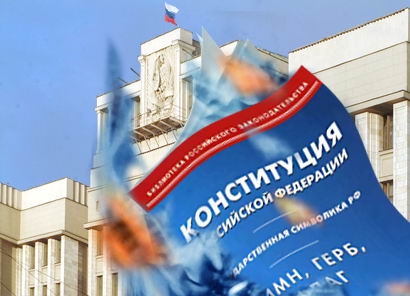
The State Duma of the current convocation seemed to have long ceased to surprise with its behavior. Which year since the presentation of the Kremlin conductors, the most anti -democratic decisions are made by the vast majority of votes: the “Hurray” was abolished by single -mandate districts, an increase in the passage barrier in the elections, a ban on creating electoral blocks, and the abolition of the election of governors.
And yet the other day the deputies managed to overshadow themselves. With an invisible account, even in the current Duma - 426 votes “For”, 0 “Against” - the lower house approved in the first reading legislative amendments that deprive citizens of the Russian Federation with dual citizenship, the rights to be elected to the State Duma and the legislative assemblies of the regions and become members of the Federation Council. The parliament proposed officially dividing the Russians into citizens of the “first” and “second” variety.
One stroke of the pen of Russian citizens of Russia even lose the theoretical right to be elected to the parliament of their own country. Among them are the most outstanding, the most worthy. Such, for example, as director Yuri Lyubimov. Writers Vasily Aksenov and Vladimir Voinovich. Human rights activist Vladimir Bukovsky. People's Artist Mikhail Kozakov. Composer Rodion Shchedrin. Ballerina Maya Plisetskaya. And this list can be continued.
But the point is not in the surnames, but in principle. The Russian Constitution (Article 32, Clause 2) provides all citizens of the Russian Federation “The right to elect and be elected to state authorities”. To everyone, regardless, say, from their hair color, literary preferences and the number of passports in the pocket. The same 32nd article (paragraph 3) gives an exhaustive list of people deprived of the right to be elected by deputies: these are “citizens recognized by the court incompetent, as well as those contained in places of imprisonment by the court sentence”. Dot.
In the era, when the world becomes more and more open, when the old dividing boundaries are erased, the Duma tries to drag Russian society into a stone bag of isolationism. Obviously, this prohibition from political activity is primarily cut off by people of liberal views, by definition of Russia's integration into the world community. The foreign Russian diaspora is also cut off from political life, which could contribute to the rooting of democratic traditions in the Fatherland. It is all the more surprising that, along with United Russia, Rodants, Zhirinovites and Communists, the few democratic deputies supported the prohibitive amendments - for example, Yablochik Sergey Popov and the co -chair of the Republican Party Vladimir Ryzhkov (the latter is even listed in the co -author of the project).
Contrary to popular belief, Russians with double citizenship are not only thicknesses who have bought the passports of the Belize or Kayman Islands. These are people with different fates, whose life outside the homeland was often forced and by no means easy. For some, the second citizenship was the only opportunity to survive, for others it was an additional convenience in moving around the world. But those who say that dual citizenship is a sign of “nonpatriotic” or “double loyalty” lying. You can be a citizen of one country and act to it to the detriment. And you can have five passports in your pocket, while maintaining spiritual and emotional fidelity to your country - the one in which it was born, with which all the best and important in life is associated. The last thing the internal self -awareness of a person depends on is the color of “crusts” on the documents. Did a French citizen Ivan Bunin or US citizen Sergei Rakhmaninov ceased to love Russia?
Does the proposed ban solve at least one of the real problems of our deputy corps: service, corruption, legal ignorance? The answer is obvious. But what about the duties of “double” citizens? Maybe in this case to exempt them from paying taxes and from calling for military service? Or deprive people of rights, but at the same time preserve obligations?
The links of the authors of the ban on “world experience” looked funny and ridiculous. Thus, the uninfront deputy Gennady Raikov, according to information agencies, said that people with dual citizenship are not allowed to run for “not a single parliament”. What is this intentional lie or banal ignorance? Just in April, when this bill was submitted to the Duma, universal elections were held in Italy, according to which several people with foreign citizenship went to the country's parliament. Among them are Senator Ron Turano (US citizenship), Senator Nino Randazzo (Australia citizenship), deputy Gino Buchchino (Canadian citizenship). According to the laws of Great Britain, citizens of the Irish Republic can be elected to the House of Commons - even if they do not have a British passport at all. In the history of Britain, there was a case when a foreign subject-Canadian Andrew Bonar Lowe-became the prime minister. And last year in Poland, a conservative politician Radek Sikorsky, who has British citizenship, was not only elected to the Senate, but also appointed Minister of Defense.
It is interesting that the “problem”, which so excited our deputies, does not care at all. I can testify this from my own experience. In the 2003 Duma elections, I ran for the Chertanovsky constituency in Moscow. In accordance with the current legislation, the presence of my second (British) citizenship was indicated in information posters and ballots. For the entire time of the election campaign - at meetings with voters and debate on the body - this topic has never been raised. My result in those conditions - 24 thousand votes, the second place out of ten candidates - speaks for itself. The “acute” voters, the topic of dual citizenship, obviously does not bother.
The most absurd that the pathos proposals of the Duma is an empty shocking of air. The proposed measure is so obviously contrary to the constitution that the request to the Constitutional Court of the Russian Federation, which will certainly be initiated in the event of the adoption of this law, will immediately lead to its cancellation. Just as it happened with absurd restrictions on the lighting of the election campaign in the press in the fall of 2003.
After all, the right to elect and be elected is guaranteed to all Russian citizens. Regardless of their hair color, literary preferences and the number of passports in the pocket.
The author is the own correspondent of the RTVI television company in Washington, in 2003 - a candidate for deputies of the State Duma of the Russian Federation from the Parties of the ATP and Yabloko.