
Translated material
In addition to the West and the East
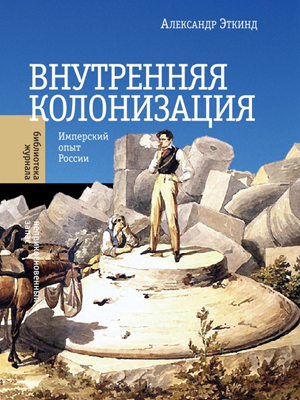
The book of Alexander Etkind, which has just been published in Russian. The imperial experience of Russia ” - of those that, generally speaking, should be published significantly more than one and a half thousand copies. However, the point is not even in the circulation. This book is one of those that in any country cause a storm of emotions, a multi -month discussion in the media, and if you are lucky - over time they change the idea of this very country about itself. At the same time, “internal colonization” is a scientific monograph, which seems to be supposed to be a circulation of 1,500 copies in the publishing house “New Literary Review”. Here, the critic and the reader, and, probably, the author falls into a difficult situation: the genre frame of the text is disproportionate neither his energy nor the tasks that he sets for himself. Solovyov or Klyuchevsky in this sense was much easier: in those days, on the border of historiography and literature, the border pillars, of course, were already standing, but it was still far from minefields and barbed wire.
Not to say that Alexander Etkind got into this alteration for the first time. Its has just reprinted (unfortunately, with some reductions) the book of 1998 “Hlyst. Sects, literature and revolution ”, in which the rethinking of both the 1917 revolution and the Soviet project in general, also received much less attention of the reading public, were proposed by the very radical by the standards of Russian historical science, which would be more attention of the reading public. However, in the ninety-eighth, many were not up to that-about fifteen years later, they may say the same, but we know that there is a difference. A new study certainly deserves both a larger and more attentive reader audience. And ideally-and (at least any) intelligible discussion outside the academic community.
 © UFO
© UFOBefore us is an authorized translation of the book published in 2011 in English. For this translation work, special thanks to the Kazan philosopher Vladimir Makarov should be said: the terminological and conceptual apparatus used by Etkinda in the “internal colonization” is broadcast into Russian in an unobvious way. However, as a result of cooperation between the translator and the author, we have a text that does not cause obvious difficulties when understanding: this is important.
Actually, it's time to move on to the subject of the article.
In the “internal colonization” Etkind proposes a large -scale revision of the generally accepted view of Russian imperial history, which he proposes to consider through the optics of post -colonial theory. However, it is not just the next case of the application of Western theory to domestic realities. Etkind, applying the methodology of postcolonial studies to Russia, simultaneously pushes their frame, demonstrating that “water spaces” and “skin color” - i.e. The criteria for the colonial situation, adopted in the modern theory, focused on classic Western empires like British, if they are sufficient, are not necessary. Thus, it turns out that modern post -colonial studies, in its classic departure already represented by the works of numerous characters in the range from the fan and said to Yang and Spivak, can be quite radically rethought in relation to the continental empires - and Russia is especially.
Etkind’s reasoning about internal colonization has several starting points at once. For example, one of them is the phrase of Sergey Solovyov that “the ancient Russian history is the history of the country that is colonized” (the author here pays special attention to the unusual return form of the verb).
Etkind sees the history of Russia as a history of imperialist expansion to the north and east, but at the same time claims that the effect of the “colonial boomerang” described by the Hannoma Rus (the transfer of colonial forking/violence from the colonies back to the metro) accompanied Russia throughout its history. The latter is connected, in particular, with the fact that, as the author writes, contrasting the spatial model of the Russian colonization by the American frontier, “over the centuries, the border of colonization all moved east, leaving behind huge spaces as virgin as before. In the future, these spaces had to be colonized again and again. The American frontier and Russian colonization - different topologies: the first continuous <...>, the second left gaps, pockets and folds. "
Jeremiah Bentham invents her panopticon as a general factory for Prince Potemkin.
Etkind makes his mosaic from seemingly long -known details: the cultural abyss between the power elite of the empire and the people; serfdom practices of control/violence; The estate nature of Russian society; Finally, Peter's reforms. However, post -colonial optics allows you to see something new in familiar historical realities. So, Peter's shaving Boror Etkind interprets as an attempt to construct the estate difference both visible, like racial with its skin color (one of the chapters of the book is called “the burden of a thin person”). The plot well-studied and, in general, well-studied by specialists in the field of economic history with the dependence (differently arranged) Novgorod, and then the Moscow state from the export of fur in the book is likened-very convincingly-the plot of the current one, i.e. depending on oil and gas exports.
The history of “development” (and in fact colonization) of Siberia and the Russian North Etkind proposes to think in the same ideas that the Soviet history of the development of the North and Siberia, i.e. As a history of expansion in the territory where the “monoresurs” is localized critical for the existence of the state. Along the way, the book proposes the conceptualization of the society formed by such an economic model - it turns out to be like “caste: a small and essentially important part of the population, which participates in the trade in monoresurs and its protection, lives differently than a large and excessive part, which exists from the first part and natural economy.” From here the bridge to the institutional theory is thrown - i.e. To "violence and social order."
Offering a new view of Russian history (and not for a separate period, as in the “whip”, but entirely), “internal colonization”, with more closely, makes the reader ask not very simple questions. How much can the methodology of postcolonial theory be correctly applied to what Etkind proposes to apply it to? Is it reflected in the text - and how much - the author’s position in relation to the subject of the letter? Do the author writes, “two narratives about Russia <...> in one - the history of internal colonization, in which the state colonized the peoples, including the people who gave this state its mysterious name”, is really connected here? Who turns out to be the subject, and who is the object of “internal colonization” - and how should we understand the “state” from the previous phrase in connection with this? Finally, how much the methodologically correctly declared desire of the author to overcome the gap “between the two disciplines, history and literature”?
Etkind declares internal colonization “as a metaphor or mechanism that makes it possible to study the Russian Empire along with other colonial empires of the past” - in other words, as an optical device. It seems that it is in this capacity that its concept is more than fruitful: it allows you to see those constellations of the circumstances and facts of the past that previously escaped the attention of researchers-and if they did not slip away, then remained private, single phenomena, not united in any consistent, whole narration.
In this narrative, both ultimatical “resource curses” of our history - fur and oil - are measured by barrels (that is, barrels) and exported to the west of the same ways. Here Hannah Arendt and Immanuel Kant - albeit at different times, but also together - are experiencing the experience of the occupation of Koenigsberg by Russian troops. Here, Jeremiah Bentham comes up with his panopticon as a general factory for Prince Potemkin ( True Story !). Here, Propp is owed to the study of Russian fairy tales as a Subaltern speech, and Joseph Conrad’s “heart of darkness” beats not only in the Belgian Congo, but also in Tambov, founded in 1636 as the outpost of Moscow colonization - i.e. As "the advanced fortress to protect against nomadic tribes, who owned these lands to the Russian invasion, and the base for further advancement to the south of the Russian plain."
In the “internal colonization” there are quite a few unobvious statements, which, coupled with not always intelligibly reasoned assumptions, would subsequently discuss more thoroughly, more details and more calmly. In places, the author is clearly in a hurry, as if fearing that the reader is getting bored - and even close the book, losing sight of a large picture, which “internal colonization”, in fact, seeks to imagine us.
But there is nowhere to hurry here: the text could be much slower and detailed. The author constructs a historical narrative so exciting, in such non -obvious methods of many times described elements synthesizes new substances that it will not work out to quit the book in the middle: to break away from the intellectual adventure, into which the “internal colonization” immerses the reader from the first pages, is decisively impossible. And even the reader who, having closed the book, will understand that he does not agree with either the author’s method or his conclusions - even he can hardly think about Russian history in the same way as he thought before.
Alexander Etkind. Internal colonization. Imperial experience of Russia / authoriz. per. from English. V. Makarova. - M.: New Literary Review, 2013. - 448 p. (Library of the magazine "Unaccounted stock")