
Translated material
Abkhaz bouquet
In the regions
 Abkhaz bouquet
September 28, 2011 Evgenia Vlasova
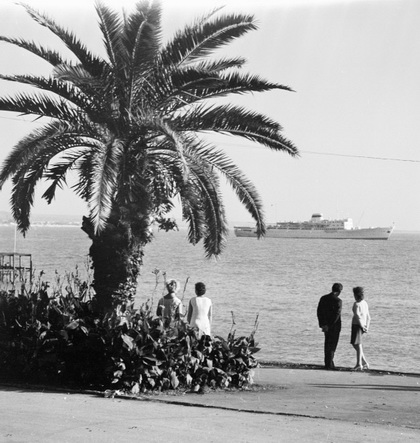
Before the revolution, they were going to arrange Russian Nice here. In Soviet times, it was an elite resort, where party bosses rested. Today, in response to the phrase “I am going to Abkhazia” you will certainly hear “Is this not dangerous?” The All -Union health resort was drunk and lost all her pathos.
Life under a canopy
Zandripsh is the first settlement on the way from the Russian-Abkhaz border deep into the republic. Residents of the village were very lucky: proximity to the border guarantees the influx of vacationers. And tourists in Abkhazia are the main source of income. Literally everyone rents housing in the summer, adapting any more or less tolerable butt to it. The remaining part of the year live with the money in the summer.
You just wonder how many beds are hung in these gray, as if cardboard, houses. "Mom, are these slums?" - my ten -year -old son asked, getting acquainted with the charms of local life. “No, son, this is poverty. Poverty looks much worse. ”
Of course, with the local climate, you can do with a minimum service. There would be a roof overhead. Abkhazian roofs-canes usually extend far beyond the limits of the house, covering a significant part of the yard from the rain. Under the canopy, in front of everyone, they brush their teeth here, cook, eat, erase, make lessons with children, rest, sometimes even sleep. “All day in the fresh air,” I thought, not without envy, examining the possessions of the owner who handed over the room to us.
The owner - Armenian Karen - turned out to be a musician, director of a music school. Therefore, under his canopy, in addition to the refrigerator, gas stove, TV and sofa, there was also a piano. “I completely dry out on the street, copy the synthesizer,” Karen’s mother complained. - Eh, we would have to populate all the rooms at least once during the season - we would have solved so many problems! ” I counted the rooms for delivery from Karen eight, they were all empty. At that time, we were the only tenants.
However, the delivery of the rooms was not the only business of a young musician. On a neighboring, noeen section, at the very railway, he built another canopy, put another piano under it and arranged a home cafe. He purchases products himself, he frying kebabs. All the rest in the kitchen is seasoned with his wife-pianist. There is a waiter in a white shirt - a student of a music school, a fifteen -year -old boy Alyosha.
In the evenings, Karen recalls that he is a musician, and sits down to play the music of his own composition for visitors, by the way, very good. When the holiday season ends, the cafe transforms into a music school, the very one where Karen is the director. The school, by the way, is municipal, and almost 6 thousand rubles are supposed to Karen for the leadership. With the start of classes under the canopy, music lessons are held, occasionally drowned out by the noise of passing trains.
Two gagras
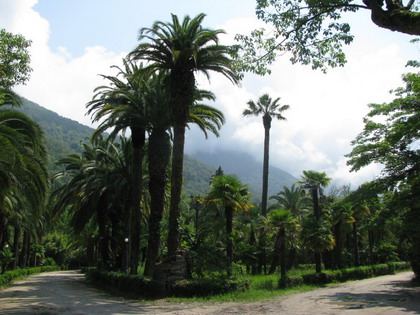
Gagra is the city of Abkhazia closest to Russia. In the USSR, the toponym of the "Gagra" was adopted, which is not entirely correct. The city is really divided into the old and new Gagra, but there is no reason to consider them two different cities.
Gagra, clamped between the mountains and the sea, is similar in shape to the snake - the same narrow and long. And this creates certain difficulties in movement. The linear arrangement of objects significantly lengthens the distance between them - you have to ride more than walking. At the same time, no city transport has long been here. It remains to be content with minibuses and taxi.
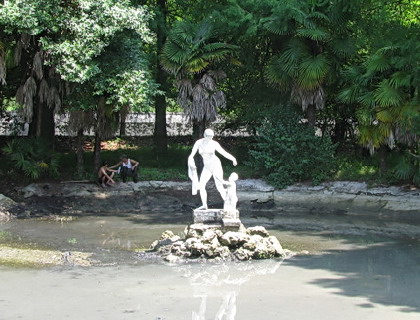
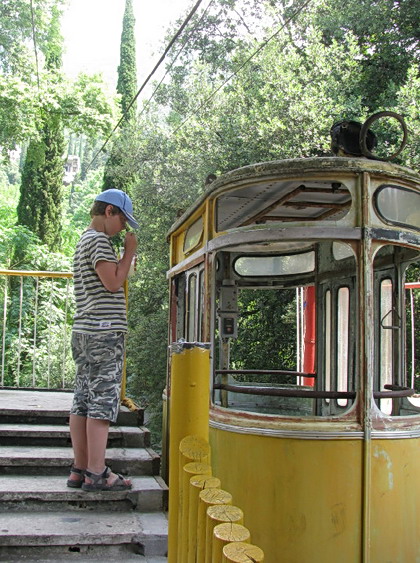
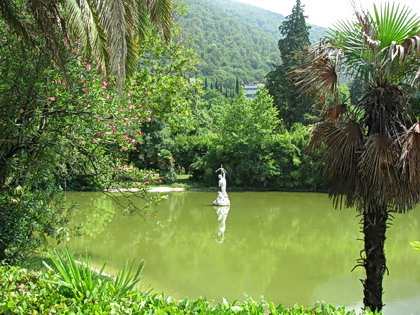
The main character of these places is the Prince of Oldenburg. It was he who in 1901 received from the emperor these people who were desolate and for several years arranged a high -society resort like Nice here. The fact that the prince had a great taste can be judged by the ruins of his exquisite castle in the Art Nouveau style and in a luxurious park, broken by him in the territory of the old Gagra. The efforts of the tsar’s relative brought various exoticism here - finish palm trees from the Canary Islands, fan palm trees from China, coconuts from South America. The park today is beautiful with the special beauty of desolation. Everything that could destroy has long been destroyed. The ponds are overgrown with tina or dried. The cable car that once raised vacationers to the alpine meadows looks especially sorry. Her rusted wagons are still obediently standing at the remnants of the pavilion, clinging to the lifeless ropes.
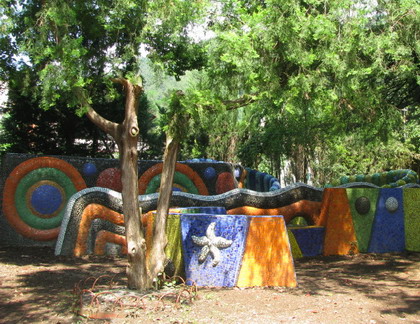
At the very beginning of the park, the mysterious sculptural composition of Zurab Tsereteli, lined with mosaic in the style of the Soviet kindergarten, is full of a foreign body. Bright, screaming figures contrast sharply with the majesty of ancient alleys.
In the new gagre, there are much fewer romance. In the summer there is noisy and crowded. The main thing that interests tourists in the new area is a market, a brand new Continent supermarket and a water park. Those who missed civilization and a more or less decent service are striving for the continent, in the water park 1 vacationers with children. The first is some disappointment: the supermarket has automatically extended doors, but a rather meager assortment of goods. The latter can avoid disappointment and enjoy if nothing supernatural from the very beginning will wait. A water park with several quite extreme slides is able to satisfy those who will not compare it with similar structures in large cities and in fashionable resorts.
In the new Gagra, you come across abandoned Georgian houses and stormed areas. They say that since the 70s there was an unspoken order of the Abkhazov in Gagra not to settle. As a result, the Georgians made up almost a large part of the city’s population before the war. So Georgia tried to strengthen its position from the Russian border.
Sukhum's secrets
In the view of travel agents, the main attraction of the capital of Abkhazia is monkey nursery. On the slope of the mountain, trapezoid on the territory of the Institute of Experimental Pathology and Therapy really houses several large cells with maca ons and pastors. Terrible signs with the inscription "Do not feed!" Are hoisted in front of the cells. Immediately for a hundred rubles, cults with food for monkeys are quite officially sold: pieces of carrots, watermelon and melon crusts.
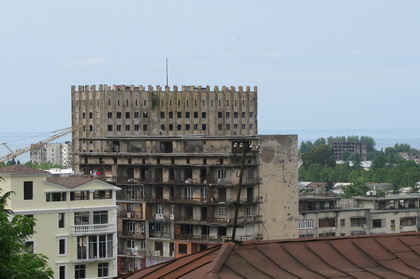
From the sites of the stairs leading to the nursery, a view of the city opens - the bruised, blackened facades of residential quarters, among which the skeletons of bombed buildings come across the eyes. The walls of the surviving houses are dotted with traces of bullets.
The center looks more cheerful. The main street is in the past of Lenin, and now Leon (in honor of the Abkhaz Tsar) - as it approaches the sea, becomes more and more plastered and restored. On an abandoned berth, the new Renaissance is loomed among the post -war devastation, the brand new Restaurant of the Apra (sail), opened two years ago by an Abkhaz entrepreneur. Stylish interior, my dear staff, exquisite cuisine - everything is as if from another life.
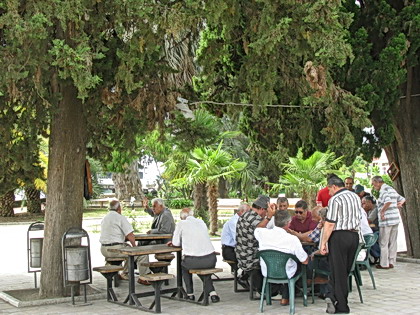
In the place where Leon's Street goes to the sea, under the canopy of amusing palm trees is a small stall-catheter, where you will not be offered anything special-only tea, coffee, every little thing. However, all the tables are busy on this patch, and exclusively men of about fifty to sixty. Abkhazian men, grouped at the tables, are discussing something ardently. In the last century, such meetings of dominoes could be seen on Moscow Boulevards. Unlike Muscovites of the recent past, Abkhazia do not score a goat. This is a purely intellectual gathering, “Brekhalovka”, where every day in the afternoon time there is a fermentation of the minds and public opinion is formed on the most pressing political issues.
I went to the men: “Are you discussing the elections? What are you waiting for? " Everyone began to praise the chambers: intelligent, they say, they take care of the people. Hadjimbe was talked with coolness. But Alexander Ankvab, whose inauguration took place on Monday, did not even remember at all. But to my skeptical question, whether they believe that the elections will be honest, categorically cut off: “We always have honest elections.”
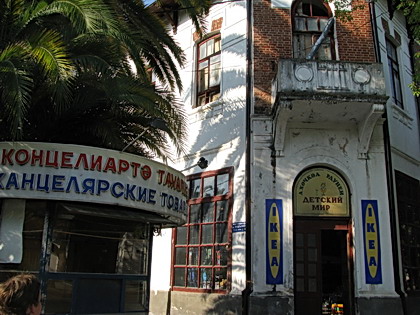
It seems that no one is particularly striving in Sukhumi now. From the Russian border far away, more than 100 km. From Georgian - too close, less than forty. And what to do in the destroyed city? In fact, there is something to do. One walk around the city is worth it. Well, where else will you see the IKEA store sheltered on the modest meal floor in the "Children's World", which is itself the size of a medium-sized apartment?
And in Sukhum there is a cinema. True, almost no one knows about this. Any Abkhaz will tell you that in the republic there are no cinemas in principle. Even Sukhumsy will say that. And it will be not true. Because in Sukhum there is a cinema! Bye. I don’t know how long it will last. I found it quite by accident, going to the electronic goods store to buy batteries. That is, I did not find, but my son. “They show the movie there,” he whispered in amazement, pointing to me at some utility door in the store. I listen - and really, it seems. "What is this?" - I ask the seller. “3D cinema,” he answers easily. The only one for all Abkhazia is behind the door of Pope Carlo! "Is this your private initiative?" I ask again. “Yes, they decided to try. But so far there are few visitors. ” - "Why do they need to be if you do not advertise yourself?" - "There is no money for posters."
Of course, we could not deny ourselves the pleasure of going to the cinema. Of the six sessions-and there every day four to six sessions with different films-they chose the "Ice Age-3". Behind the mysterious door was a truly comfortable cinema with 25 seats with folding soft chairs, the Dolbi-Stereo system and even pop-root. In general, everything is supposed to. "Turn on your air conditioning?" -the seller of a computer store asked, he is part-time ticket cashier. In the cinema, there was nobody besides us. “Yes, perhaps, only not to muzzle,” I answered capriciously, lost in the choice of 25 comfortable seats. And then I realized that I especially like in Abkhazia - an individual approach to the client.
It's still a pity that it is so difficult to get to Sukhum. They would open the Sukhum airport again, as in previous times! You look, and the people would go. “They will open to the Olympics in Sochi,” the taxi driver speaks optimistically at my sighs. - Adler alone simply can not cope. So soon you will fly to us on airplanes. Everything is formed. Everything is ahead of us ... "
Photos of RIA Novosti and Evgenia Vlasova