
Translated material
By stages
National Bolok Tatyana Kharlamova - About her prison experience
Conclusion experience. Ten months in a pre-trial detention center, four transit prisons-Tatyana Kharlamova paid such a price for this price for 1 minute of a peaceful protest campaign. Tatyana told The New Times about her experience, which confirms: in the Russian prison, a person is absolutely powerless 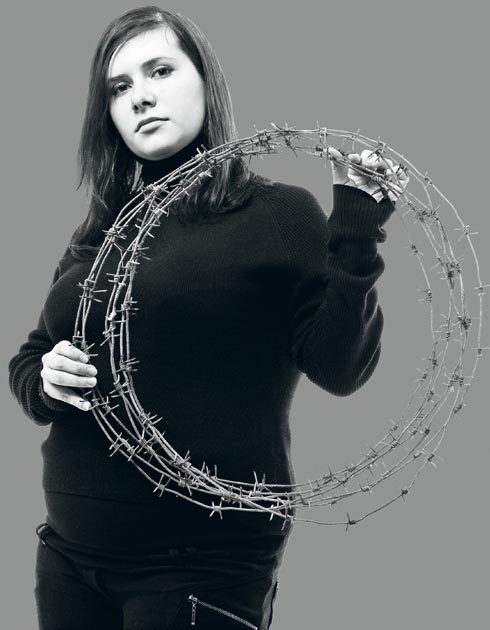
On October 1, 2008, in Khabarovsk on the closing day of the III Far Eastern International Economic Forum, which took place in the regional music theater, an emergency occurred. Two unknown young people staged a protest. The forum participants, who at that moment leaving the theater, did not understand anything: young people quickly twisted the police.
“Everything lasted no more than a minute,” recalls Tatyana Kharlamova. - I lit a smoke saber, Igor riveted the handcuffs to the flagpole, and we launched the stretching of the "island - ours." When we shouted: "There is no Chinese expansion!" - The police attacked us. Then we were taken to the department. ” Tatyana talks about this impudent action as a common cause. In general, this small woman with large black eyes and a quiet voice does not look like a revolutionary, easily lighting smoke bombs, chanting slogans, capable of confronting the police and riot police.
"Islands - ours"
Nevertheless, it was she who came up with the idea of going to Khabarovsk and protesting against China’s transfer of three Russian islands * * On December 1, 2009, Russia was an official transfer of 174 sq. Km of disputed territories (Bolshoi Island, the island of the Big Ussuriysky and Tarabarov). . According to Tatyana, she chose Igor Schuka with her “accomplice”, because you can rely on him. “National bunches are primarily friends and comrades, but you will not approach everyone and offer:“ Let's arrange something like that, ”says Tatyana. She met the National Bolsheviks at one of the protests against point development in Moscow. The party of Limonov was already banned then, but this did not bother Tatyana: she always liked the ideas of National Bolshevism. She understands them exclusively as the ideas of social justice.
The Khabarovsk law enforcement officers could not decide for a long time how to punish the detainees of the National Bolsheviks. At first, their action was qualified as “petty hooliganism”. But then they were charged with three articles of the Criminal Code of the Russian Federation: “Participation in the activities of the extremist community”, “Insulting a representative of power”, “Exciting hatred or enmity”.
Prison "roads"
During the investigation, Tatyana and Igor were imprisoned in the pre -trial detention center of the city of Khabarovsk. “In the early days, I simply did not understand how you can live there at all,” Tatyana recalls. - I was struck by the whole life there at night. In the afternoon, everyone is sleeping, and at night the prisoners communicate with each other. From a camera to a camera, the so -called "roads" are sent from one prison corps to another. These are such ropes, ropes through which notes, cigarettes, sweets are transmitted. They dissolve woolen things, make these “roads” from threads: then they tie a thicker one to thin threads. Thus, I talked with Igor, who was sitting in a different building of the pre -trial detention center. ”
Tatyana says the prison building in Khabarovsk is very old. In the cells, old wooden bunks, there is no hot water, instead of the toilet - just a hole. They drive to the bathhouse once a week, it was cold in the cells, in winter I had to walk in a down jacket.
"
There is something in prison experience, which made me look at life differently
"
Escape
On April 1, 2009, the investigator changed the National Bolshes of the preventive measure for a recognizance not to leave: before the trial they had to live in Khabarovsk. But they fled from there a month later, after threats began to come from the operatives that if the National Bolsheviks did not agree to admit their guilt, then at the end of May on the eve of the Russia summit, the EU will be planted again.
“We decided to ask for political asylum in Ukraine,” Igor Schuk told The New Times. - We got to Moscow by hitchhiking, and then we got on a bus and drove to Belarus. We were detained when it was not far from Smolensk. Police officers stopped the bus, checked documents from all passengers. I did not have a passport. Then we were struck on the database and detained. ”
“I ended up in the pre -trial detention center of Smolensk, and for a day they kept me in a cold basement,” continues Tatyana. - I felt bad there. I was in the second month of pregnancy and asked me to be examined by a doctor. But the jailers told me that the gynecologist was not laid with transit prisoners. In the Smolensk pre -trial detention center I had a miscarriage. And the doctor examined me only in Chelyabinsk. ”
"Stolypin" car
“The stage is probably the most difficult thing in prison life,” says Tatyana. -The prisoners are transported in special “Stolypin”, * * For the first time, the wagons appeared in 1908 during the time of Prime Minister Peter Stolypin. These were ordinary commodity wagons adapted for the transportation of immigrants from European Russia to Siberia, which, by the name of the initiator of the mass resettlement of Stolypin, were called "Stolypinsky." When the resettlement campaign went to decline, these wagons began to be used to transport convicts. which look outside like mail wagons, only on the windows of the grate. The prisoners are planted in the "tees" - in the area it is half the compartment. Only here are three shelves and there are no windows. The feeling is as if you are sitting in an iron cage. In the heat is unbearable. Dry ration is given with them: lean cookies, tea in bags, sugar and custard cereals. In the way, boiling water is carried three times a day. But, as a rule, this is only a name, not boiling water. And the porridge is not brewed on it. So you don’t eat anything on the road. According to the law, the toilet should be taken three times a day. But the problem is that about 50 prisoners can go in the car, and if someone alone screams that he wants to go out, then other cameras begin to scream immediately: “We want too!” If the convoy is normal, then it can be persuaded, and if not, then you have to endure. The train goes a long time: in every city where there is a transit prison, it stops, the mail car is unchanged. Everyone who needs, unload, plant new ones. Then they wait for a new train to come, and a wagon with prisoners clings to it. According to the law, prisoners should be squatted from the car to the car to the car. And the jailers do not care what way the train will be fed to. I saw how men crossed the stairs from one railway squatting. ”
The most difficult was the stage from Irkutsk to Khabarovsk. It lasted a week, and Tatyana seemed that this torture would never end.
“Then eleven people rode with me in the“ tech ”: two“ youngsters ”, an elderly woman, two pregnant women and three mothers with infants. The smallest was four months old, Tatyana continues. - On the street is 20 degrees of heat, and in the wagon even hotter. We asked the head of the convoy to plant us in two cages. He objected that everything is according to the law, and if we are capricious, they will not take us to the toilet and will not give water. ”
Tatyana says that “it is not known whether all women could survive this trip”, if not for the thief in the law of Koba Baghdad. He rode in a neighboring cage and, having heard the complaints of the women-confused, called the head of the convoy to himself. “I heard Koba said:“ You want blood, you will get it. One of my word is - and there will be rivers of blood. ”
“He hinted that on his orders, the prisoners could open his veins. The chief of the convoy planted us in two cameras and opened the window. ”
New life
And again Tatyana fell into the same pre -trial detention center of Khabarovsk, where she was already sitting.
And in mid -September, the court began. The prosecutor asked the National Bolsheviks to the year and a half of the penal colony. The judge has mercy and gave them 10 months. The time that they have already served.
After eight months of imprisonment, two months of the most difficult stage for Tatyana Kharlamova, a new life began. She expects a child and thinks about how she will educate him.
“Now I am not drawn to any feats. I just can't risk my child. I would not want my child, when he grows up, survived what I experienced. Although there is something in prison experience, which made me look differently at life: I learned patience, I began to understand people better. But at the same time, I realized that life outside the garden ring is worse than we think. In Moscow, at least you can call human rights activists or journalists, and there, far, far, everyone absolutely does not give a damn what problems you have. Absolutely terrible things can happen in prison with a person, and no one will help you ... "
Prison roads. The most common way in prison between prisoners are external roads along the external walls of the prison and between the buildings using the so -called Horses - homemade ropes and ropes, the manufacturing technology of which is a whole art. The most difficult thing in this business is to break and install the road. The easiest way to do this is located on each other. The upper ones lower the horse, the lower ones with a hook (a bent plastic handle on a long stick, twisted from a newspaper and glued with a bread braster, which is called a fishing rod) is tightened inward. To break with a neighboring hut on one floor, it is already more ingenious. If you can put your hand through the grate, then the weight is tied to the end of the rope and, unwinding it, throw a fishing rod on the line exhibited from the next window. You can also hang a load on a cable of sufficient length on a fishing rod, start gradually swing until it is caught with a fishing rod from the camera window located below diagonally. Then it only remains to raise the horse to the floor above, and the side road is installed. If at least someone vertically installed such a side road, then, passing each other's horses vertically, such roads can install each floor.
Vitaly Lozovsky. "How to survive and spend time with benefit in prison."