
Translated material
The end of the quote
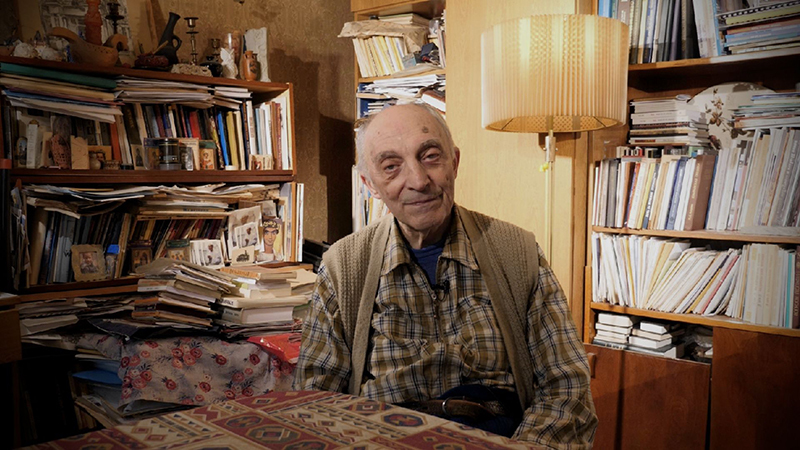
The word about Yuri Lvovich Freudin would like to start with an archival extract. Because the archival topic goes through his whole fate. At the end of the letter of the semitologist and biblicalist Joseph Davidovich Amusin to N.Ya. Mandelstam dated January 22, 1968 we read: “Yes! In order not to forget. In the collection “Materials of the XXII Student Scientific Conference I” Tartu, 1967 there is a report by student Yu. Freudin (or: oh?) “Notes to study the work of O. Mandelstam”. There are two reports of Akhmatova. Very nice that students take it into their own hands. Here they are these “boys” that you talked about. ” The end of the quote. Around this time I visited N.Ya., and she wrote about me a letter of recommendation V.M. Zhirmunsky, which ended with the phrase: "They are now appearing, our" archival youths "in more than one sense." The end of the quote.
It seems that N.Ya. In the Ezopian epistolary manner of the socialist era, it reports on the spiritual impatience, freedom and freedom of this pile of poetry. In the case of Yura, like Lena Smorgunova, which was unwanted from him, it had significant biographical foundations.
The theses that Amusin wrote about, said that against the backdrop of the evolution of poets of the first third of the twentieth century, the evolution of Mandelstam stands out with the swiftness and almost the complete absence of retreats, downs, dead ends.
Those. - We explain to today's reader - it was a question of rehabilitation, advancement, praise of the late, sub -Soviet and Soviet, samizdate and Tamizdate Mandelstam, still unknown to the massive Soviet reader in 1967, and whose publication in the era of perestroika Yu.L. I gave a lot of time.
Further, these theses spoke of Mandelstam's prose, prose in quotation marks as a specific section of the poetic system of Mandelstam, which was illustrated by the lexical and conceptual parallels of his poems and prose. Finally, it was first talked about the poet’s proximity to the ideas of Saussure, i.e. A kind of great -structuralism of Mandelstam, and to the ideas of a formal school (primarily to Tynyanov’s “gap”). These theses were really pioneer. The dialogue of poetry and prose in the semantically united building of the full Mandelstam was then deployed and impressively said seven years later in the collective manifesto “Russian semantic poetry as a potential cultural paradigm”, where Yu.I. was responsible for the Mandelstam part. Levin and D.M. Segal, and about the relationship between Mandelstam as a theoretician of poetry and the POSI was told in a thorough article by E.A. Toddes.
The theses for the Tartu Conference grew out of many hours of interpretation - what is sometimes called home, oral or kitchen mandelstamation of the sixties. In the conversations - say, the houses of Dima Borisov and in other places (Yura, for example, the four talented young people, who were called in Tartu at the mentioned conference, were called “vagrant structuralists”) - the most fantastic ones sounded, but a lot of the fact that later came into a commentary to qualified publications. In Yura, she aroused respect, although by the first reaction, sometimes perplexity, his tolerance for almost any interpretations, unproven, unprocessed, intuitive, but non -informed, the doctor, the healer of souls affected. But then it became clear that this he created the environment, the Wednesday of a special part of the unpredictable, incorrect in the quotes of the poet discussed. Yura himself was a man-in-the-humor, incorruptible flatter by an arbitration judge, an educational (like Sasha Morozov) ethics of mandelstaman studies, and I witnessed, as glorified by his delicacy and excessive softness, Yura strictly baked those who violated this unwritten but unshakable code. For me, the word “environment” and a quote sticking to it are curled over Yura - I'm talking about the whole environment with which I had in mind, etc.
I happened to accompany loved ones in the Jewish cemetery, to worry about what Mandelstam embodied in the poem "This Night is irreparable." There, in our area and in our times, after the mandatory part, after the Kadish and tearing clothes at the orphaned, the violin plays a little. Therefore, it seems to me appropriate to recall the poem "Alexander Hertsevich lived." What is there? Doesn't matter. The end of the quote.
Speech by R.D. Timenchik sounded in the program “Strong texts” dedicated to the memory of Yu.L. Freudin.
* The organization is introduced by the Ministry of Justice of the Russian Federation in the register of NPOs that perform the function of a foreign agent.