
Translated material
How many years later?
In society
 How many years later?
February 17, 2009 Alexander Osovtsov
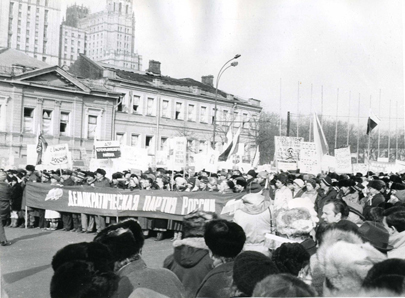 Leonid Radzikhovsky invited collectively to write “20 years later”. On the one hand, his invitation, judging by my biography, is addressed, including me. On the other hand, it is obvious that it is quite difficult for me to evaluate the events in which I was a participant, and not an observer, and it is almost impossible in the format of the standard “Hedgehog” column. Therefore, I will refrain from creating short memoirs, and after Leonid I will try to limit myself to a description of my today's sensations about the period being discussed.
I must say right away that in general, these sensations are not as gloomy as the initiator of the conversation. I will try to explain this “small difference”, not reducing everything to the natural unequal of our temperaments. Firstly, the numbers in such situations are a very conditional thing. For example, today, February 13, 2009, when I write this column, not 20, but 25 years from the date of election by the Secretary General of the Central Committee of the CPSU Konstantin Chernenko. And if we consider this anniversary, it turns out that over a quarter century in the field of promotion to freedom, law and civilization, great progress has been achieved. Secondly, I continue to participate in the activities of both democratic and united opposition and I want to confidentially inform everyone that the “new young” are. I will call only a few famous - and at the same time in every sense very different - people. Maxim Reznik, Sergey Udaltsov, Vladimir Milov, Ilya Yashin, Marina Litvinovich, Maria Gaidar, Oleg Kozlovsky - it is not difficult for me to continue. How many were 20 years ago?
In general, it can be argued that in comparison with 1989, one, although very important - a development trend or, as it is now fashionable to say, trend has changed significantly.
In 1989, it seemed to many that everything that had just begun would bring very fast and, most importantly, irreversible results. Well, if you want to make fun of the Almighty - tell him about your plans. Nevertheless, in 1809 the ideals of the Great Revolution mentioned by the Radzikhovsky in 1809, not everything remained, to put it mildly. And the basic trend was quite imperial. But it was higher, which was not so long.
Therefore, in Russia, it is required, as always in such cases, “to turn the trend” or, if you want, “change the agenda”. But the agenda now, right these days, is changing due to objective reasons. The one that was in previous years is no longer - no one argues with this. The question is what a new agenda will be.
And now I would like to recall that in 1989 - twenty years ago - it was primarily that this notorious agenda changed, the content of which determined the trend of subsequent development. The agenda of B1989 was determined by Yuri Afanasyev, Gabriel Popov, Andrei Sakharov and many other, sometimes already half -forgotten politicians and public figures. And they determined it so fiercely and attractive that no one was in doubt that not only the main, but also almost the only alternative to the then ruling elite is a democratic opposition.
Incidentally, this situation has developed as a result of the huge economic problems that the USSR arose and the political crisis, which of them stemmed. No analogies come to the head? If they come, it remains, in essence, a little - it is realistic to form approaches to solving problems that have now arisen in Russia, those that would really show light at the end of the tunnel and allow citizens to see this light.
Let me remind you that is it bad, good, but the economic situation in Russia after the start of the reforms that were proposed in 1989-1991. And began in 1992, with all their huge mistakes, but still allowed to avoid a threatening disaster. And now it’s ridiculous to remember at what prices for hydrocarbons in 1999 (today this can also be considered as an anniversary and as another allusion on the topic of Dumas - ten years later) economic growth began. What to talk about if in the summer of 1998 the Russian government asked the IMF less than in the fall of 2008 issued Deripaska! It is clear that not about numbers. And about the meanings. Of course, my old friend Leonid Radzikhovsky is right that these thoughts became less in demand. The words of the ponders hear worse. So, we say badly. Or maybe we think it doesn’t matter. So to whom is the claims? Mamardashvili to the late Merab - for the fact that he is not among us? For dead? So would he be alive, would he live in Moscow now? After 2006 and 2008, I think it is unlikely.
Of course, the line of the 80-90s gave considerable chances, and to a large extent they were mediocre. But not all. It is clear that many mistakes were made, and their analysis is absolutely necessary. I once spoke out on this subject and did not mind continuing. But not wide strokes.
Not Glazunovskaya "Mystery of the twentieth century", and somewhat more structured. History - any, including the last twenty years - must be written for chapters. You can chronologically: the first chapter - about 1989, the second - about 1990, etc. And you can - on problems. For example, N is important to discuss the problem of the correlation of historical predetermination or, if you like, the basic properties of the country and the people and the role of specific actions, including errors, fixed historical characters and certain socio-political groups. After all, if “everything is predetermined in advance”, then we are not to blame for the fact that “everything ... lost”. And what are they to blame?
In general, personally, a detailed conversation about the past twenty years seems important and interesting.