
Translated material
Word at a crossroads
The first international
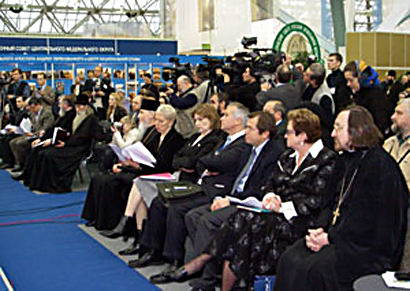
Festival of Orthodox media“Faith and Word”, which took place two years ago, was very crowded. This time the crowds decided not to arrange: the church press is not particularly stable (as, indeed, secular) - today there is a newspaper, and tomorrow is no longer, therefore, for the current forum, which took place from October 30 to November 2 under the motto “Freedom and responsibility. Christian values in modern Russia ”called only stable publications. “We did not strive for the quantity,” said Sergey Chapnin, the responsible secretary of the Church Herald newspaper, the official body of the Russian Orthodox Church and one of the festival organizers, “last time we had about 360 participants, now about 270, but the quality of journalists and interest is much higher, and the atmosphere is much more business and open.”
The forum really had a very working atmosphere. Two years ago, of course, they also did not lie, but then because of the abundance of people who wanted to speak for each had to 3-5 minutes, so many serious professional issues remained not talked. Now, the work took place mainly on seminars (with a total number of about 15: about the tasks of church journalism, trends in the Orthodox Internet, the features of illustration of the Orthodox publication, the possibilities of using the visual series for missionary purposes, etc.), there was plenty of time and place - the ancestral boarding house “Forest Dali” was given to the festival, therefore, they discussed the problems of interest to the problems with the very And with the arrangement.
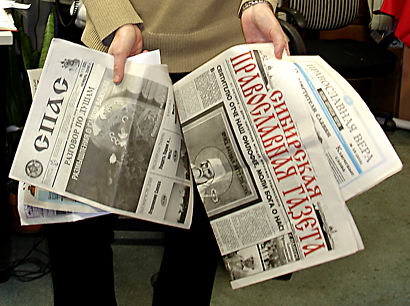
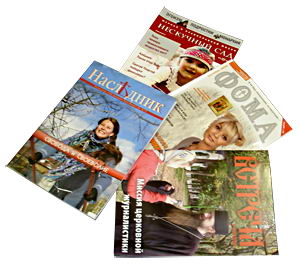
Judging by the samples of their products brought by the participants, the church press has significantly “grew up” over the past two years. Firstly, it has become more diverse substantially. There is no former fear to go beyond a narrow religious theme, new headings appeared, for example, “thoughts of contemporaries”, and not some great, but the most ordinary people who discuss, say, now the price of decency (Kaliningrad newspaper “Spas”), “memory of a friend” (“Siberian Orthodox newspaper”); In the "Nizhny Novgorod diocesan shoes" in the section "Martyrs and Confessors" regularly recall priests executed during the years of Stalin's repressions. Cultural sections, previously containing responses exclusively on Orthodox art, now do not shy away of a variety of works. For example, the Orthodox Vera Saratov newspaper prints excerpts from the discussion about modern literature, arranged by the library of the Saratov Social and Economic University, in which priests also took part. Among the books under discussion - “White on the Black” Ruben Gonzalez Galeo and “There, with the Babylonian rivers, Denis Gutsko. The Orthodox even had their own glamor, in any case, the Foma magazine drifts in this direction.
The design has also improved, although to a lesser extent. A completely color seal, if we still can’t afford, no one can afford, units use two or three colors, “Nizhny Novgorod diocesanies” make color the first and last pages and turn in the middle-well, they took the first place in the competition, which was dedicated to the festival (they have a large volume-16 lanes, and the circulation of 19 thousand, despite the fact that the majority have three-five-flip, the most, the most. They even have advertising!). Not all diocesan bishops are ready to “invest” in the church press, although newspapers are released alone, rarely twice a month and typographic expenses for them are small. In the Tambov region, for example, an independent church publication, a “bell ringing”, appeared only a few months ago, but absolutely all regional newspapers - about 25 - have an Orthodox application without fail. “Here they went to the missionary path,” said Priest Viktor Lisunin modestly, the head of the information and publishing department of the Tambov diocese, who managed to establish “fruitful cooperation” with the local government of the print media. In some newspapers, the priest, for example, in Michurinskaya Pravda, said, the weekly Orthodox application is so bright that it pulls the entire publication, which mainly consists of ads. “Cheap district newspapers are now the only means of communication that unites people in the regions,” Father Victor added.
Most dioceses, however, have their own newspapers, since the leaders of the patriarchy consider the press an important missionary tool. Even the salary of diocesan journalists grew up: if two years ago it was an average of one and a half to two thousand, now it is pulled by six. For the province, newspapers assured me, this is not so bad, in any case, a little different from salaries in other areas of activity. In his own
software reportMetropolitan of Kaluga and Borovsky Clement once again called on the diocesan authorities not to regret the church journalism of “big financial investments”.
Teachers working with an Orthodox theme feel much more vulnerable. In Volgograd, for example, on the RTR channel there was an independent Orthodox program that has now closed - there is no means. The diocese throws some kind of money so that stories telling about church life are presented in the news, but Inga Martynova searches for sponsors “on the side” for a new full-fledged program. “I fundamentally do not want to make a program at the expense of the diocese: any sponsor is a pressure. And I want to be independent, ”she says.
Free groups making Orthodox cinema and programs for television broadcasting are even more difficult. “We do not need a church or secular television,” said Prota, the head of the studio “Lybniki” (Dnepropetrovsk) studio with bitterness. Igor Sobko at the seminar “Orthodox community and civil society: problems and prospects for television dialogue”. -In the regions, it is possible to attach something, but the local television has what opportunities, and the central channels are not at all interested in us. We offer - look what we are doing, but no one wants to watch. ” Even on the Savior Savior, the Savior Savior, which appeared a little over a year ago.
We need specific steps from the church, perhaps the creation of a fund for the development of Orthodox journalism and studio work, for training. Such wishes were expressed by many. But if the personnel problem still cares the hierarchy, there are plans to introduce journalism in the seminaries (in Kaluga, for example, they have already introduced, however, as the listeners themselves, they teach there it doesn’t matter), conduct training seminars, the patriarch
He promisedTo think about encouraging the awards of the best publications and the journalists themselves, then the rest of the church leadership is not ready to take an additional burden. Perhaps the most frankly of his mindset was expressed by the diploma at the Moscow Theological Academy Dmitry Sredun, who represented the meeting “Meet”, which is published by students of MDA at the forum: “You work - and we will come for you.” And to a perplexed murmur, he dampedly answered: “You have a bustle, and there should be peace in the church. Our task is catechization. We baptized thousands of people, and they wander and steal. We will use you in catechization. ”
Another feature of the current forum caught my eye - apparently, all politicized publications were deliberately detained from it. There is no one among the diocesan media - there was one, the newspaper “Victory that defeated the world”, the organ of the Synodal Department for Interaction with the Armed Forces, but from the beginning of autumn it turned into a tab to the “Red Star” (also, by the way, an eloquent sign). However, there are newspapers and magazines of various Orthodox public organizations (such as Radonezh, Rus Sovereign, etc.), as a rule, politically engaged, at the last festival some of them were represented, and now - as cut off.
What is the matter? It seems, in the borderline of the moment and delight of the situation. The festival took place before the very day of popular unity, on the eve of the “Russian march”, about which until the last moment it was not clear, they would not be allowed - they will not be allowed. At first, Orthodox-patriotic public organizations were going to participate in the march (the closest to the Patriarchate is the Union of Orthodox citizens). The split of the nationalists began precisely with the fall of the Orthodox from them. Back on the 20th of October, both the moderate LNG, and the Fundamentalist Union of Orthodox Borevens, who until recently not hiding their chauvinistic views, left the organizing committee of the march. The official reason: the organizers joined the radical National Socialist “Slavic Union”, and the threat of provocations became inevitable. “To go in a column with Hitler’s fans and friends of the“ orange revolutionaries ”as their“ Orthodox decoration ”, thereby discrediting the true Russian nationalism, the imperial idea, as well as the Russian Orthodox Church, we do not consider it possible for ourselves,” it was said in a joint statement that “frightened”.
At the same time, obviously, they also decided the public Orthodox press, which does not directly subordinate to the patriarchy and broadcast a variety of beliefs, to prevent the festival. It’s away from sin: it was said that the church distance from the political struggle - so, make sure yourself.
Moreover, an attempt was clearly made to introduce the church as a conciliator and collector of folk forces. The festival was adjacent to the Fair "Orthodox Rus'", on which on November 2 took place
public hearings“Popular unity. Overcoming divisions of the twentieth century. " They were conceived as a free discussion of people of different views - politicians, public figures, leaders of different faiths, experts - about the nodal moments of Russian history. According to the organizer, the chairman of the department of external church relations of Metropolitan Kirill, the hearing should have contributed to the "building a single space of Russian culture." And the discussion was really alive and interesting, many visitors to the fair, who wandered at the meeting quite by accident, remained to sit to the end and then discussed something enthusiastically in the hall with the speakers. It’s a pity only - they arranged it late. When power, by no means in search of unity, but out of fear of complete irritation, has already shot down a nationalist wave. And the church, which hitherto silently, immediately built into the mainstream, once again demonstrating that it is not an independent social force.