
Translated material
Millions for Yekibondo daughters
Russian rich people are ready to overpay for the names of artists from childhood
In London, the traditional Russian week ended in the largest British auction houses "Sotbis" and "Christis". This tradition is not one decade. But this time, trading was struck by the imagination of the British: buyers, mainly from Russia, were ready not only to pay, but also to overpay in a large way. The New Times sorted out the motives of unheard of generosity 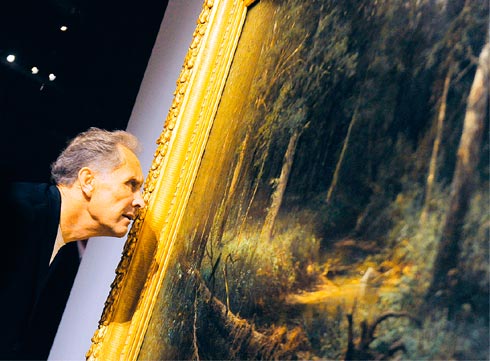
In May, the Sotbis, the Museum of the Moscow Historical Museum, took place. Visitor at the picture of Ivan Shishkin "Chernolesy"
In recent years, Russian auction has turned from a purely commercial event into large -scale events of cultural and social life. In addition, now two more auction houses participate in them - Bonams and McDugalls. By prestige and sophistication, London Russian weeks can be compared with the Parisian Russian seasons of Diaghilev’s ballet troupe at the beginning of the last century. And this happened thanks to wealthy buyers from Russia. During Russian trading on fashionable Bond Street and King Street, where Sotbis and Christis are located, Russian speech is heard much more often of English.
Aivazovsky from London for representatives of the Russian business elite has become fashionable to spend time in the British capital, where they, of course, are busy with purchases not only painting. Nevertheless, it is especially important for them to acquire a picture of Aivazovsky or Shishkin precisely in London, where, in their opinion, they are insured against deception and fakes.
* * In May 2007, Sotbis was the first of the leading auction houses to open the department in Moscow. A thing purchased in the British capital with a certificate from Sotbis or Christis acquires additional value, and there is a practical reason in this.
The international art market is practically not subject to inflation, it does not have a significant influence on it and the global economic crisis. Prices in this market are constantly growing: the fact that only 10 years ago cost hundreds of thousands of dollars is now worth millions. As the head of the Russian department of Sotbis Joanna Vikeri noted in a conversation with The New Times, “the things that we sold three years ago can cost two to three times more in today's market.” No securities know such a leap in increasing liquidity in such a short time. For Russian businessmen who make up 90% of painting buyers in the Russian week, the possibility of legal investment of huge sums in works of art, and even in crisis, has gained additional value: against the backdrop of a collapse of the value of shares and real estate, the Masterpieces of Repin and Levitan look like the most stable and stable international currency. Hence the unprecedented take-off of prices at Russian tenders and “crazy”, from the point of view of British art deilers, the amounts paid by Russian buyers. “Over the past five to six years, prices for works of Russian art have risen by an average of 60%, and in some market segments-doubled,” says Joanna Vikeri. According to her, the “Russian invasion” completely changed the atmosphere of auctions, turning them into violent and unpredictable battles between buyers with bottomless pockets. Over the past ten years, the turnover of Russian trading in Sotbis has increased 18 times, in Christis - 15 times. Otherwise, the profitability of the largest British auction houses largely depends on the Russian weeks that have become one of the main sources of their income.
Record, another record ...
| Hits of the Russian week: |
 |
| Yuri Annenkov. Portrait of Zinovy Grzhebin |
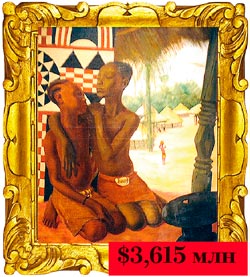 |
| Alexander Yakovlev. Titi and Naranghe, daughter of the leader Ekibondo |
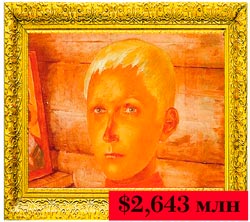 |
| Kuzma Petrov-Vodkin. Vasya |
The last Russian week, starting on June 7, showed: the economic crisis did not measure the artistic passions of wealthy Russians. On the contrary, they are with even greater zeal for capital -intensive and liquid goods. A flurry of world records collapsed on auctionists, collectors and art dealers. The first lot in Sotbis was a small impressionistic canvas of Sergei Vinogradov (1869–1938), the artist was by no means the first row: "View of Ai-Petri, Crimea." However, an acute struggle between eight Russian buyers immediately unfolded for him - those traded, regardless of either artistic value or with the real market value of the picture. As a result, her Estimaite is a preliminary assessment by experts - $ 154 thousand. It was blocked six times, and it left for $ 900 thousand. For Vinogradov’s work, this is a world auction record.
On the same day, at the evening auction at Sotbis, the preliminary catalog price of the exotic picture of Alexander Yakovlev “Titi and Naranghe, the daughter of the leader of Ekybondo” was almost three times. Yakovlev, of course, is a brilliant artist, but this is his study of 1926, created based on a trip to Africa, it is difficult to call the stage work of an outstanding master. However, it cost the Russian buyer $ 3.615 million (Estimaite $ 1.080 - 1.390 million). Another Russian posted at the Christis auction $ 2.643 million for the picture of Kuzma Petrov-Vodkin Vasya-the amount was six times higher than Estimaite and became a global price record for the work of this artist.
Such a huge discrepancy between the real market value of the thing and the money paid for it is inclined to attribute not only to the Russian merchant scope and the fairly “heated” of the art market. It is also said that this is also a way to legalize significant amounts of money that has left taxation. Only the price paid for Sotbis (again by the buyer from Russia) for the portrait of the publisher Zinovy Grzhebin Yuri Annenkov did not cause questions - $ 2.564 million. For the last 80 years the picture has been in the Grzhebin family, has not been exhibited since 1932 and has never appeared on the market. Its sale was accompanied by serious excitement among the auction hall of Russian business and financial bomonds.
Originally from the primer and yet: why do buyers from Russia seek to invest in London auctions in Russian art? And why do they most often prefer academic classics? At one time, the head of the Russian department "Christis" Alexis Tizengauzen presented the author of these lines with a rather harmonious theory. Its essence is as follows: the tastes of those who can afford to spend millions on painting in Russia are limited by their children's artistic experience. Illustrations in two books that they are most remembered for in life - “primer” and “native speech” play a paramount role here. That is why Repin, Shishkin, Savrasov, Aivazovsky, Levitan, Polenov, personifying the peak of picturesque art for them, beat world auction records.
Indeed, the main battles at Russian auctions in London unfold around these names. It is impossible to recall Russian auction in which there were no paintings by Aivazovsky and Shishkin, who repeatedly beat world auction records and became the personification of the average taste of the Russian nouveau riche.
Sotbis is one of the oldest auction houses in the world. Together with the Christie's auction house, it occupies about 90% of the global auction sales market of antiques, art objects, etc. It was founded on March 11, 1744 in London, the book -ghosts Samuel Baker and at first was a closed club. In 1977, Sotbis shares began to be sold by open subscription and quickly grew up in price. By the beginning of the 80s of the XX century, Sotbis almost went bankrupt due to the industrial crisis that had begun and in 1983 was sold to American entrepreneur Alfred Taubman, the owner of a large chain of stores in the United States. In 1998, Taubman brought Sotbis shares to the exchange. The presentation at the Sotbis of Old Russian Art has not yet gone beyond the limits of 1% of the total turnover of the company.