
Translated material
"Not a threat, but good"
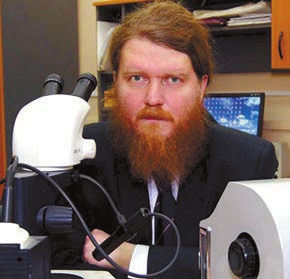 Our newspaper has repeatedly concerned the topic of introducing theology into the category of scientific disciplines in Russia and the topics of clericalization. At the end of 2015 , the concern of a number of scientists with these issues intensified, but there are those who believe that there are no big reasons for anxiety . The doct answered the TRV - science . Geol.- min. sciences, head. Department of Crystallography, Professor of St. Petersburg State University, Deacon of the Russian Orthodox Church of the Moscow Patriarchate Sergey Krivovichi .
- How do you feel about the emergence of aunts or departments of theology at Russian universities ?
- I think that this can only be welcomed - however, with a certain degree of caution. To welcome - because the level of dialogue between representatives of the natural sciences and theologists in Russia must be increased. Now it is at an unacceptably low level, which is explained by the position that religious organizations had, and in particular the Russian Orthodox Church, in the Soviet period, when "being determined consciousness."
In the West, unlike the USSR, believers, scientists could completely express their religious views (see my recent book “The Science of Believers or the Vera of Scientists: Twentieth Century” (M.: Algorithm, 2015)), and theology as a discipline found and finds its place in the leading world universities - there are theological schools in Harvard, Princeton and Oxforda and many other authoritative scientific and educational institutions.
Academic freedom and mutual respect between representatives of natural and exact sciences, on the one hand, and theology, on the other, are the key to social calm and balance. This is now very necessary for us, since, as you say, religion acquires an increasing weight in Russian society and this cannot be simply dismissed from this.
Now about caution: the creation of a faculty or department of theology in itself will not solve the problem. It is necessary to immediately set a high level of teaching and scientific research, which raises the question of personnel support of the relevant structures, and problems are possible with this. If there are no problems in religious organizations in religious organizations in religious organizations in religious organizations, for example, the level of teaching, say, in St. Tikhonovsk University), then in the field of natural sciences, in the field of natural sciences, in the field of natural sciences is not so simple. I think that the situation should be settled and calm down a bit.
By the way, at St. Petersburg State University, our native university, the creation of the Faculty of Theology is not forced precisely on the basis of reasons of reasonable caution. This is too serious. However, we have a scientific and theological center, which is headed by Archpriest Kirill (Kopeikin), candidate of theology and candidate of physical and mathematical sciences. His recent book is called “What is reality? Reflecting on the works of Erwin Schrödinger ”(St. Petersburg: Publishing House of St. Petersburg State University, 2014). Read it, and you will understand what modern scientific theology is.
- How do you relate to the inclusion of theology in the category of Vakov disciplines ?
“Just like the creation of theological departments, is carefully optimistic.” In general, theology as a science deals with issues that lie beyond the liability of other sciences. For example: why and why the universe exists? Why is the universe just so and no other? Why and why exists a person? What is the soul (consciousness) and is it immortal (it)? Data of natural sciences reinforce or deny the existence of God?
These are questions from the field of natural-scientific theology, and I would like to notice here that they do not have a bright confessional coloring, and therefore are behind the brackets of specific theological disciplines, for the teaching of which there are relevant educational institutions. And as far as I know, a certain transition period is provided in the process of awarding scientific degrees on theology. After all, tips must be formed, the selection of their members must undergo, the basic requirements should be formulated, etc. All this requires time and attention.
- How would you comment whether the inclusion of the chairman of the department of external church ties of Moscow Patriarchate , head . The Department of Theology in NIYAU MIFO Metropo Lita Volokolamsk Ilarion in the Council of the RGNF ?
- Metropolitan Hilarion is one of the most educated bishops of our church. He has a doctoral degree of Oxford University and numerous scientific works in the field of theology and patrology (teachings about the father of the Church). In addition, he has a bishopric dignity and serious weight in church structures, which allows him to make important and very responsible decisions. His participation in the Council of RGNF can only be welcomed.
- Is there , in your opinion , the threat of clericalization of the scientific and educational sphere in Russia ?
- It depends on what to understand by this. If the fact that education and science in our multinational and multi -confessional country will be controlled by “priests”, rabbis and mullah (the list can be continued), then no, there is no such threat. If this means that religious figures will be involved in the issues of moral education of children at the request and choice of parents, then yes, but this is not a threat, but good.
As Dostoevsky wrote, "... without faith in his soul and its immortality , the being of man is unnatural , unthinkable and unbearable . " And the fact that religious worldview does not interfere with the development of science and technology are proved by states such as the USA and Israel. In both countries, the vast majority of the population is religious (in Israel, religion generally has state status), and the fundamental and applied sciences flourish.
By the way, the idea of posthumous retribution and immortality of the soul for our country is very relevant. After all, if everyone who needs to be understood that they would not take anything stolen with them “there” and in the end they will eventually have to answer, then the device of our society and our life would be more interesting and much more fair.