
Translated material
This is not a court
In the opposition
 This is not a court
July 22, 2013 Elena Sannikova
If as many people would have come to the Moscow City Court in support of the “prisoners of May 6” as on July 18 in support of Alexei Navalny, then, perhaps, the prosecutors would have demanded the release of the defendants for a recognizance not to leave.
But obviously fewer people come there, and the execution of the Zamoskvoretsky District Court, entitled “The Judicial Court”, goes on as usual.
On June 17, the continuation of the interrogation of witnesses was expected - such an order was initially agreed by the prosecution with the defense. Suddenly, prosecutors filed a petition for the announcement of the whole volume from the case file, as well as a significant part of the materials from the next two volumes, which, as it turned out, contain a free retelling by the investigator of the videos attached to the case.
The defendants and lawyers clearly and intelligibly explained to the court that the request in all respects is ridiculous. Firstly, if you change the intended order of the judicial investigation and move on to video recordings, then first you need to watch the video itself. “How can a court explore the inspection protocols without seeing the initial evidence? The investigator first watched them, and then described them - why should the court act in the reverse order? " The lawyer Luvgant asked reasonably.
In addition, it turned out that these inspection protocols are presented in the case only in copies. “You cannot announce a copy of the protocols at the hearing without finding out where the originals themselves are,” said lawyer Makarov.
In addition, the video records attached to the case file as material evidence are also presented only in copies. Most of them do not indicate the time of shooting, there is no data on the origin of the records (who filmed, where and when), and the source is not indicated on the records copied from the Internet. “Digital copies, any specialist will say this, lose authenticity. It is impossible to prove that the record was not subjected to installation. These are copies of videos made incomprehensible as it is not clear in what order. They a priori are unacceptable evidence, ”said the lawyer Agranovsky.
Thus, copies of the protocols of inspection of dubious copies of videos were proposed in the courtroom, it is not clear when and by whom the mounted ones. Vladimir Akimenkov generally filed a request for the seizure of these materials from the case as unacceptable evidence. The judge willingly moved to the discussion of the petition of Akimenkov, and then refused with emphasized complacency, continuing the discussion of the petition of the prosecutors. “The protocols contain the subjective opinion of the investigator, and not objective evidence,” said Sergey Krivov.
Nikolai Caucasian noted that the video files in the case are mounted in such a way as to remove the illegal actions of the police from the field of view, and those that could not be removed are silent in the viewing protocols.
Dmitry Borko, defender of Alexandra Dukhanina, a professional operator and director, said that only the initial videos tied to a certain time can serve as an illustration of real events, and everything else is their free interpretation. Not to mention the fact that the images described by words do not contain the information that they give them view.
The discussion of the petition lasted about an hour. Judge Nikishin, without hiding the grin, carefully listened to the arguments of the defendants and their defenders, after which, with a triumphant look, without really justifying, satisfied the petition of the prosecutors.
The court session plunged into hibernation. Two young, well-fed prosecutors, alternating, in quiet voices, the texts of illiterate descriptions of some biased mounted videos froze in quiet voices. It was barely audible to the public: “Dukhanina throws an unidentified object towards the police officer ...”, “Rybachenko alone pushes the fences towards the police ...”, “Employees detain individual protesters ...”, “The chain holds citizens from the side of the small stone bridge ...”, “Citizens are breaking through and run away, employees delay the most aggressive citizens ...” ” “... the detention of the most violent citizens by police officers ...”, “... throws unidentified objects towards the stone bridge, after which it disappears ...”, “Caucasian makes the movement with his hand and foot towards the police officer ...”
According to what criteria the investigator Gurkin, the author of these protocols, determined the degree of “aggressiveness” of detained citizens, of course, is not indicated in the texts read, as well as what this “aggressive” or “violence” was manifested. And what, of course, immediately attracted attention - this is the mention of surnames. Even journalistic ethics does not allow the contents of the video recordings similar to the retelling of the contents, in such cases it is customary to say: “A person similar to such and such.” And here is still an investigative action. According to what criteria the investigator determined that there was a dudakhanin in the video, and there-Kovyazin, Krivov, Rybachenko, is not explained anywhere in the protocols.
“In the reader read, the investigator violates his powers, calling the surname and not proving that this person is in the video. This is a gross violation of the Code of Criminal Procedure, ”the lawyer of the clamp is making a remark.
“The investigator Gurkin has never carried out any investigative actions with Yaroslav Belousov,” said Agranovsky’s lawyer at the mention of his client.
Sergei Krivov states that Gurkin never saw his surname in the protocol, and asks to invite this investigator to the courtroom. The judge deprives him of the word. Later, after repeated remarks of lawyers, Krivov proposed to replace all surnames in the protocols with the name of the investigator. Being a moment of aim, the hall again plunged into the hibernation under the monotonous bubbling of the prosecutor.
Note that all this is happening in the Moscow City Court: a lady without a diction reads such protocols that there is doubt whether the investigator who wrote them gradually graduated - so illiterate and absurd, sometimes and comical, they are compiled. And the hall is in a half asleep prostration, because listening to this tambourine is pointless and unbearable.
All this lasted until the end of the working day on July 17 and lasted July 18, thus occupying two full days of the trial. At the next meeting, scheduled for July 23, it is planned to view the unknown of the mounted video files.
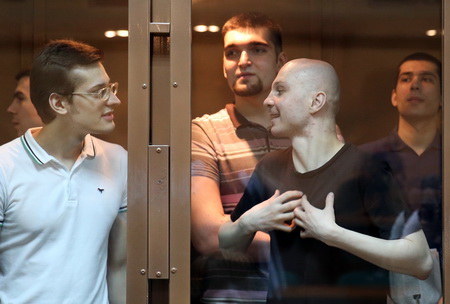
Meanwhile, the conditions of the content of the defendants remain torture. They are lifted early in the morning and taken to the Moscow City Court in stuffy car carriers, and there they are kept in dirty, dark and cramped basements for long hours. The defendants are already noticeably tired in the courtroom. They are also forced to be in the cramped and stuffiness of this ridiculous crypt, not even having to straighten up, because for some reason, benches for the defendants in this hall were without backs. Due to the dense walls, the defendant is poorly heard what is happening in the hall. They are brought to prison sometimes after 12 in the morning, so they are not able not to prepare for the next court hearing, but simply to sleep. It is impossible to eat dry rations that are given to them in prison, cereals and soups are not boiled, the defendants are deprived of hot food these days. Vladimir Akimenkov reported that he sees nothing from the Aquarium. He was recently transferred to a Butyrka, which is unsuitable, as many believe, for the maintenance of the defendants. For two weeks he has not been able to wash, the sanitary-hygienic set has not been given to him.
Judge Nikishin, as usual, stated that "the conditions of detention are not related to the subject of this trial."
Sergei Krivov at the beginning of the meeting on July 17 repeatedly tried to file a petition that he was not allowed to submit, as he explains, from July 10. Judge Nikishin did not allow him to declare anything either at the beginning of this meeting or at the end, and refused him such an opportunity and the next day, July 18.
The answer to the question of why the prosecutors, and then Judge Nikishin so sharply deviated from the intended plan and moved from the interrogation of witnesses to video recordings, suggests itself, in my opinion, by itself. The interrogation of Colonel Deanichenko, who lasted several days and ended on July 16, forced, apparently, a side of the prosecution to be wary. At the end of the interrogation, Judge Nikishin shot almost all the issues of the defendants and the parties to the defense to the colonel as allegedly not related to business, even though they were just directly related to the case. It was just that at some point it was impossible to understand who the defendants are here and who witnesses, who are lawyers, and who prosecutors. The crime of Colonel Deanichenko and his colleagues, who ordered to block the turn from the Small Stone Bridge to Bolotnaya Square (contrary to the plan agreed with the organizers and a day earlier than the internal instruction announced in the courtroom), became so obvious that the inaction of the judge Nikishina, which, according to logic, should deduct a private definition in relation to Dinichenko, by itself He is an offense.
So while Judge Nikishin and her colleagues-prosecutors come to themselves after this interrogation, being distracted by an incomprehensible mounted copies of the videos, the interrogation of witnesses is suspended. And one thing remains clear: what is happening today in the premises of the Moscow City Court on the process of Zamoskvoretsky district court in the “case 12” or the so-called “swamp case”, has nothing to do with justice. This can be called reprisal, an execution, an awesome action, torture, mockery of hostages - but not by a court.
In the photo: Russia. Moscow. July 16. Yaroslav Belousov and Vladimir Akimenkov (from left to right in the foreground), accused in the case of riots on Bolotnaya Square on May 6, in the hall of meetings of the Moscow City Court.
Photo by ITAR-TASS/ Sergey Fadeichev