
Translated material
The wisdom of the "great inquisitor"
In society
 The wisdom of the "great inquisitor"
February 12, 2014 Victor Khrul
A year ago, on February 11, 2013, the unexpected decision of the Pope Benedict XVI resigned the world and brought the Catholic Church to a state of confusion, since the last precedent of this kind happened in history six centuries ago.
Some experts then called this step “fleeing from power” and the recognition of helplessness in the face of crises inside the Catholic Church. Jakomo Galeazzi and Andrea Tornielly, Vatican Insider portal observers, reminded the list of reproaches that sounded to Benedict XVI in February last year: the inability to control the church and reform it, withstand the “lobby” of the cardinals, maintain confidentiality of information (especially in the context of the Vatileaks scandal Personal valet Pontica transmitted information to reporters).
“Twelve months later, the pope’s gesture is seen as a manifestation of his greatness and humility,” said Galeazzi and Torniel. They emphasize that the changes in the Church, reorganization of the units of the Roman curia, the desire to put it in the service of local churches, the revision of the principles of activity and the personnel changes in the ostricum of religious affairs (better known as the Vatican Bank) again returned to Catholics enthusiasm, since they see the desire of Papa Francis to “abandon the logic of power”.
Experts are that the fruits of the resignation of Benedict XVI for the Catholic Church were benign: his successor decisively and consistently conducts reforms, the image of the Catholic Church in public space improved, confidence in it - according to representatives of the representative sociological surveys in different countries - has increased significantly, and the popularity of the new successor of St. Peter returned to the record records of the times John Paul II (more than 11 million users have signed on the Francis’s blog in the Twitter service).
Until the election of Cardinal Joseph Ratzinger to the Papal throne in 2005, he could easily be met next to St. Peter's Square, when he walked in a modest Black Sutan from home nearby to serve in the congregation of creed. Meanwhile, the appearance of a smiling and modest person, a large connoisseur of the piano game and a lover of cats sharply contrasts with the image of the tough and irreconcilable “great inquisitor”, “Cardinal Kardilnal”, which tirelessly created the media when the radregular led the influential creed-the heir to the Inquisition. The image was gradually dispelled with each new peacekeeping initiative of Benedict XVI, after being elected to the Apostolic throne - by steps of reconciliation with traditionalists, excommunicated from the Catholic Church, the creation of structures for Anglican Catholic, sincere apology of a person crushed by the news about pedophile scandals among the priests, methods of intelligent "soft power" in solving various problems.
The time of Benedict XVI was a time of transparency unprecedented for the Vatican during obviously crisis situations that could only be found out about in private conversations with insiders: the reform of the financial system, an open investigation and a trial over the former valet, Paolo Gabriela. Speaking about dialogue - with other people, communities, churches, states - Benedict XVI from the very beginning of its pontificate emphasized that this dialogue should be "in love and truth." The course on transparency is fully supported by Pope Francis - this is evident to continue the renewal of the Bank of the Vatican, which took unprecedented measures to prevent "laundering of money."
The Russian vector of Pontificate Benedict XVI-not as pronounced in the public sphere as that of its predecessor-turned out to be constructive and effective: the level of diplomatic relations of the Holy See and the Russian Federation in December 2009 was increased from representative offices to full-fledged embassies, Orthodox and Catholic relations in Russia also-according to Patriarch Kirill-improved.
The theological heritage of the Pontificate of Benedict XVI contains three deep and convincing encycliki: Deus Caritas Est (“God is Love”, 2005), Spe Salvi (“Saved by Nadezhda”, 2007), Caritas in Verite (“Mercury in Truth”, 2009), which are translated into many languages of the world. The fourth encyclical Lumen Fidei (“Light of the Faith”), in the creation of which Mozart theology played a significant role (so often called the Nemza), was already signed by Pope Francis on June 29, 2013 and published on July 5, 2013. All these texts can be read in Russian.
At the same time, Benedict XVI was not popular in the media and did not have much public success. According to journalists themselves, in this regard, charisma is much more noticeable both in his predecessor John Paul II and his successor Francis. Benedict XVI has never become a Person of the Year, which Francis was awarded in the first year of his pontificate (in particular, according to Time magazine).
Despite this, experts resemble, for seven years, ten months and nine days of Benedict XVI, the time of honest and uncompromising protection of Catholic teaching, and regardless of how it was perceived in the liberal public sphere - from the extremely unpopular statement that condoms are morally unacceptable as a means of combating AIDS, which caused a " The resonance of "zero tolerance" to the sexual abuse of the clergy and the radical demand to report such crimes to civil authorities. Just these vectors of Pontificate Benedict XVI are developing his successor on the papal throne of Francis.
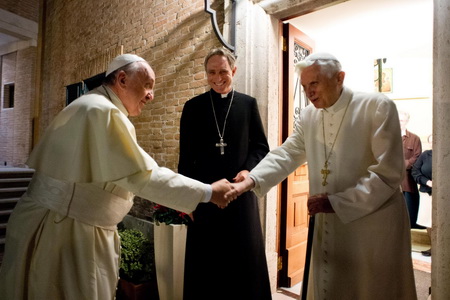
The meetings of the current and past of the PAPs (Francis, without having moved to the Apostolic Palace, lives in the Holy Martha’s house, which is often called the “Vatican hotel”, and Benedict XVI in a small house in the Vatican gardens) always arouse great interest among journalists. However, their heart atmosphere does not give a chance to find at least the slightest hint of the lack of succession in the leadership of the Catholic Church and emphasizes the wisdom of an honest and courageous decision, which was made exactly a year ago by Benedict XVI.