
Translated material
White as a canvas
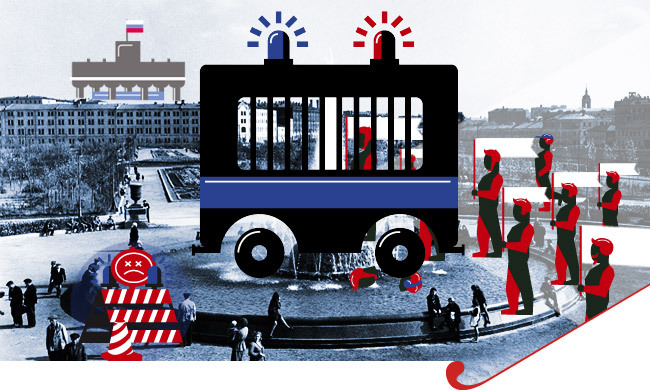
The “swamp business”, as it is accepted now, has split society in half.
After the first arrests, there was talk about what they took - the provocateurs who came to our rally with their pieces of asphalt in the rear pockets and let them sit where they are sitting. But I clearly remember how the events developed that day: when the columns were stuck on a small stone bridge, since the dual chains of riot police were created in front of the area of the bottleneck, Udaltsov and Navalny announced the beginning of the seated strike near the Drummer cinema. Some of the people who stuck on the bridge turned and went to them. It turns out that these fourteen people stood with everyone on the same bridge, and then went to the “drummer”.
Then they “knew”, “screwed” and fought with riot police - in general, like many.
Therefore, the statements were a great surprise that these people were “sent Cossacks”, they say, so some of them were put on masks and now everyone who comes to the miting of a mask, we will catch from the crowd with our own hands. And Ilya Yashin directly stated that the provocateurs in masks "interacted with those police officers who organized acceleration."
A measure of restraint was elected to the Basmanny Court, where they chose a preventive measure, and then it was extended until November, no one went for a month except journalists. In the courtyard of the Basmanny court there were no people with posters, they did not shout “shame!”, And in the Moscow City Court, where quickly, in fifteen minutes, they examined cassation complaints about arrest, and cameras with cameras did not crowded.
And if someone had a desire to come to court, then it was supposed to quickly disappear after the recent transfer of Sergei Parkhomenko “essence of the events”. In it, Parkhomenko said in direct text that there were people specially introduced into the crowd on the square and that "some of the arrested under pressure showed an testimony of Alexei Navalny, pointing to him as the organizer of the riots."
In the spring of the protest movement, many of us seemed to be a park of entertainment with a variety of attractions - there is a trip to the car carrier, there is songs to the guitar in the park, and here is a walk with writers.
The case would have acquired a completely tragic turn, since the word “provocateurs” threatened to replace the word “traitors”, but then Alexei Navalny himself finally wrote a post that these fourteen detainees were real political prisoners and they needed support, and of course, they immediately began to be supported massively.
Such a split and stressful expectation of a “signal from above” were impossible in December, when people in masks and without masks, anarchists, nationalists and people with white ribbons united to fight the common enemy.
Then it seemed that everything was at the same time, and anyone who was at least once detained at the rally was declared in advance political prisoners.
If fourteen people were arrested in December, then we would have carried banners with their portraits all of January and February and distributed leaflets in their protection.
But we were silent for a month, and at the last rally on June 12 there was, in my opinion, not a single slogan in support of the “people with Bolotnaya”.
I think I know why.
Until May, the protest movement many of us seemed to be a park of entertainment with a variety of attractions - there is a trip to the car carrier, there is songs to the guitar in the park, and here is a walk with writers.
But immediately after Putin became the president “Disagreed, on purpose”, the authorities began to quickly tighten the nuts, hoping that representatives of completely different layers of society would understand that any rally, albeit consistent, threatens with fair -haired troubles. The houses of activists went with searches, fines for participating in street actions took off to heaven. In some universities, they began to collect lists of politically active students: supposedly "prepared for deduction."
According to one of my friends, the frequent visits of the police “angry townspeople” were not ready. In the end, we are not “other Russians”, not lemons, not anarchists, we are normal, so why do they go to us? None of us were aware that the authorities, in general, do not care who to press.
Against this alarming background, any direct participation in the fate of the fourteen "pogromers" of Bolotnaya Square has become uncomfortable, unpleasant and even dangerous for many. It is known that one of the witnesses who promised to testify in favor of the illegality of Denis Lutkevich’s detention did not come for interrogation.
And one of the accused of unrest in Bolotnaya Square, Fedor Bakhov, before my eyes promised the judge “never to go to any rally again”, hoping that he would be forgiven and let go on bail.
People are afraid, hide, move, and even those who are not particularly noticed in anything reprehensible, write posts on social networks, calling for a quick departure from this country, which cannot be called normal. Two political activists - the “other Russia” Dolmatov and the member of the “Solidarity” movement of Rybachenko - have already been asked for political asylum in Europe, and this seems to be only the beginning.
The other day, I received a letter from the deaf -mute journalist, with whom I made an interview for the harmless reports about the inner life of the facial and gesture theater in Moscow. She wrote: "Please remove my last name from the text."
And when I asked her what such a decision was dictated, she sent me an answer, consisting of exactly one line: "The time is restless now: repression, arrests, searches."
I walk around Moscow, past the high -rise on barricade, towards Pokrovka. Once upon a time, in a past life, the parks were “occupied” here, leaflets were distributed, assemblies gathered with a living microphone.
Now - emptiness.
People with white ribbons left the boulevards, and reach the nearest rally, which was scheduled for the next century, namely for October, is not possible. I personally know several people who, after preventive conversations, decided to tie with protests - well, it is more expensive for ourselves, we have Belarus without five minutes. Fear, as you know, paralyzes the will.
After single pickets near the State Duma against the Law on the slander, threatening, by someone's apt definition, “covering the mouth of the whole press”, sitting with colleagues in a cafe, discussing recent events. The main question is - did the authorities be touched, and if so, at what point? Three believe that yes - after a rally in Bolotnaya Square. One is sure that this happened earlier-somewhere between January and April, between the second “Million march” and a protest camp on pure ponds.
But now, it seems to me, it is very important to understand how we pissed.