
Translated material
Wikileaks Adventures in Russia
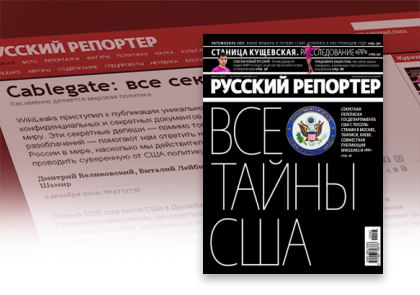 While the leading world media - Guardian, El Pais, Spiegel, The New York Times - published deep analytical articles based on WikiLeaks, the Wikileaks partner, the Russian reporter magazine, unpleasantly struck the series of articles consisting of direct lies and propaganda cliches.
So, in the very first article, “RR” stated that on the basis of “reading reports of American ambassadors in Georgia” “no one in the world had the illusions that Saakashvili had begun war.”
This is a strange statement, for the reports followed exactly the opposite. Andrei Illarionov even suggested that we are dealing with the new campaign for misinformation: not having the opportunity to refute American dispatches, the Russian special services are trying to reduce the damage, distorting their content.
Meanwhile, this was not the only amazing statement in the article. It also reported that the sources of the American ambassador in Moscow were "experts, slandering the ruling regime from year to year."
The article also tells how "before the performance of President Iran Ahmadinejad at the UN General Summarian, the State Department sent directive to all European countries, indicating them when their representatives should leave the hall." At the same time, the Swedish ambassador had to leave the hall on the word “Holocaust”, but Ahmadinejad did not utter the word. “Representatives of other countries came out, and the Swede remained in the hall, sending anxiety signals and asking his American mentor - what to do?” This story seems to be so impressed by the authors of the article that they were not too lazy to retell her word to word again - in the room from Dec 2. 2010.
The small problem is that there is nothing like that in telegrams. There is only a telegram of July 31, 2009, in which the American ambassador in Iran says that the EU countries decided to send the most insignificant embassy workers to the inauguration of Akhmadinejad so as not to close the window of opportunities, but agreed to leave if he begins to talk about the Holocaust. That is, as in a joke: “Not in preference, but in a point. And he did not win, but lost. "
What's happened? Why is the Russian public forced to judge American diplomacy not by documents in the Russian Reporter, but by Guardian and The New York Times?
The answer is contained in the name of one of the authors of the articles of the “Russian reporter”: Israel Shamir. This person is a representative of Assange in Russia and writes about himself in the third person: “The head and founder of WikiLeaks Assange is now in the north of Europe. Next to him is the journalist Israel Shamir, thanks to his work, the Russian Reporter receives preliminary materials before they become public. ”
Israel Shamir is a person who denies the Holocaust, calls Academician Sakharov a “harmful Zionist agent” and in his articles discusses the conditions under what the Jews sacrificed children. Another famous statement by Shamir is that before September 11, many Jews were warned by SMS. However, from the point of view of Israel Shamir, he is not anti -Semite, because there is no anti -Semitism in the world at all. Anti -Semitism exists only in the inflamed imagination of Jews. There is only a reaction to the actions of the Jews themselves. From cooperation with Shamir, due to the fee of being suspected in Nazism, even many missiles refuse.
Israel Shamir proposed cooperation not only to the “Russian reporter”, but also to other Russian publications. One of them was Kommersant. Given the reputation of Israel Shamir, it is clear that Kommersant did not risk the fact that on his pages there would be a retelling of the content of documents, which no one had seen before Israel Shamir.
According to the source from Kommersant, with Shamir they "did not reach the discussion of the fee." Other sources claim that Shamir asked for 10 thousand dollars. For access to those information that Brawli Manning passed to Julian Assange the gift.
That is why at the moment when all the leading newspapers of the world published a sorted and translated, if necessary, the archive, accompanied by deep analytical articles, the “Russian reporter” published a material that mildly can be characterized as the vague impressions of the odious newcomer about documents that he did not seem to be able to read properly.