
Translated material
Circles on the water
Almaty-Malovodnoy-Kazak-Almaty-two years later
Sanat Urnaliev, Lukpan Akhmedyarov especially for "Dosh"
Two years ago, on March 18, 2007, in the villages of Malovodnoye and the Cossack under Almaty there were pogroms of Chechens. Five people were killed: three Makhmakhanov brothers, as well as Sadykov and Bugutov, participants in the attack on the house of this Chechen family. The incident was a shock for Kazakhstani society and a challenge for the current President Nazarbayev. Interethnic consent has always been the most weighty argument of the regime in the political polemic about the legal capacity of the aging president. What changed in Kazakhstani society two years after those dramatic events? How much has the life of people in whose eyes all this happened? We tried to find answers to these questions by visiting the scene in February this year.
Market day
The village of Malovodnoye, the Enbekshikapsakh district, cannot be called a depth. Less than an hour from Almaty - the former capital of Kazakhstan, and now we are near the market in the center of the village. The bazaar in the low water is a place where you can find out the latest news. On March 18, 2007, Dashma Baitieva, trading in her store in the bazaar, heard that near the building of the rural administration, a large crowd of men gathered and some showdowns seem to be brewing. She did not attach the values of this news. In the morning, her attention was more occupied by another issue - how soon the court of the prime minister will pass through the village. On this occasion, the police ordered the merchants to close their shops in the market until the motorcade passes. A few hours later, Dashma heard that some mass fight occurred in the neighboring village of Kazat. An hour later, the participants of this fight, the same men who drove around the rural administration building in the morning, arrived at the market, and Dashma saw them firsthand. - Cars began to drive up to the bazaar. A lot of cars. Men began to come out of there. They were excited and shouted something. Suddenly shots were heard, and I saw a man who stood by the road and shot from a gun into the air. Young guys ran to my kiosk and began to beat the glass with sticks. They wanted to break the glass in the next kiosk, but someone stopped them, shouting: “Do not touch that store! He is not Chechen. " Then I finally heard that these men shouted: “Chechens, get out of Kazakhstan!”, “We will kill you!” and so on. They began to rob Chechen kiosks and shelves. I took cigarettes, beer, everything that came to hand. At vegetables, cabbage, vegetables, fruits were carried with bags. I did not understand anything. I tried to fight with these raiders, but almost immediately they took me to the depths of the store. It lasted about half an hour. Then everyone sat down on the cars and left. I did not recognize anyone. These were all the guys not from our village, ”Dashma recalls.
Adult surprise
The chronology of that day and all subsequent more or less accurately restored, they did both during the investigation and in trial. In the afternoon, a crowd of 200-300 men arrived in cars in the village of Kazatkom (8 kilometers from the low water), accompanied by police officers and burst into the courtyard of local residents, the Chechens of the Makhmakhanovs. The result of this pogrom was a burned house and five murders: three Makhmakhanov brothers, Hadzhimurat, Zazhmutdin and Amir were scored to death and two of the attackers were shot. On the same day, several more houses of ethnic Chechens in a low water was subjected to attacks. The next two days the crowd arranged riots in the low -water and demanded that the authorities give them the rest of the Makhmakhanov family. The incident was a complete surprise for both local Kazakhs and Chechens. - I can't say anything bad about the Kazakhs. Life in the village and in the district was normal. I do not remember that there were some friction or claims to each other between the Kazakhs and the Chechens, ”says Dashma. - And now, after those events, something has changed? - we ask. - Yes ... now a lot is different. It’s not as before ... I don’t even know how to express it in words - it is clear that Dashma is difficult to answer. To understand what has changed in the life of this village, you need to be a local person. It is very difficult to catch these changes to the visiting. It seems to be still everything: Dashma also sells on the local market, and Kazakhs conduct their trading next to her store. They greet, make fun of each other, as before. As before, in the courtyard of a local school, boys frolic - local children from Chechen, Kazakh, Kurdish and Turkish families. But something has changed ...
Living and dead
The bloody events of March 2007 introduced their amendments into the measured life of these people. The most striking changes occurred in two families - the Chechens of the Makhmakhanovs and the Kazakhs of the Sadykov.
The Makhmakhanovs left the Casatcom forever, and the family, like a impulsive March wind, dispelled around the world. The father of the family - the elderly Elsa - is alone while spent the days in the low water. His wife, along with the son of Sado in Almaty.
- Father does not want to leave far from the house where he lived all his life. And mom after those events does not even want to hear about Kazatkom. It was used to gather the whole family for the weekend in a parental house in Kazatkom. And now ... who to gather? Hadzhimurata, Nazhmutdin and Amir are not alive. Dad in Malovodnaya, mom in Almaty. Would gather, where? - says Sado Makhmakhanov.
The garden, huge, like a fairy -tale knight, when he talks about it, as if cringing, becomes lower. He shows us photos of his killed brothers. Small, 3 to 4, these photos of the garden turning with its thumbs so carefully, as if it is afraid to damage them.
- I often look at them. It is still difficult to breathe when I think that they are no longer there. What did they do this? Why were they killed? - asks Sado.
Kulgaysha Sadykova, the mother of the murdered 30-year-old Sabit Sadykov, like Sado, examines a photo of her son, who is no longer there for a long time. A large portrait is the only photograph of adult Sabit. On others, he is captured by the child. Here he is with his mother and with a cousin Azamat. Boys are 6-8 years old, they are on the knees of a young woman under the canopy of sprawling wood. As in the house of Elsa Makhmakhanov, in the Kulgayshi house is also uncomfortable and gloomy. But unlike the old man, this woman-Cossack is unshakable in her faith that her son died for national honor.
- Events in the low -water and Kazatom caused a wide resonance in the country. There were rallies, the people went out into the streets, my son died. It will not be a mistake if I say that all Kazakhstanis participated in this event. These are events that have affected the national spirit of the people. I personally did not have and there is no reason and desire for inciting interethnic growth between Chechens and Kazakhs. But our national dignity is hurt, which entailed this event. The people will not rise just like that. Until now, the people are offended: why did the state have not brought to just anyone by the Chechens? - says Kulgaysha.
The teacher by education, Kulgaisha even composed poems about this. They also have a lot about prudent pride and righteous popular anger. She stores these poems and newspaper clippings with publications about events in the low -water in a separate folder. He sincerely believes that someday her son will be immortalized, and then this folder will gain particular value.
Astana's widely closed eyes 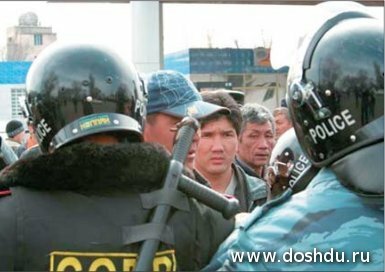 The perception of the Chechen pogroms as manifestations of popular anger - here it is, the main change in the low water after March 18, 2007. There is nothing surprising in this, if you recall what official assessment was given to those events by the authorities of Kazakhstan in the early days, according to the fresh traces of what happened.
Shamil Makhmakhanov, just as Kulgaysha Sadykova carefully monitors all publications on this topic.
- I still can’t understand where Serik Abdrakhmanov (then the deputy of the Parliament of Kazakhstan - ed.) I could take that our family, as he said, did not give life to the locals. We always had a good relationship with our neighbors. And most of our friends are Kazakhs. In those days, I wanted to ask Abdrakhmanov: “Show me at least one Kazakh whom we would offend!” - says Shamil.
In the first days after the tragedy, the official Astana in relation to the incident reduced its position to emotional rhetoric. Serik Abdramanov, elected to the parliament in the district, which includes the village of Malovodnoy, came to pacify the riots, which he preferred to call a "spontaneous rally."
- Everyone knows that the Makhmakhanovs lived, not like everyone else. Everything happened due to the fact that some Chechens began to feel too free, ”the deputy said then to reporters, commenting on the bloodshed in the Kazatcom.
Following the deputy in the same spirit, the country's president Nursultan Nazarbayev spoke out:
- I will not allow anyone to rock the boat of interethnic consent ... Apparently, someone forgot that Kazakhstan at one time sheltered, fed and heated these people (this refers to the deportation of the Chechen people in February 1944, - approx.
As you can see, at that time the authorities absolutely did not want to give a legal assessment of what happened. It is not surprising that in the village, where they did not know before, they did not know what interethnic discord is, today the nationalist intonation in the memoirs of eyewitnesses of the tragedy is more and more clearly felt.
But even those who are tuned against the Chechens today are abandoned about how insolvent accusations were abandoned against the Makhmakhanov family.
- Well, how to characterize them? The older children of the Makhmakhanovs never touched anyone. In vain to slander someone is not worth it. Three dead brothers simply fell under Schumovka. And so they are all decent, ”says Tamara Sadykova, the mother of Azamat Sadykov, one of the convicts in the case of the murder of the Makhmakhanov brothers. Tamara just like Kulgaisha is inclined
Idealize the act of your son. Last year, her son was sentenced to 12 years of strict regime.
- I do not condemn the guys. The Kazakhs went there for the sake of national honor. And I can’t condemn the rest, they say, my son sat down, and others are free. All of them together went for national honor, ”she repeats after Kulgayshoi.
Today, many in Malovodnaya note that the participation of Chechens in the public life of the village has decreased significantly.
- The Chechens are now at all, at all. They don’t even go out into the street. I don’t know for sure, but they say that several Chechen families moved. When I meet on the street with the Chechens, I feel great heaviness on my heart. Honestly, I don’t even want to look at them, ”says Tamara Sadykova.
- Yes, we really closed. We try not to go out into the street. But so it cannot continue forever. Many of us were born and grew up in Kazakhstan. For example, I have never been in Chechnya in my life. I don't pull me there. Here is my homeland, and it is not clear to me why I seem to be not my own here, ”says Dashma.
The depth of the low -water
About how much the life of the Chechens in the low -water changed, Razhaudi Guchiev, an ethnic Chechen, born and grew up in Kazakhstan, tells more thoroughly. We met him in the house of Elsa Makhmakhanov. Razhauda periodically comes to visit the old man, talk about the latest news. According to him, after the March pogroms, he increasingly began to hear nationalist replicas from his villagers-Kazakhs.
- On the bus, in the store, you hear: "You eat our bread, you live here." There are people with nationalism. They think that by accusing some one nationality, people, you can solve the problems of all Kazakhs. At one time, 21 nations were evicted to Kazakhstan. They built on a par with the Kazakhs, plowed, grazed cattle. The same Makhmakhanovs have been engaged in the hardest labor - cattle breeding all their lives. Well, if there were no Makhmakhanovs, local Kazakhs would live better? Richer? But more and more often we are made to understand that we are strangers on this earth. And this trend goes on increasing, ”says Razhaudi.
According to Razhaudi, the case in the low -water is only a particular, which shows how the situation has changed in all of Kazakhstan.
- The low -water is not the first case. And not the only one. There were even earlier clashes in some villages: in Chilik with Uyghurs, in Mayatas with the Kurds, the massive beating of Turkish workers in Atyrau. In Kazakhstan, inciting interethnic growth is a criminal offense. This is what the law says. But there was not a single case yet to be punished for this. This does not mean that there is no nationalism in Kazakhstan. The reason is that the authorities do not want to recognize the obvious. Look - 200-300 people arrange pogroms for several days, burn houses, rob shops, kill three people. And only three are planted, and none of them are condemned for inciting ethnic hatred. I don’t know why this is being done, but I know exactly what it will lead to. People suffering from nationalism, on this example, see that the law distinguishes people by a national basis. For one nationality, there is a law, but for another, no. After all, the law should work regardless of nationality. It turns out that, silenting the problem, we do not solve it, we aggravate it, ”Razhaudi believes.
Last year, the court ended on the attack on the house of the Makhmakhanov family. Three participants in the pogroms were sentenced to long terms of imprisonment. People were convicted of murder, destruction of other people's property and under other articles of the Criminal Code. Thus, the authorities decided that it was possible to put a fat point in this matter. The position of the official Astana is unequivocal - in the low -water, however, just like in Chilik, Mayatas and Atyrau, there was no facts of inciting interethnic growth! Instead of an epilogue in all of a low water there is only one person who believes that nothing has changed in the relationship between Kazakhs and Chechens. This is the head of the Makhmakhanov family, 78-year-old Elsa. In the distant 1944, he was deported to Kazakhstan by the will of the “father of the peoples” of Stalin. Then he was 13 years old. He grew up on this earth, worked a lot, married and got the largest family in the district. Over the years, the memory of the distant Chechnya disappeared, and children's memories have completely faded. Children grew up, grandchildren appeared. He considers this land to be his homeland. When we arrived at the Malovodnoye, Elsa Makhmakhanov insisted on going with us in the Cossack. “I will introduce you to my Kazakh friends, the same old people like me.” All our lives we lived side by side. They will tell you about my family, about me. You ask them - who is Elsa Makhma -Khanov? Do they have resentment against me, my family? They will definitely tell you how we lived together, ”the old man repeated on the way to his native village. In the Kazatom, Elsa showed us the house of his old neighbor. - Here come here. My friend lives there. Tell him that Elsa came. Do you know how he cried when we left? Let it come out, we will say hello, - Elsa admonished. Aksakal came out of the house, with impudent eyes he looked at us for some time in bewilderment. - Assalam Maleikum!. - Wilecum Salam, son! Who are you looking for? Aksakal asked. - Father, your name is Bisatai? - Yes, it's me. How can I help? - wrinkles on the old man's face were smoothed out by a smile. - Bisatai -aga, we wanted to talk with you about the former neighbors - the Makhmakhanovs. There is outside the gate in the car of Elsa Makhmakhanov. He also wanted to say hello to you ... The old man's face instantly became gloomy, alienated. There was no trace of a smile. - I don't know that. He has not been living with us for a long time. And not at all anxious! - the old man hastily slammed the door in front of me. I returned to the car. Elsa Makhmakhanov asked: - Well, what did he say? Will he go out into the street? I had to lie: - Uncle Elsa, your friend is not at home. They say that he left for the city. It will not return soon.