
Translated material
Nikolay Dyatlov: Light bulbs of the future

Nikolai Dyatlov 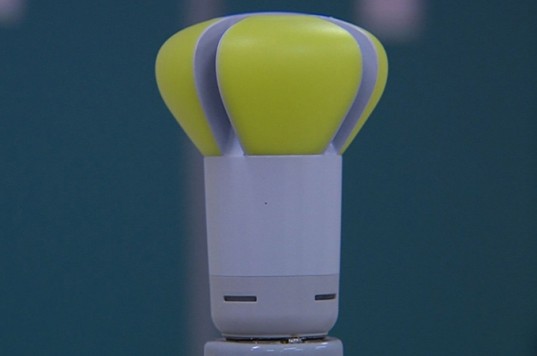 Award Winning Led Bulb. Photo with inhabitat.com
 Award Winning Led Bulb. Photo with inhabitat.com
The Earth Day has been held on April 22 since 1970 and is designed to remind people of the importance of respect for nature. It was on this day in 2012 that Philips launched its new LED light bulb to the market, which is designed to replace ordinary incandescent bulbs and fluorescent lamps. True, she has one drawback: she costs $ 60.
The new light bulb is called quite ingenuously: Award Winning Led Bulb, that is, "the LED light bulb" received the reward, "but there is a base. In 2008, the US Department of Energy announced the contest L Prose, or Bright Tomorrow Lighting Prize, the purpose of which is to stimulate the development of a highly effective lamp, which will replace a 60-watt incandescent lamp. The organizers set rather strict conditions: a new light should have a light downtime of at least 90 lm/W, at least 900 lm brightness, color temperature 2700-3000 K (that is, like a regular incandescent lamp 60-100 W), color rendering coefficient of more than 90 (that is, very good color renders), consume no more The cartridge and, among other things, should have a life cycle of at least 25 thousand hours.
The last parameter is especially important: many lamp manufacturers deliberately overstate the maximum service life of their bulbs, but it is usually impossible to refute this data: for this it will be necessary to conduct tests for several years. The organizers of L Prize approached this issue seriously, and one of the conditions for participating in the competition was a long test of 200 samples. Of course, a full check of 25 thousand hours of work would take almost three years, so the check lasted only 7 hours. However, the results allow you to predict with confidence of 95% that after 25 thousand hours of work, the brightness of the Philips lamps will be 99.3% of the initial (only 70% was required for the competition).
It is worth noting that it was the need to provide 200 working samples, as well as very serious conditions, greatly limited the number of people who want to take part in the competition. More precisely, there was only one who wanted: Philips. Small firms, even if they had know-how, could hardly produce 200 samples without preliminary financing.
In addition, at least 75% of the cost of the light should be made in the USA, and the assembly should be carried out there. Philips fulfilled all the set conditions and received the promised prize-10 million dollars, and humanity received a decent replacement of the 60-watt light bulb. The only price raises the question: the light bulb-the “winner” costs $ 60 in retail. Of course, taking into account energy consumption, such a light bulb will pay off for its service life more than once, but this is still too much investment for most consumers. It is assumed that in the United States part of the costs of such lights will be covered by deductions from utility bills, and the price for the end consumer will drop to $ 22.
Why did the US Department of Energy pay 10 million? Why is it so important to establish the production of LED bulbs worthy to become competitors of an ordinary incandescent lamp?
First of all, it is economical. The contest winning the LED lamp https://led-on.com.ua/ consumes 6 times less electricity than the incandescent bulb and one and a half to two times less than a fluorescent lamp. Unlike the now popular “energy -saving” (fluorescent) lamps, mercury is not used in LED bulbs, and they do not need special disposal. However, it will not be necessary to dispose of them soon - the service life of LED lamps can reach up to 25 thousand hours, against 8 thousand hours for fluorescent and 1 thousand at the incandescent lamp. LED lamps instantly turn on - they do not need time for heating, like fluorescent. In addition, they distinguish little infrared and ultraviolet radiation, and do not flicker. Also, LEDs effectively work with dimmers, which allow reducing the glow to 10%, and do not burn out like incandescent bulbs - over time they simply begin to shine worse.
However, LED lamps also have obvious disadvantages - except for cost. First of all, the low limiting temperature. With their small size, the LEDs release more heat than they can disperse. This greatly limits the capabilities of manufacturers. You have to either limit the amount of LEDs used simultaneously in the lamp, or use external cooling elements, which significantly increases the size of the LED lamp, and is the difficulty for installing it in a conventional lamp.
Another serious problem is the so -called Led Droop, or the sliding of the LED efficiency with an increase in voltage. When a certain critical point is reached, the electromagnetic field inside the diode becomes too strong and leads to the “leak” of electrons - that is, the energy efficiency of the diode drops sharply. This is an ode from the reasons why the LED equivalents of a 100-watt bulb are still not represented on the market.
The possible solution to this problem in early May 2012 was published by scientists from the University of California. Instead of the usual gallium nitride, which is used in most LEDs as a semiconductor, and around which the same harmful electromagnetic field is formed, they used the grown Mitsubishi Chemical Corporation substrate, in which the gallium nitride crystals are located in a special way-which will be announced at the conference on lasers and electrical optics in the San Madrid- Thanks to which you can get rid of an undesirable electromagnetic field. So far, this special substrate is too expensive in production, however, the appearance of really effective LED lamps depends on it.
However, on May 7, the same company Philips announced at the Light Fair conference that its engineers developed the first LED lamp, equivalent to a 100-watt light bulb. Exact technical details are still unknown, but it is argued that it produces 1700 lm, has a light downtime 73.9 lm/W (which is slightly smaller than that of the “winner” light bulb) and consumes 23 watts. Together with the already actively sold Ambientled bulbs on 12 and 17 watts, as well as with an increasing number of manufacturers - for example, at the end of 2011, Samsung entered the market, one of the largest manufacturers of electronics in the world - we can assume that in the near future the LED lamps will become more accessible.
Russia also does not stand aside. Two St. Petersburg companies, Optogan and Svetlana produce LED lamps for the Russian market. The Optoluks-E27 lamp produced by Optogan consumes 11 W, has a brightness of 720 lm and is an analogue of a 60-watt light bulb. The price of the lamp from the “optogan” is 999 rubles. Svetaled lamas from Svetlana cost a little cheaper: 595 rubles for 6-watt and 745 for 8-watt. The luminous flux of the 8-watt lamp is slightly less than the lamp from the “optogan”-600 lm, which is slightly less than the 60-vat incandescent lamp. Optogan attracted the attention of Philips-the companies announced the creation of a joint venture for the production of LED lamps in Russia. This means that the proposal will grow, and the prices to decline.
Unfortunately, not all components for bulbs can be bought in Russia, which affects the cost of domestic bulbs. But even the domestic market is actively developing, for example, Russian Railways gradually begins to use LEDs both in semaphores and in the lighting of the stations.
New scientific developments and engineering solutions that appeared in the last year suggest that the LED lighting is waiting for active growth - recks, in the very near future. And although for most consumers the cost of a bulb of several tens of dollars still seems too large, their introduction in public places, in street lighting, will not only be able to contribute to the development of the market and popularize technology, but also a noticeable economy of electricity. Given the gradual introduction of prohibitions on the bullets of incandescent and the complexity of disposal of fluorescent lamps, LED lamps have every chance of becoming the main domestic source of light.