
Translated material
Flight "Dragon"
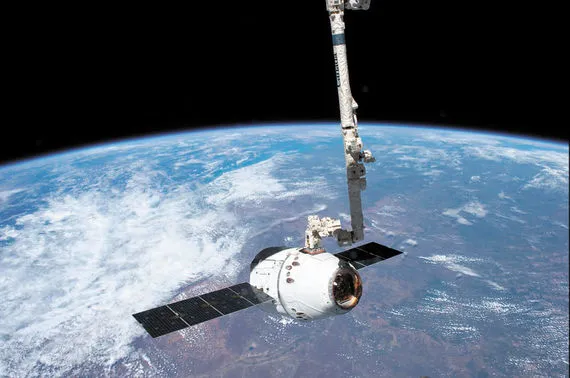
The world's cosmic community worried for the success of the first commercial spacecraft Dragon, which-after several transfers-on May 22, still started to the international space station on board the Falcon 9 launch vehicle. After entering the orbit, the ship maneuvered near the station for some time, then after checking all the systems-was seized with the station using the manipulator Canadarm 2. After unloading and staying in the station, for several days on Friday on May 31, Dragon was plundered and successfully led in the Pacific Ocean, thus complying the program of three demonstration flights that was supposed to conduct according to the terms of the contract with NASA (concluded in 2006) as part of the COTS program (Commercial Orbital Transportation Services, "Commercial orbital transportation services").
He wrote about the first flight of the Dragon of the Triv-hunger after its landing [1]. Then it was about the first demonstration flight (Demo Flight 1), when the ship had to simply demonstrate, speaking roughly, the ability to stay in orbit and perform a flight program. Now the task was much more complicated. Generally speaking, in the framework of the COTS program, before being commissioned, the ship must take three demonstration flights, the third of which will end with the docking with the ISS. But after the first success of Dragon, the tasks of the two remaining were decided to combine. Perhaps that is why the start took place so late: according to the original plan, Dragon was supposed to fly back in 2011. Already in 2012, when after several transfers, on May 19, Falcon 9 was on the launch pad, the launch was canceled literally in the last minutes due to the malfunction of one of the engines. The precaution was probably not unnecessary; At least on May 22, the start was successful on May 22, and this in this situation is much more important than the appointed deadline.
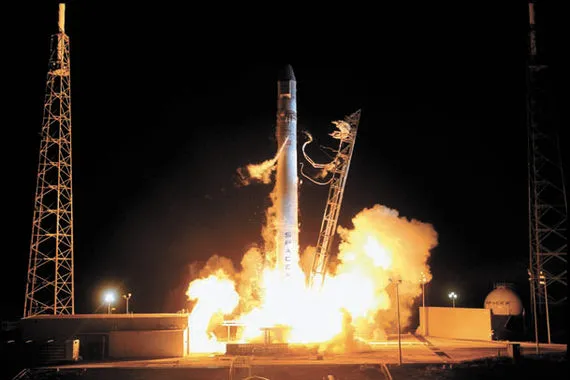
Dragon on board the Falcon 9 launch vehicle (both are the development of Space Exploration Technologies Corp., or, abbreviated as SpaceX), on May 22, at 10:44 Moscow time, from the NASA cosmodrome at Cape Kanveral. Before approaching the station, the ship was in an independent flight for several days. During this time, it was required to check the maneuvering systems, as well as the ability, if necessary, to interrupt the flight. On the third day, a “meeting” took place with the station. At first, Dragon approached a distance of about 250 m, from where he began to slowly (about 2.5 hours) to approach the ISS. When about 10 m remained before the station, the astronauts began to operate. Unlike the “Unions”, “Progresses” and the ATV European truck, the single mechanism of the addiction that Dragon uses does not allow him to attach himself to the station on his own. The ship “captures” the Canadian Canadian hand-manipulator Canadarm 2, which was controlled by members of the 31st expedition to the ISS: Don Pettit, Joseph Acaba and Andre Kuipers (Andre Kuipers). Dragon was attached to the Harmony module on May 25, at 19:02 Moscow time.
Dragon delivered about 520 kg of useful cargo to the ISS (however, about 60 kg of them “went” to the packaging), most of which was the power and personal use of astronauts. In addition, Dragon raised the set of experiments that were prepared by students to the ISS.
The network went around the photos of the interior of the Dragon ship and the words of Andre Koypers, which he published on Twitter: “A lot of space. Modernly. Blue LEDs. A bit like a scenery for a science fiction film. It is not surprising, because he is from Los Angeles ”[2].
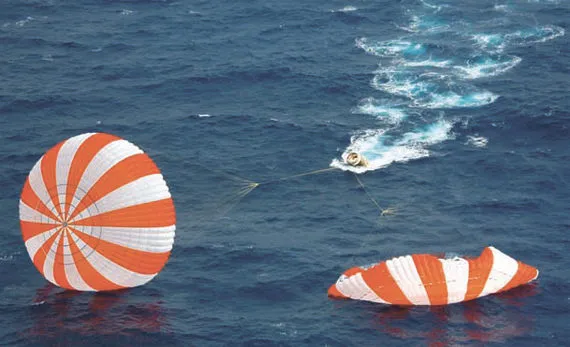
Until May 31, Dragon was part of the ISS, and then was plowed (again using the Canadarm 2 manipulator) and left the orbit. A few hours later, at 19:42 of Moscow time, the ship spent in the Pacific Ocean, 740 km southwest of Los Angeles. Together with it, the ship brought about 660 kg (620 kg-bez accounting for packaging materials), including materials of scientific experiments. Thus, Dragon became the second after the “Union” (and the third after the “shuttle”) with a ship capable of delivering goods not only in, but also from space.
The ship was raised from the water and transferred to SpaceX to check all systems. It is also planned that this week NASA and SpaceX will discuss the results of the second demonstration flight, after which a decision will be made on the further use of the ship and the date of the next flight is set, with full load (as the creators say, Dragon is able to deliver about 6 tons to low near -Earth orbit).
The creators of Dragon and the Falcon 9 launch vehicle celebrate a well-deserved victory and proclaim the beginning of the era of commercial space. However, the following should be clarified in relation to the word "commercial". Firstly, private firms have long been actively involved in the development of the same NASA or ESA. Secondly, the NASA contribution to these flights Dragon is quite tangible: the administration has already entered into a contract with the SpaceX for $ 1.6 billion, which provides for the launch of 12 Dragon ships with the ability to increase their number at the maximum price of the contract to 3.1 billion.
The COTS program, however, is not exhausted by Dragon: in addition to SpaceX, it is involved in ORBITAL with Antares launch vehicle and Cygnus ship. The first flight under the COTS program should occur this year.
In addition to the delivery of NASA goods, it is also concerned about the problem of delivering astronauts to the ISS, which the CCDEV program should be helped by the CCDEV (Commercial Crew Development, it can be somewhat voluntarily translated as “Development of commercial crew delivery tools”). SpaceX is also involved in it with the modification of the Dragon ship. In the manned version, the ship will be able to take on board seven astronauts. Unlike other participants in the CCDEV program, SpaceX plans to use its own funds - the already well -known Falcon 9 missile.
When the tests of Dragon’s manned version begin, it is still unknown (in fact, this modification does not yet exist “in the gland”), although it is clear that real flights with people on board will require much more checks. In the same year, perhaps the tests of the ground landing Dragon will begin (recall that another feature of the ship is the reusability of some of its systems).
However, the successful test of the ship may have brought SpaceX another bonus in addition to the success of NASA: after the launch of the Dragon, the company entered into a contract for the launch of the satellite using the Falcon Heavy launch vehicle with the IntelSat. The intrigue is that the modification of Falcon Heavy does not yet exist. This launch vehicle should differ in high loading capacity-over 50 tons (more than twice as much compared to the “shuttles” and “Proton”) and is still under development: its project was presented to the public just about a year ago.
Dragon's success forces many to talk about the prospects of private companies in space: from the development of devices for supplying and transporting astronauts to the ISS to the creation of fully private space stations and commercial flights in the interests of private individuals. So far, the success of SpaceX proves only that space flights are a market with a very limited number of customers. Actually, in addition to the ISS, there is nowhere to fly in space and, except for astronauts, is almost nobody, since the number of space tourists is very limited. At the same time, the example of Virgin Galactic and Bigelow Aerospace, which bet on suborbital (and in the future - orbital) tourism shows that the time for the latter has not yet arrived: real results are much less frequent than in the case of SpaceX.
Olga is a snack
PS is interesting, by the way, at about the same time as the second flight of Dragon, the X-31b spacecraft, the “mysterious” American military drone (for the same article in the Trv-hunger), which started in March 2011, completes its second flight.
1. M.Musin. All paths lead to orbit, the TRV-hunger No. 69, 12/21/2010 http://trv-scieence.ru/2010/12/21/vse-puti-ved-na-orbitu