
Translated material
People and horses
Anichkov Bridge, one of the most famous symbols of St. Petersburg, is 300 years old this year. It is unlikely that any other construction of the Petrine capital has such a cultural mythology, connected not so much with the bridge itself as with its decoration - Klodt's horses
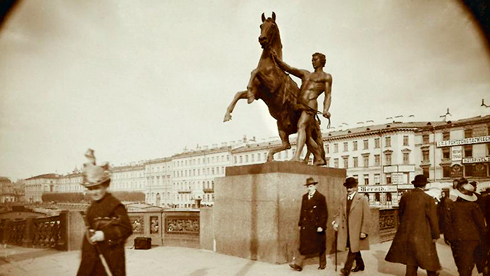
Today it seems that the figures of Dioskurov were always on the Anichkovo bridge, St. Petersburg, 1912-1914 when in 1715 Peter I signed a decree-to make a bridge on a fountain river during the perchpetic road, the future of Nevsky Prospekt-he was unlikely to think that an unusual fate was prepared. The axes knocked everywhere, and the bridges were massively pointed. Already on May 15, 1716, the tsar was reported to the tsar: “On the perchpective across the Fontannaya River, they were made: the length of 80 fathoms are hidden on the plows, across 3 fathoms with plates, but 4.5 arshins and lifting shields are wound over the entire bridge over the entire bridge, and Brusya is laid on the entire bridge on both sides on both sides.” So on the border of St. Petersburg appeared a wooden multi -span bridge on pile supports, painted “under a stone”, blocking both a fountain duct and a swamped floodplain.
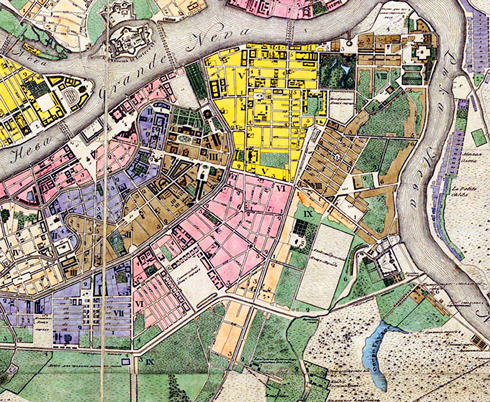
"Plan of the capital city of St. Petersburg",
Compiled by Alexander Savinkov, 1835
How to go down in history was built by the Bridge Battalion under the command of Lieutenant Colonel Mikhail Anichkov
* * NT did not manage to find a portrait of Lieutenant Colonel Anichkov: as they told us at the Hermitage Museum, the rank of Anichkov was not high enough for the portrait. , stationed on the shores of Fontanka in the Finnish village. After the object handed over on time, the lieutenant colonel received a promotion and land allotment in addition not far from the settlement - in the place where the Alexandrinsky Theater is now. The bridge was dubbed Anichkovsky, or simply - Anichkov. The village itself has become an Anichka settlement. The lane to Sadovaya Street also became Anichkov (under the Soviet regime, he was still renamed the lane of Ivan Krylov).
And even when Empress Elizaveta Petrovna, having ascended to the throne, decided to decorate the entrance to the capital and ordered to build a palace for her favorite Alexei Razumovsky, the high baroque Rastrelli was immediately called an Anichkov palace.
The Anichkovs led his family from the Tatar Khan Berk, who in 1301 entered the service of the Moscow Prince Ivan Kalite and received the named nyky at baptism. There were stolniks, the Duma nobles, the governors of large cities, one founded Kuznetsk (now Novokuznetsk), the other was an ambassador to Sweden, but a simple officer, known as the builder of a wooden crossing. And she, as it soon became clear, was built so -so. The bridge quickly failed. In 1749, architect Semen Volkov urgently erected a new, typical wooden bridge, decorated with lanterns on tall wooden pillars and a fence of wooden balusters standing between the tums with vases and balls. Then, elephants walked from Tehran as a gift to the imperial house, and they wanted to meet the caravan with dignity.
In 1780-1789, the Fontanka was equipped - they dressed in stone coastal walls with descents to the water and placed seven stone bridges, the extreme vaults of which were faced with granite blocks.
In the "happy reign" of Catherine II, Petersburg expanded its borders. Anichkov Bridge has lost the status of the gates of the city, but acquired ideological significance. On Aleksandrov Day, August 30, from the Kazan Cathedral to the Alexander Nevsky Lavra, the procession was already walking along Nevsky. The procession stopped on the bridge, and the senior spiritual rank made a prayer for the welfare of the capital.
In December 1840, Nicholas I approved the next project of the perestroika of Anichkov Bridge, the wooden part of which was dilapidated. In addition, Nevsky became wider, and the narrow crossing interfered with the movement.
The new crossing was built in seven months, by the fall of 1841. The bridge was expanded, supports and spans were lined with pink granite, which was first intended for the Isaac's Cathedral. They put cast -iron railing with alternating paired images of sea skates and mermaids according to the drawings of Karl Friedrich Shinkel. Exactly the same can be seen on the palace bridge in Berlin. The leader of “romantic historicism” in German architecture was then at the zenith of glory and yoke. Although historian Vladimir Kurbatov ascribes the railing drawing to the builder of the Isaac's Cathedral to Auguste Montferrand.
On each of the supports, states for bronze vases were set, but the vases remained only in the project. Granite pedestals for statues appeared on the boundaries of the bridge.
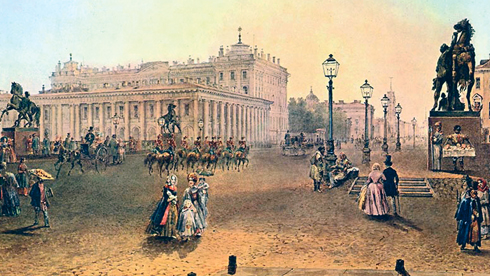
“Type of Anichkov Bridge”, Watercolor Vasily Sadovnikov, Hermitage, *1842 *mane and tails once to Nicholas I, a great lover of horses, presented a wooden rider. The sculpture liked the emperor so much that this miraculously changed the fate of the woodcarker. The author of the wooden horses Baron Petr Klodt von Jurgensburg, the son of the hero of the war of 1812, a hereditary military who recently resigned, was in poverty in the basement on the Vyborg side. He cut out the figures of horses from a tree, painted them, inserted glass eyes and made manes and tails from his hair - he lived on this. The figures were successful, but they did not bring much income.
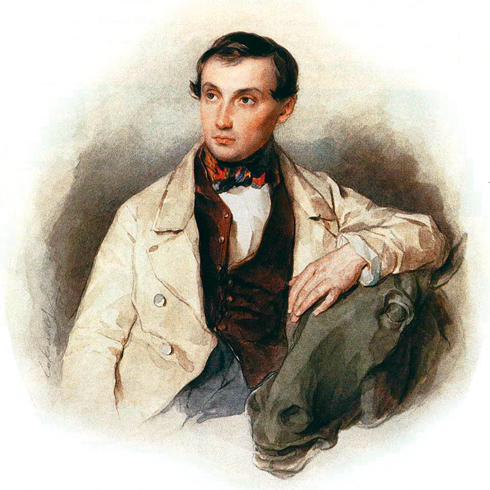
"Portrait of the sculptor P.K. Claudt von Yurgensburg "
works by Peter Sokolov, State Tretyakov Gallery,
1840-1849
And suddenly - royal mercy. The retired officer was accepted by a freedom at the Academy of Arts, and after some time he, at the request of Nicholas I, received a government order for the sculptural design of the Narva Gate. Klodt did not have time to finish the work, as a new highest order received-we need sculptural groups of Dioskurov, legendary brothers-Argonauts
* According to legend, Poseidon gave the dioskurs of horses and gave the power to save the shipwreck. , to decorate the palace pier on the Admiralty embankment. The emperor approved Clodite models, discussion at the Academy of Arts was also successful. By 1838, the first group was ready to transfer to bronze.
But by that time the king thought of putting horses on the pier at the Admiralty. The sculptor was glad of this. He found another place for his creation.
On November 20, 1841, the grand opening of the rebuilt Anichkov bridge took place. Newspapers choked with delight:
“The new Anichkov Bridge is admired by all residents of St. Petersburg. In crowds, they are going to admire an amazing proportion of all parts of the bridge and horses - boldly say - the only ones in the world. There is something open, dexterous, attractive in the Anichkov bridge! Having entered the bridge, it seems that I had a rest ... none of the St. Petersburg structures made such an impression on the inhabitants of the capital as Anichkov Bridge! Honor and praise builders! "
In the turmoil, few people examined that only statues on the right bank were bronze, placed plastered copies on the left.
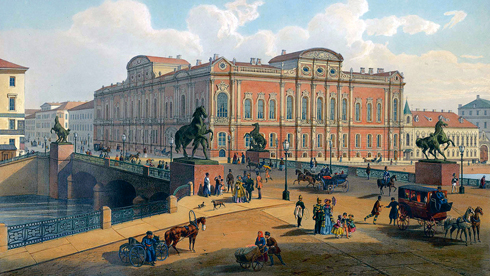
"View from Anichkov Bridge to the Palace of Beloselsky-Belozersky in St. Petersburg." Litography from the drawing of Joseph Charlemagn, *1850s *"Bridge of the eighteen eggs" The second pair was cast in a year. But they did not get to the bridge, but decorated the main gates of the palace of King Friedrich Wilhelm in Berlin.
The Prussian ruler was moved by the gift of the Russian Tsar and sent in response two sculptures of the glory, which were installed on the Connogwate Boulevard in St. Petersburg. The sculptor did not go unnoticed - Friedrich Wilhelm granted Klodt the Order of the Red Eagle and a diamond snuffbox.
New statues were installed on Anichkov in October 1843, but in April 1846 they shot. This time, Nicholas I decided to thank the king of Sicily Ferdinand for the magnificent reception of the Russian empress. The originals were sent to Naples, they came to the court there. A copy was again put on the bridge.
European newspapers wrote: “There are three miracles in Naples today: the Savior’s body, removed from the cross, covered with a transparent marble veil,“ Removing the Savior from the Cross ” - the picture of Espanoletto and the bronze horses of the Russian Baron Klodt.”
The Russian sculptor received the title of Honorary Member of the Academies of the Arts of Berlin, Paris, Rome and World Fame.
Meanwhile, gypsum copies became unusable.
The Ober-Police reported to the president of the Academy of Arts: "The alabaster figure of the horse turned out to be a crack, and Alabastra began to fall off in places, which is why the figure was made ugly."
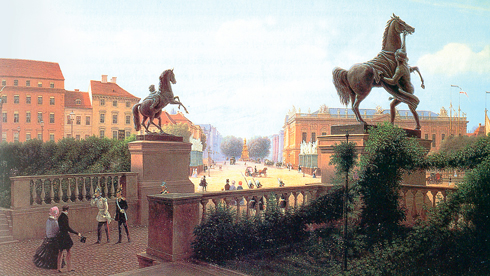
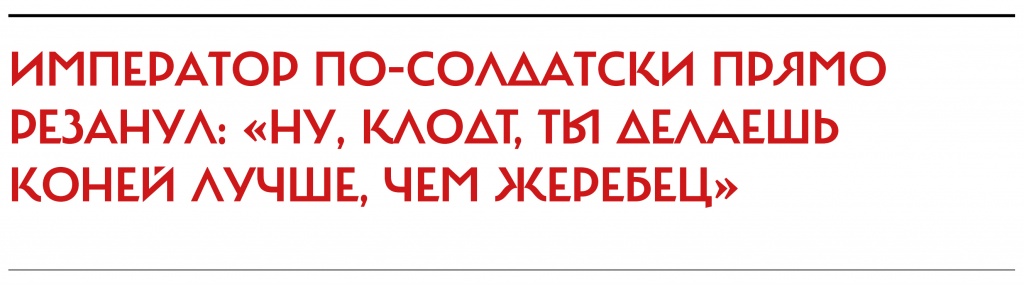
Koni Klodt adorned the main gate of the Berlin castle until 1945, Berlin, until 1870 and then the sculptor had two new plots for Anichkov associated with the pacification of the horse by man. Klodt's son Mikhail wrote: “In Pavlovsk, his father started horses. Serko - the old veteran of the court stable, completely white, served as a model when he sculpted the Anich horses. The other is Alamatbek - a white Arabic, obedient, impeccably folded. The father trained her: by order it became hives, took all kinds of poses. A twelve -year -old sister went on her in the Amazon, by the will of her father a horse with a horseman famously clung to his hind legs. ” In 1850, all four groups finally stood on the bridge. Contemporaries admitted that Klodt's sculptures are one of the peaks of fine art. The emperor in the Soldatian directly cut: "Well, Claudt, you make horses better than a stallion." City folklore did not lag behind the crowned person:
“Baron von Clodt is presented to the cross / for the fact that on the Anichkovo bridge / surprisingly all Europe / he put up four naked w ...”.
Then the folklore name was born - "The bridge of eighteen eggs." After the opening of the bridge, until 1917, the city was constantly on duty there.
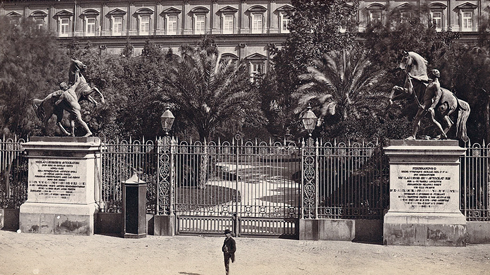
Ferdinand II ordered to establish the “tamers of horses” opposite the Royal Palace, *Naples, 1880 *Napoleon under the tail of Anichkov Most acquired the status of urban attractions that the city authorities took as a guide to action. Despite the protests of the Academy of Arts, lanterns were placed on the bridge in fashion for gas lighting. Then a small chapel appeared. But already in 1843, trouble was widespread - deformation of the arches. The crossing was taken "under special control", periodically fixing the destruction. But only in October 1902 the bridge was recognized as emergency. On Nevsky Prospect, they decided to let the tram, there was nowhere to retreat. The commission of the city railway proposed the bridge to completely disassemble and build a new, single -span - so cheaper and faster.
A panic began in the city. The Academy of Arts officially advocated the preservation of the historical appearance of the crossing, insisting on the complete preservation of even patches on sculptures. Academicians supported the construction committee of the Ministry of the Interior.
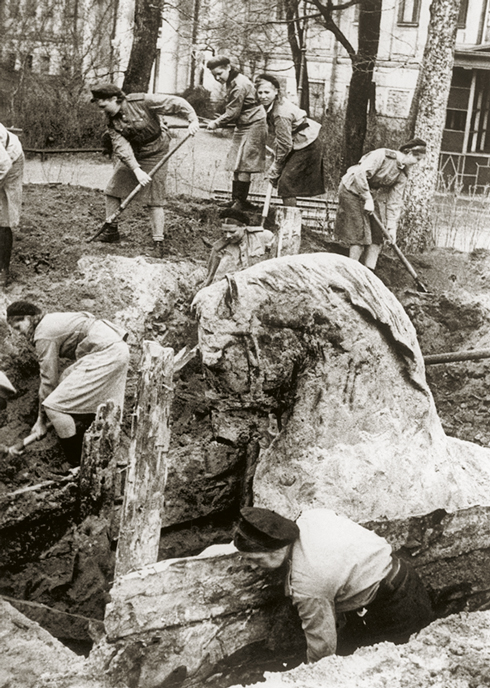
Fighters digest sculptures Peter Klodt
In the garden of Anichkov Palace,
Leningrad, Spring 1945
They listened to authoritative opinion. The reconstruction, which lasted from 1906 to 1908, was led by Alexei Shchusev. Foundations and bulls (
The support of the bridge. - NT ) The previous, brick arches have remained, for the convenience of pedestrians, narrow gangways from the bridge were replaced by wide steps. There was no longer such a large reconstruction of Anichkov. In 2008, they carried out only the overhaul of the arches.
Today it is impossible to imagine Petersburg without Anichkov Bridge. The Bridge "Horse and Man" is known all over the world. If you stop and begin to consider sculptures, there will probably be a person who will explain that Claudt has only filed those horses that is closer to the Admiralty, and the other pair is only “going to the blacksmiths for the foundry”. From guides we can hear about how during the war all the sculptures buried in the garden of the Anichkov Palace, and in 2000 they again left the pedestals, going to restoration. You can show you the memory of a 250-kilogram bomb that fell into crossing during the blockade-not only potholes in the pedestal, but also the stigma of the “pinetle” on restored grilles.
And of course, they will lead to the sculpture at the Anichkov Palace, so that in the outline of the horse you see a minted male profile. According to many, this is a portrait of Napoleon.
Photo: Photozone-t.livejournal.com, Offbeatpiter.ru, TretyakovGallery.ru, Wikimedia.org, Itar- Tass