
Translated material
The results of the week. Man and place
In the economy
 The results of the week. Man and place
July 26, 2013 Maxim Blan
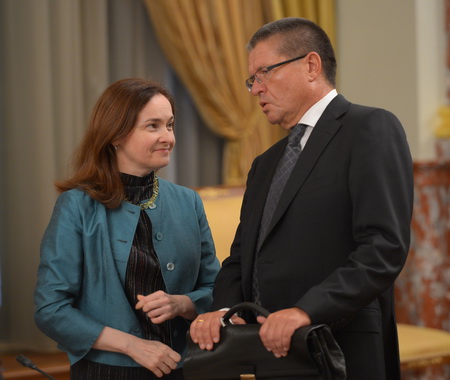
Despite the Dead Season, the last week was marked at once with two events that have every chance to have a significant impact on the development of the Russian economy in the foreseeable future. On Wednesday, Vladimir Putin met in the new head of the Central Bank, ex-minister of economic development Elvira Nabiullina, who promised the head of state to return inflation to the planned framework by the end of the year. After that, Putin with a light heart signed a law that creates the notorious Megaregulator on the basis of the Central Bank, around which passions boil for several years. On Thursday, at a meeting of the government, the newly -made head of the Ministry of Economic Development, the former first deputy chairman of the Central Bank, Alexei Ulyukaev, presented a plan of events aimed at accelerating economic growth in Russia.
The situation arose piquant, given that recently, Ulyukaev was responsible for inflation, and Nabiullina arose for the growth rate of the economy. So there was an opportunity to evaluate the consequences of Putin's “castling” in the economic bloc.
Perhaps it is worth starting with an unbending liberal-monitor who came to the service of the state in the team of Gaidar-Alexei Ulyukaev, for many years shoulder to the shoulder with the leadership of the Ministry of Finance of a fighting with the creeps of former Nabiullina subordinates to spur economic growth in the country with measures of budget or monetary stimulation. No further, as in the spring of this year, Ulyukaev very convincingly proved that in the current conditions additional incentives (in particular, reducing the refinancing rate and reducing the cost of loans for business or weakening the ruble) will only lead to acceleration of inflation. And by mid -summer, the situation in the Russian economy, it turns out, has changed radically. For no reason, the gap that had not previously been observed before Ulyukaev was discovered between the possible and actual release of products, which makes monetary and fiscal stimulation effective. This is the Ministry of Economic Development and intends to do. We are talking about the return of the abolished benefits for the payment of insurance premiums for small and medium -sized businesses, and to facilitate access to small and medium -sized businesses to state order, and to increase the availability of bank lending. And, of course, about state investments of the funds of the National Welfare Fund in “system -forming” projects that can spur the growth rate of the Russian economy. By September 15, the ministry will develop a mechanism for investing FNB funds in investment projects, and by October - the rules and criteria for selection of projects. By December, the Ministry of Economic Development, the Ministry of Finance, the Ministry of Transport, the Ministry of Energy and the Ministry of Industry and Trade should agree on a list of projects. The timid proposal of the Ministry of Finance to limit the use of FNB funds by investment in BAM, the Trans -Siberian Railway and the high -speed highway to Kazan, it seems that no one has heard so.
Almost nothing new in terms of the Ministry of Economic Development is contained: Ulyukaev only brought the ideas of officials of the ministry at different times. The only news is that the former implacable opponent of this kind of incentive defends this plan.
As for Nabiullina, the transformation of her economic views is far from so obvious. Although it is worth noting that with Putin she spoke precisely about the curbing of inflation, and not that the Central Bank has turned into a “mega -regulator” is ready to do to stimulate economic growth. And the fact that, having been in her new post, Nabiullina did not rush first of all to reduce the refinancing rate, which has long and so far unsuccessfully achieved her former department, and he talks about something.
It is difficult to predict how for a long time the current views of Nabiullina will remain. Especially if you take into account that Putin’s new law on the Central Bank was supplemented by the norm, according to which the main goal of the Bank of Russia monetary policy is to protect and ensure the stability of the ruble by maintaining price stability, including the formation of conditions for a balanced and sustainable economic growth.
Photo by ITAR-TASS/ Alexander Astafyev