
Translated material
Moscow was presented with an ultimatum
Around Russia
 Moscow was presented with an ultimatum
September 21, 2020 Alexander Golts
The day after the chief chief of Russia solemnly celebrated the day of the gunsmith and once again announced that, having put the hypersonic missiles on service, Moscow leads in the arms race, the ultimatum was presented to our country.
It is contained in an interview with Kommersant’s special supporter of the US President to control the weapons of Marshall Billingley. Billingley said that the agreement on February 5, 2021 on further measures to reduce and limit strategic offensive weapons (DSNV) may be extended if the presidents of the two countries sign a certain memorandum that will determine the parameters of the future agreement. At the same time, Billingley, let us give him his due, was extremely frank, which is not too characteristic of diplomats. He stated that in case of non -proceeding, US DNCs will immediately deal with the “reverse conversion” of its weapons. This means that submarines and bombers, who, under the contract, seemed to be deprived of the opportunity to carry strategic nuclear weapons, will now receive such an opportunity again.
It can be assumed that as a result of the “reverse conversion” to American strategic missiles, the warheads that were removed from them to fit into the ceilings of the contract will also return. According to experts, as a result of such manipulations, Washington will be able to very quickly double (up to 3,000 units) the number of warheads on strategic media, but Russia will be able to increase no more than 500 warheads and, as a result, its potential will be about 2000 warheads. Moreover, Billingley said that it would be better for Moscow to sign this document before the US presidential election (and, we note, provide another Trump's foreign policy victory), because otherwise “the price of the entrance will be higher”.
In principle, in the development and signing of a document that defines the main parameters of the future agreement, there is nothing unusual. Similar documents were accepted by OSV-2, and on START-1, and, finally, on the DNSV. However, this time Washington requires that very significant concessions from Moscow be recorded in the memorandum. The main thing is “the future agreement - and we have identified this very clearly - any future agreement should become multilateral and assume the participation of China,” says Trump's special beam. That is, by signing this document, the Kremlin will be doomed to do what he decisively refuses now - to encourage Beijing to participate in negotiations on strategic weapons. What puts Russia in, to put it mildly, an awkward position in front of its strategic ally. After all, China has declared a thousand times about the unwillingness to participate in such negotiations.
In addition, the memorandum should record the intention of Russia and the United States to solve a truly titanic problem - a reduction in tactical nuclear weapons. She could not be solved even during the maximum mutual trust between Moscow and Washington. Now, judging by the words of Billingley, the USA is offering something that was not even in the 1990s-to establish mutual control over the production of nuclear ammunition and, most likely, behind the warehouses where they should be stored. At the same time, Washington refuses to fulfill the main requirement of Moscow for tactical nuclear weapons: he does not intend to withdraw nuclear bombs from Europe.
In addition, judging by the words of the special supporter, the United States intends to significantly tighten the system of verification and verification of the execution of the contract. Anatoly Antonov, the current Russian ambassador to the United States, who conducted negotiations on the DNSV in 2009-2010, put significant restrictions on the exchange of telemetry of missile launches in a special merit. As a result, Antonov claimed, Russia may adopt the data on the launches of missiles, whose characteristics were well known to the Americans, and avoid informing about the test flights of new missiles. Billingley now wants to put an end to this: “The Russian Federation provides data on old systems absolutely legal, but it has already provided us with this data earlier. And it just does not bring any benefit. This does not contribute to transparency or trust. And at the moment, at a given period of time, we need to strengthen trust and transparency most. ”
I will not say that the implementation of the current American requirements will cause significant damage to the strategic stability and security of our country. Moreover, even the possible quantitative superiority of the United States in warheads and carriers is not, in my opinion, a significant threat. Nuclear parity in modern conditions is not quantitative, but of qualitative in nature. In any circumstances, Russian missiles retain the ability to break to the territory of the United States.
Another is dangerous. In the conditions of international isolation, Vladimir Putin put nuclear weapons at the head of domestic foreign policy. And Billingley quite frankly indicates that negotiations on nuclear topics are the only possible that the United States is ready to lead with Russia today: “And we think that it is very valuable in the current situation, when the United States and Russia do not trust each other in anything. This is a rather significant step forward, which both countries could take together at the moment when we should seriously look for such opportunities for collaboration. ” The American diplomat without abysses indicates that in Moscow it should be appreciated.
However, the Kremlin reaction to this ultimatum may be different. After all, presenting it, Washington demonstrates the reluctance to consider Moscow equal even in the area where, according to the Kremlin, this equality exists. In this situation, Putin can take a chance and try to show the United States the reality of his threats. That is, pursue a policy borrowed from Kim Jong -un. Trump in this case is unlikely to backward. In this case, the escalation of mutual threats in this case can quickly lead to an unthinkable ...
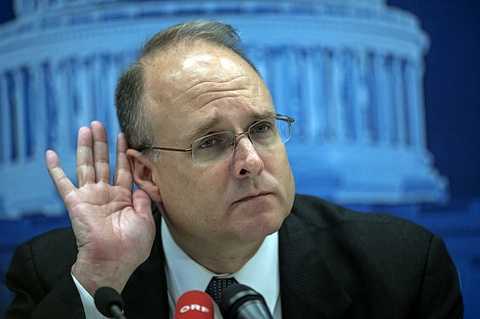
Photo: Special Representative of the US President for Marshall Billingley Marshalling at a press conference following a meeting with the Deputy Minister of Foreign Affairs of the Russian Federation Sergey Ryabkov on strategic stability and control over weapons. EPA/Christian Bruna/TASS