
Translated material
Let me play
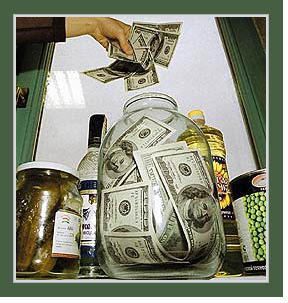
Long disputes about where to invest a stabilization fund, the size of which exceeded $ 60 billion (as of April 1 - 1.677 trillion rubles), it seems, can be considered complete. The decision has been made. This week, Prime Minister Mikhail Fradkov signed a government decree according to which the stab fund can be placed in three world currencies (American dollars, British pounds and euros) on the accounts of the Central Bank or in state securities of 14 developed countries with the highest credit ratings. The low profitability of this kind of papers - an average of about 3% - is compensated by their high reliability and liquidity. The Ministry of Finance will manage money.
It would seem that the celebration of liberal ideas is evident: the money will not go to the Russian economy, but will be invested abroad. This is the only application for them, which, with numerous reservations, was allowed by almost all wrestlers with “Dutch disease” - from Illarionov to Kudrin. The supporters will not spend the temptation either - the money will be invested, albeit at a small percentage, but this is still better than nothing at all. As there will be no reason to blame the Ministry of Finance for the stabund lies with a “dead load”, melting due to high inflation. As for the ruble that is strengthened in relation to the world currencies, which makes foreign exchange investments, to put it mildly, not too profitable, the stab fund is needed just in case of falling oil prices, and in such conditions the ruble will most likely fall.
Unfortunately, this logic is good for a housewife, who carries part of the husband’s salary to the exchange point to set aside a few dollars or more and more popular euros in case of another default. On the scale of the country's economy, everything looks somewhat different.
No one questions that the stabilization fund, where superpituals from high oil prices are going on, today plays an extremely important function of sterilization of excess ruble mass. If there weren’t the fund, the economy would have been waiting for either high - much higher than the present - inflation, or a serious strengthening of the ruble exchange rate, unprofitable for Russian manufacturers. An extra and a half trillion rubles is not yet able to digest the economy. It follows that the Ministry of Finance cannot simply enter the foreign exchange market with his money. So this option can not even be considered. It remains to use the Central Bank as a large exchange point.
But the proposed operation has no practical meaning. If you trace the fate of the money, supposedly dead loading in the stabunde, it is easy to understand that all that they are going to buy on them have already been bought. In fact, Russian oil companies export oil, selling it for dollars. The Bank of Russia prints rubles and buys on them from oil exporters to the lion's share of their currency revenue. After that, the Central Bank for purchased dollars acquires another currency and stateboards and puts it all in gold and foreign exchange reserves, and exporters pay by rubles an export fee that settles in a stabyfond.
What will happen now that the Stabfond will begin to convert to euro-funds-dollars? It is impossible to simply change the stab fund funds for currency, this would mean to throw more than one and a half trillion extra rubles into the market. Therefore, all the operations will have to be cranked through the Central Bank, which has gold and foreign exchange reserves. That is, the Central Bank will sell the government bonds of developed countries (part of the gold and foreign exchange reserves), will help out for them the notorious euro-funds-dollars, put on the accounts of the Ministry of Finance, and ministerials will buy exactly the same papers on them. And so to infinity - or rather, until the moment until oil money ends.
Having converted the stab fund, the Bank of Russia will lose $ 60 billion from gold and foreign exchange reserves (it is, as we already wrote, the size of the stab fund). The percentage income that the Ministry of Finance will receive will receive the Central Bank. Or maybe no one will even buy anything, there will not even be: the Central Bank will simply rewrite more than a quarter of gold and foreign exchange reserves to the Ministry of Finance, and the resulting rubles will write off-this will end. The problem is that the rubble of the Central Bank is not needed at all. His tasks include regulating the foreign exchange rate, for which foreign exchange reserves and the “printing machine” are required. Moreover, the more reserves, the easier it is to cope with the task. As for the stab fund, it has a completely different function - to replenish the income of the Russian budget that falls out in case of reduction in oil prices. And for this, neither dollars nor euros are needed.
The warning for the money of the money of the Ministry of Finance officials can be understood. Firstly, I would like to hide from the ruin of the “cubic”, and secondly, I would even more like to rule 60 billion (by the end of the year, you look, and all one hundred will be drew if oil prices continue to grow at the same pace)-some well-known currency speculators-filanthropes and with much smaller amounts did such miracles that the whole world was shuddered. As for the state, it will not receive nothing but transaction costs, which at best will be calculated by hundreds of millions of dollars.
Who does not understand what it is about, let him try to change the rubles for dollars and back. And so several times. And then he will look at the result.