
Translated material
Exile to paradise
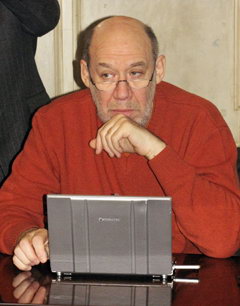 It is no coincidence that Alexander Ryklin was a little earlier here, on the “hedgehog”, admitted that he was ready to subscribe to almost every word of the report of the Institute of Modern Development “Russia of the XXI century: the image of the desired future”. On February 10, the official one took place, I would even say a “ritual” presentation of the report. With such a combination of people, which completely excludes a serious discussion of the text. But the text, however, deserves an attentive attitude. Therefore, let's deal with him seriously, on the Hamburg account.
Let us proceed from the fact that any serious text is richer than its author. Therefore, first we will come to him with the standards, which the authors themselves offer, recommending their text as one of the options (“models” - according to the terminology of the authors) of the country's renewal program. And after that we will see what else is in this text, that he is still “whipping” outside the author’s intention. And not only the text, but also the context of its appearance. This will allow us to evaluate not only its shortcomings, but also importance.
First about the text as a whole. It is striking in compositional sloppiness, repetitions, disproportionate of parts and plots, the names of sections, provocatively contradicting the content of these sections. It feels like the text did not have responsible for the final result. Maybe it was, but this means that the text has not passed final editing; those. The “city and the world” is not presented with the final result, but an intermediate. Why this could happen, we will discuss at the end of the article. Now let's move on to the content.
Scientific ethics prevents the discussion of what is not in the proposed work. But there are exceptions. If you are shown evidence of the theorem without its formulation, then you have the right to make claims to the author, you can even just ignore his efforts. It is with this situation that we are dealing in this situation. But we cannot ignore the fact that in the report of Incor there is no serious diagnosis of the situation in which the country is located. Several dissatisfied interjections about the present, by tangenting in the text, cannot be called a diagnosis. And without it, gaping voids appear in the program itself. In fact, we are offered treatment without a diagnosis. Therefore, we not only do not have any reason to trust the prescribed recipe, we begin to doubt that we are sick at all. The lack of a diagnosis gives rise to other important negative consequences, but we will need them later, as well as an explanation of why gaps in this text are important at least the text itself.
In general, the text looks very professionally, sometimes even unnecessarily professionally, flaunting with terms that do not know the overwhelming of the number of readers. The beginning pleasantly surprises in some elegant literary shamanism of the postmodern sense. But along with this there are amazing failures that destroy the impression of the text. As for you, for example, such a statement: “Each round of Russian modernization of past years with all its achievements has generated less economic competition and less political freedom.” If the authors insist on this historical observation, then they should be prepared to answer the following question: “Is there really less political and economic competition in Russia today than in the USSR of a 1985 model?” I gave an example that is clearly striking, but there are many similar, less obvious blunders.
The lack of a diagnosis entails a number of negative consequences. First - goals and means are confused. This was most clearly manifested in a rather thorough plot of a report on the electoral system and political competition. To substantiate a deliberately weak sentence - to return to the old mixed system - professional terminology is completely inappropriate in such a text. At the same time, it is completely unclear what we want to cure and what we get as a result. Meanwhile, the diagnosis of the electoral system (systems as a set of formal rules, I'm not talking about practice) is extremely clear: high barriers to enter the political market and reduced accounters reduced to almost zero. By the way, modern economy metric studies very convincingly show that the combination of my properties contributes to the growth of corruption in the country. It is completely unclear why half -curved measures are offered to treat these ailments. After all, the former mixed electoral system combined not so much the advantage of majority and proportional systems as their shortcomings.
The second consequence of the absence of a diagnosis is unjustified imbalances, when the plot indicated in the text is represented completely inaudibly and inconsistent with its importance. Such, for example, is a mini -citizen about the legislative process. I will give all four recommendations on this subject: “Practice the parliamentary hearings, to broadcast meetings on TV, not to rush with the second reading, members of the government to report to parliament once a week (with the existing number of government members, leisureliness of the legislative process will be ensured). This empty set could appear only because problems are not formulated, there is no diagnosis. And he is extremely clear to anyone who monitors modern lawmaking.
The plot about the courts is amazing. The topic of law in the document allows three tiny paragraphs. Their general meaning - the laws must be executed, and the court must be independent. But we are talking about a problem that can be called the main one without any exaggeration. Without the supremacy of law in the country, not only modernization will not go, normal human life will become simply impossible. It already becomes.
It is amazing that the self -awareness of power periodically breaks through in the text, which the authors freely or involuntarily translate. For example, the idea of partnership of the authorities and society (authorities and business, etc.) is discussed. There is a clear confusion. It is worth recalling that according to the third article of the Russian Constitution of Russia, the source of power in the country is its people. Those who (using simplifications in terminology) call themselves power are nothing more than the clerks hired by the people. Only the people have the right to dose and express their attitude to the clerks. The latter are required to do only one thing - to serve. This is how the place of power in democratic countries is interpreted.
It causes some bewilderment that place of the report that concerns civil society and where it is proposed to “stimulate” its development. It is difficult to resist quoting. The authors propose to establish “the creation of tax, financial and other incentives for non -profit organizations, primarily working with the state in the implementation of social projects. With the accumulation of positive experience - the spread of these benefits to an increasingly wider circle of public organizations. ” Complete Surkovism is a reservation for the right and obedient. Here I recall the dreams of an innovative economy, presented in detail in the report. It is possible, I remind, only on the basis of free civil society. But in captivity, it does not multiply, as in reservations.
I could continue to list my claims to the text, but, firstly, it is limited by the volume of the article, and secondly, it is time to move on to the promised explanation of why it is necessary to pay attention to the voids in the report.
We cannot ignore voids, gaps in the political program, because in this genre of passes are part of the text and context. We have the right to be surprised, for example, without finding in a diagnosis (however, absent), nor in the very text of the appropriate reflection of the problem of corruption. After all, it is strange: when citizens in sociological surveys are asked what the authorities should do first, they together indicate the fight against corruption. The same clearly overwhelming number of experts in the field of law, economics, politics, etc. But in the same way, the reason for the lack of a topic of corruption in the text of Incor is extremely clear. The authors have a misfortune to work in a reservation that has clear boundaries. A more or less honest conversation is possible inside it. Outside of it - impossible. The topic of corruption is a taboo, since an honest conversation here implies a designation of the level of control, which corruption reaches. And this is unacceptable. Is it possible to write in the country to write in the country with an honest diagnosis of corruption in the country, for example, such a phrase (this is from the description of the future): “The political leadership and society“ take into ticks ”the decomposed part of the middle and lower bureaucracy.” After all, the question immediately arises: “What is this leadership?!” From various explanations of the authors it follows that we are talking about the current leadership, which imitates the fight against corruption for ten years, actually depends on this average and lower bureaucracy. I'm not talking about terminological subtleties: what can this be called the current leadership of the "political"?
The thesis expressed above on the working conditions of the author’s team is confirmed by other gaps. For example, such an important problem as taxes is awarded timid mention - there are words about the desirability of “acceptable tax load”. But it would be necessary to say that in Russia the tax pyramid is turned upside down, that without it returning to a normal pose, it is pointless to talk about the restoration of federalism or subordination to the police of security for municipalities. But the topic of the tax system is prohibited, since the current bureaucracy earns, among other things, to plunder the budget, and the main bureaucracy in Moscow; Therefore, it is impossible to reduce the flow of taxes to the federal budget.
In the report, higher education is omitted as the most important topic. How, with a corrupt, degrading higher education, the authors see, for example, an innovative breakthrough, I’m not just talking about lawyers, doctors, builders of bridges who received diplomas after bribes for which they hit the student bench and passed tests and exams? And who calculated the number of destroyed scientific schools!? But is it possible to give sociological data on professional preferences of youth without shame!? You can’t talk about such higher education in a country rising from the knees!
For the same reason, the theme of the legal system and independence of the court is simply castrated. Can you imagine what will happen to the current “elite” with normal justice and law enforcement? Need more comments? I would consider the mention of the word “court” in the report as a moral and professional feat of the authors.
Now it is clear why there is no real diagnosis in Incor's report. It is impossible when many important topics are outside the zone of permissible discussion. And one more reason. An honest diagnosis can cross out the relevance of the topic of modernization, as it will be more like a pathological conclusion. Such a feeling can occur in the reader. Worse, it may arise with the compilers of the report. And this is already - schizophrenia. What modernization is there when it is necessary to protect people's right to life or save the integrity of the country.
So, as a finished program, the text of the Incor report did not take place. Moreover, according to his genealogy, he could not take place. In addition, he appeared, as it seems to me, a miscarriage, in a hurry generated by leaks, in the absence of a preliminary professional discussion planned. And this affected the quality of the report. But why and why did he appear like that then? How has it become possible to emerge the text of such a low quality with such a high goal? There are several reasons and explanations. I will briefly touch them.
In society, the demand for a serious vision of the future is absolutely lost, and the intellectual elite has ceased to form a qualitative proposal, the bar of political analysis of the country's prospects is extremely low. In this sense, the Incor report plays an important provoking role. He shows this low bar; encourages her to lift; Responses on the presented text demonstrate that, at least in narrow near political circles, such a demand is born.
With all its defects, the report has a clear democratic and liberal orientation. The fact that it is released from the “kitchen at court”, the report signals: this is discussed! And openly discussed! You can take it seriously! Do not stew, colleagues! If we take into account how timid most of the “colleagues” is, this report of the report is extremely important. The report simply screams from his palace cuisine: “We, in the semi-basement, cannot afford everything ... But you are free! Come on, fill in the voids ... make your diagnoses ... Write down your recipes ... ". And what a delicious gap was left by the authors for followers - how to go to a brighter future. This is where you can walk around people with imagination!
Let's fix it for clarity: in the Russia, which the authors of the report offered us, there is no place for Putin, Nor Sichin, nor Surkov and the like; I and Medvedev are weak there. In this Russia, there is no place for plundering the country, seizing someone else's business, unlimited violence and rudeness from the authorities, a shameless and arrogant molestation of people through a monopoly on information and propaganda. And in this sense, the report is a clear challenge of the current bureaucracy of all levels, starting with the highest. And this is also important.
Finally, it is useful to pay attention to the international part of the report-the most voluminous, very thorough and absolutely west-oriented. Here is the contrast with the usual anti -Western rhetoric of power, and just a scream: “The future Russia is part of the West! AU-U-oo-oo !!! ” Be sure: the West does not give a damn, he is not up to that. But do we ourselves hear this desperate scream?
Photo by hedgehog