
Translated material
Long live our Soviet court ...
Long live our Soviet court ...
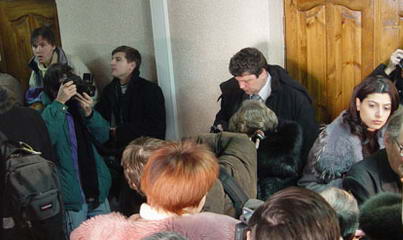
"... The most humane court in the world" - not without reason those who had to be frosty in the afternoon of February 3 came to hear the verdict of Stanislav Dmitrievsky.
After all, the case was considered by the Soviet court - the court of the Soviet district of Nizhny Novgorod.
And for this only a Soviet court could be judged. Formally, Stas was accused under Article 282 ("inciting the growth" - racial, religious and so on). It turned out that the Dmitrievsky state did not like, for some reason the society of Russian-Chechen friendship was created in the newspaper “Right-Provision” Basurmansk letters prints, and there the word “Putin” with a small letter ... In the old days they would say “obviously false slander fabrications defaming the state and social system”, article 190 “Prim”. Or "is accused and guilty of terrible, non -notable crimes against God, crown and tranquility ..."
Finally, the humanism of justice is obvious: they gave two conditionally, although the prosecutor requested four unconditional years of a general regime camp. You could almost rejoice ...
Which, in fact, did at first
gathered at the court. Before the announcement of the verdict, an hour and a half break was announced, but when the people reached for the court building, the doors were closed. That is, the judge and journalists were inside, upstairs, and outside the defendant and numerous observers. The latter - perhaps exclusively human rights activists; From the "Old Guard" of the Politseks, the familiar to standing "at the open door of the open court" Sergey Kovalev, Alexander Podrabink, Elena Sannikova were present. In court, and even more so to the hall, they were not allowed, which already gave birth to bad forebodings regarding the sentence. Then the defendant himself went to the principle: he refused to go to the hall, because according to the law, even a closed court must announce his decision publicly!
Stas Dmitrievsky in general
Principal idealistAnd requires compliance with these ideals from the surrounding reality. Inappropriate and untimely. Well preserved since the time of perestroika and the "democratic union."
"Is it easy to be young?" - This question was asked about twenty years ago the director Juris Uzniex. Then it was very easy, regardless of age. It seemed to those who felt young, it seemed that they knew what is good and what is bad. War, dictatorship, censorship, political prisoners are bad. And everything that was “bad” against this seemed “good”. The dictatorship collapsed on this awareness ...
Then, however, many details became clear. Not only good, but also another evil was ready to fight with evil. The national liberation movement easily became a small dictatorship and a small empire. New independent states were headed by the first secretaries yesterday. The second secretaries became notebooks. In the fight against the Communists, the remnants of a punitive machine created by the same communists were the best tool. The category of “bad” has not remained in the past: the “small civilian” of the 93rd, “first Chechen”, the elections of the 96th, the war of compromises either averted from everything that was connected with the word “politics”, or accustomed to compromises from the “rotten”. "Decade of disappointment." In all this, it turned out to be easiest to forget what is good. At this oblivion, the nineties ended and the inevitable return movement of the pendulum of history began: "This inevitability was felt in everything ... And in the fact that the townspeople ceased to sing the purchases of political content, became very serious and knew exactly what was needed for the good of the state." Such cynicism helped the old evil change the skin, to appear young and attractive - a new war was met by society "with a bang".
But not everyone. Stas Dmitrievsky, for example, did not increase cynicism. But now people like him - preserving the ideals of youth - seem completely inappropriate. There are not so few of them. In one lower whole community: in addition to the society of Russian-Chechen friendship, the Human Rights Society, and the Committee against torture. The latter, by the way, recently won in Strasbourg, in the European Court of Human Rights, the Mikheev case: for torture in the police, falsely accused and lost health, awarded 250 thousand euros - precedent of all -Russian significance. This is quite combined: the province, professionalism and ideals ...
And in the year before last, the authorities took up this community seriously. The statements of Maskhadov and Zakaev published by Dmitrievsky were given
experts(about "examination"
We already wrote) - and spun. With a criminal case against Stanislav himself
"accidentally coincided"The equity of tax authorities and the administration of justice, as well as pogrom leaflets against Dmitrievsky and his colleagues. At the same time, events were held against other local organizations and activists.
Why? At first glance, there is not enough rational in this police zeal. The Little Type Gazeta prints texts about the war and against the war - so what? These texts are unlikely to be wound up a mass audience (the author’s pathos has not been compensated by the “informal” and provincial style) - and ten years ago they would have passed into general background. Then it was not forbidden to talk and write about it, but times are changing ...
But if the "Dmitrievsky case" was a local initiative, then only at first. In recent months, the court picked up "ours" collected in cities and towns. So, it was not without the highest attention.
What is important to the Nizhny Novgorod process for the work of "controlled democracy"?
Firstly, the application of the 282nd article against Russian-Chechen friendship is indicative. With this article (in the Old Code-74th), strange things are generally going on. For its intended purpose, it does not work. "Mine Kampf" and other similar content literature was unstable both in Moscow and Nizhny. Skinheads regularly kill people with the wrong skin of the skin and a hostile shape of the nose. But law enforcement agencies, with rare exceptions, do not see in this “growth” - everything is entirely hooligan motives.
It is unlikely that there are only coincidences. My acquaintance recently visited police presence, whose responsibilities were charged with extremism. Both in the prosecutor’s office and in Rubope complained to her that materials on the activities of fascist groups were littered, but they could not give affairs as an appropriate move: the authorities do not bless. And the deeds, on the contrary, gives a move. When asked whether this misunderstanding of publicity should be given, she was answered negatively: “Well, I sits in front of you, say, Ivanov, who cannot arrest the subject hung with swastikas. And you will write - he will sit in the same place, say, Petrov, with the swastika. Do you need this?” So we live ...
When struggled
The exhibition "Caution, religion!", the court decided that the pogromers were innocent. But the organizers of the exhibition, led by Yuri Samodurov last winter, were convicted-again, the 282nd article. And the deadline was also conditional, which, under the first careless movement, turns into real.
In his speech in the Soviet court, the prosecutor spoke about the importance of the fight against "racial disorder", referred to a recent attack on the Moscow synagogue. Have mercy, what's in common? She, article 282. An uncommon, convenient for arbitrary and expansion interpretation, is an uncommon, a good tool-the absence of an unkind memory of articles of the 70th and 190th "approx". In those articles, there were also subjective moments (“the goal of undermining” or “knowingly false fabrications”), the proof of which Soviet justice did not bother.
It seems that such legalization - written against one, and the opposite of a completely different one - is still awaiting us. In connection with the same attack on the synagogue, we are stubbornly repeated: the crime was committed under the influence of "bad" sites, and about the publications printed by a tongue twister. You do not need to be a prophet (especially after Putin’s words that there are no “dragon” measures on the Internet) to know: they will now make something interpreted uncontrolled, and therefore convenient to use “not for its intended purpose”.
So the conditional sentence to Stanislav Dmitrievsky is a conditional, like Damocles of a sword - applies to everyone who knows how to read and write. All who use freedom of speech.
"The most humane in the world" the Soviet court created a precedent. We are clearly made to understand who in today's Russia decides that citizens are allowed to know, speak and write, and what is not supposed to. Censorship was not introduced - the calculation on the "internal censor" sitting in each.