
Translated material
Black outflow
In the economy
 Black outflow
April 14, 2010 Mikhail Delyagin
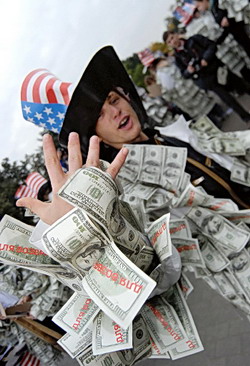 The movement of private capital is one of the significant characteristics of modern open economies. And although more than 85% of foreign capital that come to our country are loans and a tool of short -term speculations, this rule retains its relevance for us: the influx of capital indicates an improvement in the country's economic reputation regarding other countries, outflow is a worsening.
The maximum level of pure capital outflow-18-25 billion dollars a year-was observed in Russia in 1996-2000. The level of $ 24.8 billion for that time - was reached in 2000, when the post -depleted shock still owned the souls of Russian and foreign businessmen, and the influx of petrodollars and the restoration of the economy ensured quite wide opportunities for earnings.
After that, as commercial optimism has grown in relation to Russia, the scale of the outflow of capital was rapidly falling until they reached the minimum level of $ 1.9 billion in 2003 in 2003.
The “Yukos case” was mortally frightened by the business, exposing the new “rules of the game” in front of it, and in 2004 the outflow of capital grew to $ 8.9 billion, exceeding the level of 2002 and 1995. However, the corporations quickly realized that the arbitrariness of the power oligarchy is electoral and serves as beneficial for the commerce, a tool for monopolizing the markets, due to which the income received is enough for bribes and high profits.
Therefore, already in 2005, the pure outflow of private capital from Russia fell to symbolic $ 0.1 billion, after which a galloping influx began: in 2006, it amounted to a record 41.4 billion dollars, and in 2007 it almost doubled to 81.7 billion.
The internal dynamics is very interesting: the first blow of the crisis, which also touched Russia, occurred in August 2007, and in one month, 6.8 billion dollars left the country “clean”. However, the flow of petrodollars steadily increasing then, for a while, really turned our country into a kind of notorious “island of stability” - and in September, the pure outflow was reduced to $ 2.1 billion, and then the pure tributary resumed, amounting to $ 21.3 billion for $ 21.3 billion.
Then the mood of investors changed, like a pendulum: the pure outflow of the first quarter of 2008 in the amount of $ 24.5 billion was more than compensated by the record tributary of the II quarter of 40.2 billion, which also continued in July, when $ 17.2 billion came to the country.
However, then the global crisis turned into an open phase, and the net outflow of capital began to grow rapidly - from $ 7.7 billion. In August, 28.6 billion. In September and 130.5 billion, for the IV quarter, which was more than “ate” the entire tributary of the previous two “obese years”!
The outflow of capital was at a high level and in January-24.3 billion dollars, but then, as the situation stabilizes, it decreased sharply, and in May-June it even gave way to a pure tributary, which, respectively, amounted to 0.6 and 5.3 billion dollars.
The July destabilization of the currency market caused a sharp outflow of capital in the III quarter, which amounted to $ 34.2 billion, but already in the IV quarter of 2009 it was replaced by a clean tributary of capital of 8.3 billion.
True, by the end of last year, a pure flow of private capital to Russia was again replaced by an outflow. If in October the maximum monthly clean tributary was observed for the entire time after the crisis transition to the acute phase (since July 2008) - $ 9.5 billion, then in November it decreased to $ 3.0 billion, and in December, pure outflow amounted to $ 4.3 billion.
This was not due to the intra -Russian situation, but primarily with the fluctuations in the global markets that changed the relative attractiveness of Russia all all kinds of connection with its own state; Such is the fate of countries open to external influence and are not able not only to adjust, but even just to take it into account.
In the first quarter of 2010, the net outflow amounted to $ 12.9 billion, but almost all of it (about 13 billion) came in January; A small outflow of February was compensated by the equally small tributary of March, so in the II quarter we should expect a pure prima of private capital on a fairly noticeable scale.
At the same time, the banking sector, having increased foreign liabilities by $ 1.5 billion, with the growth of their foreign assets by only 0.7 billion, provided a net of capital of $ 0.8 billion.
The outflow of capital was not associated with banking, but with the non -financial sector. An unusual feature of the past I quarter of 2010 is that the legal operations of the non -financial sector also approximately balanced each other: an increase in foreign assets by 11.9 billion dollars was generally compensated by the growth of foreign passions by $ 10.1 billion.
The determining contribution to the dynamics of the movement of private capital was made in whole and completely illegal operations. They are not even partially observed, as a result of which only their total result can be taken into account, the balance - in the form of an article of the payment balance, delicately called “passes and errors”.
In the first quarter of 2010, the pure outflow of “black” capital from the country amounted to 11.8 billion dollars. This is the maximum quarterly value over the entire observed period (that is, since 1994), which exceeds all the annual indicators except 2007 (then - over the whole year - a net outflow of illegal capital from Russia amounted to 13.3 billion dollars).
In January-March of this year, the nature of the movement of private capital to Russia and for the first time during all the time of the reforms was completely determined by the movement of completely illegal capital-not even “gray” (which include, for example, non-return of export revenue, fictitious imports and securities), and entirely “black”!
This indicates a decrease in the state of capital operations by the state and the growing tendency of the business to illegal operations caused, probably, of both administrative pressure (including from the power oligarchy) and general uncertainty in the future.
Author - Director of the Institute of Problems of Globalization, Doctor of Economics
Photo by RIA Novosti