
Translated material
DNA keeps the history of evolution
Brian Six. Seven daughters of Eve / Per. from English. E. Ya. Migunova. M.: Ripol Classic, 2003. 304 p. (Universe).
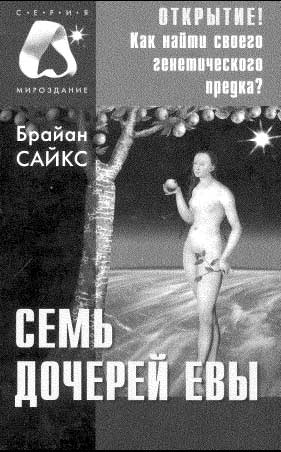
The playful name and a bright glossy cover with a naked Eve against the background of a space landscape are possible, perhaps, scare away a serious reader. Advertising slogan on the cover “Opening! How to find your genetic ancestor? " It also does not inspire much trust. Meanwhile, Brian Six - a professor at the University of Oxford, a world -famous scientist - lively, brilliant, witty and, most importantly, simply and clearly described the history and results of his scientific research on evolutionary genetics. The book is built as a good textbook: all the introduced scientific concepts - from quite well -known ones, such as chromosome, DNA, blood group or homo erectus, who appeared recently - receive clear, clear and surprisingly simple interpretations. For all the mentioned scientific facts and discoveries, a short background is given.
Undoubtedly, it is worthwhile to give this book to schoolchildren before they begin to pass genetics at school. The author talks about his discoveries rapidly, convincingly and excitingly, allowing you to find answers to many riddles. Is a genetic analysis of fossil bones possible prehistoric people and animals? Where was the birthplace of the ancestors of the modern Polynesians-in Southwest Asia, or, who tried to confirm with his journey to Kon-Tiki, the Hayerdal, in South America? Did the Neanderthals extracted under the onslaught of Cro -Magnons or their descendants still live among us? Do modern Europeans take place from the oldest inhabitants of Europe - nomadic hunters who gradually comprehended the advantages of a settled life, or from the replaced nomads of farmers from the Middle East? How is the data of linguistics that reduces all the European languages to one common primary language, and the data of archeology, which draw conclusions based on ornaments on fossil ceramics, correlate with the discoveries of modern genetics? Is the Basques really the only descendants of the ancient population of Europe and their origin is different than other Europeans? Do the relatives of the Cheddert man who are about nine thousand years old and whose skeleton is stored in the British Museum of Natural History live in the current Cheddere, who live in the current Cheddere. Is the royal family really buried in the grave found in the vicinity of Yekaterinburg, and was Anna Anderson Tsarevna Anastasia? And if there is a person who is not interested in any of these issues, then maybe he will seem curious the narrative of where the home hamsters came from.
But do not think that the book is a collection of disparate stories. No, all these secrets are just the links in the sequential story about the adventures of the central heroine of this novel - mitochondria, or rather mitochondrial DNA.
It turns out that a new round of genetic studies, which ultimately led to truly incredible discoveries, became possible because in the late 1980s the study of DNA not in the chromosomes of the cage nucleus, but in mitochondria. Mitochondria is the smallest formations that are in any living cage; They are located in the cytoplasm and are engaged in oxygen processing into energy. “In the depths of each mitochondria there is a tiny fragment of DNA, a mini-chromosome, the length of which is very small-only sixteen and a half thousand bases. This is really very little compared to the chromosomes of the nucleus containing three thousand million (as in the book. - E. U.) of the foundations. ... The genetic code in mitochondrial DNA is slightly different from the code in DNA of nuclear chromosomes ”(p. 63).
Mitochondria has a unique property that made them indispensable to clarify the secrets of kinship, but not family, but deep - binding people in tens of thousands of years. The fact is that if a person inherits the chromosomes of the nucleus from both parents, then mitochondria - only from the mother. It is very difficult to explore the evolutionary history of a person through DNA of nuclear chromosomes, at this stage of the development of genetics it is almost impossible: after all, they “have the habit of mixing, crushing all genetic information in each generation” (p. 167). In nuclear DNA, genetic information that came, say, from his grandfather on the paternal line, is connected to the same line from her grandmother; Therefore, you can only figure out what is taken from the father, and what is from the mother, but not deeper.
But mitochondrial DNA is remarkably suitable for studying the distant human past, since the information that she carries is transmitted from mother to children, from grandmother through mother to granddaughter, then to the great -granddaughter and great -great -grandson in almost unchanged form. The sequences of mitochondrial DNA in humans and his direct ancestors on the maternal line do not differ, with the exception of those changes that occur with mutations.
Mitochondria turned out to be messengers who carry us information from our most distant ancestors (on the maternal line). Moreover, these messages are dated, as it can be calculated temporarily. The frequency of mutations arising in the chromosomes-unplanned changes in the structure of DNA that arise due to failures and errors in cell division. “The level of mutations in nuclear chromosomes through it is long - roughly speaking, normally, with each division of the cell, one nitrogen base of a thousand million mutates. In mitahondria, control over errors1 is not so debugged, so mutations occur about 20 times more often. ... In other words, the “molecular clock”, with which we, by means of mutation in DNA, can determine the time, in mitochondria tick much faster compared to the core ”(p. 66).
That is, if two people had one common ancestor in the female line ten thousand years ago, then in the sequence of the control region2 their mitochondrial DNA will be one difference. “... although the speed of mitochondrial mutations seems too slow in order to study the evolution of a person over the past hundred thousand years, it is just perfect, but the main events took place on this period of time” (p. 86). The study of mitochondria makes it possible to make a matrineal genealogical tree for all of humanity! To do this, you just need to analyze the DNA of each person and compare the resulting data.
Having examined the mitochondrial DNA structures of a large number of modern Europeans and processing data as a network using a mathematical apparatus developed by the German mathematician H. Yu. Bandelt, Brian Six found that all structures are divided into seven groups, or seven clusters. “Within each of the clusters, the DNA sequence is either identical or very close to each other. More than 95 percent of the modern indigenous population of Europe fits into one or another of these seven groups ”(p. 203). All Europeans thereby come from seven women, “seven ancestors of clans. It only remained to give them names ... " Based on the comparison of each cluster with the rate of occurrence of mutations, it was determined how much time it evolved. As a result, Sykes came to the sensational conclusion: “The age of the seven clusters lay between the forty -five and ten thousand years ... These numbers show us what a segment of time required that all the mutations that we see in the cluster now develop from the only sequence of the founder of the clan. Continuing the course of reasoning ... You inevitably come to the conclusion that is breathtaking: this is the only sequence from which all other sequences came ... belongs to one and only person, and even more precisely-the only woman ”(p. 204).
Here, the scientific part of the book is interrupted, and the artistic-historical reconstruction of the life of each of the seven women begins. Unfortunately, as a historian and writer, the author of the book seemed less interesting to me than as a scientist and popularizer of science.
So, this book has many heroines: this is both mitochondrial DNA and seven European irises. There is another heroine, also very beloved by the author, is a science. The story told by the book very well demonstrates that a real scientific study is by no means “a confident advance forward to a well -known goal on a pre -planned route. It resembled a much more chain of random shots, and such factors as a case, a tired case, personal relationships, monetary difficulties, even physical injuries, determined the direction of each of these throws to no less than any well -thought -out strategy ”(p. 28). It is important for the author what the mechanism of the emergence of scientific thought: “... And here I dawned on me-that is, I experienced a rare state when something, some kind of slurred thought pops up from the distant natives of the mind, and a person understands that he found a solution to the problem, even even having time to figure out what it is” (p. 68). With goodwill and respect, the author calmly and dignity speaks of all his scientific colleagues, including opponents, including those opponents who have long been frank trafficking: “This is absolutely logical and legitimate to demand exhaustive explanations from those who challenged the established views. Extraordinary messages like ours demanded overdue evidence. We recognized all this, and yet we could not get rid of the sensation of very strong pressure. We were in the role of boys who dared to challenge the establishment. Nevertheless, I did not doubt for a second that we were right. And the only faithful in such a situation was to remain calm and in detail, by points, to respond to all criticisms ”(p. 162).
It is hard to believe the reader, who finds out about the sensational discoveries of modern genetics from this vivid and briskly written book that all the material presented in it is scientifically justified. Meanwhile, this is true: after long years of fierce scientific disputes and distrust of colleagues, Brian Six has acquired universally recognized authority in the field of human genetics. He also succeeds in commerce: the company organized by him offers anyone who wants to study his genealogy based on the genetic analysis of mitochondrial DNA.
For Saix, a person’s sincerely not indifferent to universal problems, the connections discovered by him are very important between people of different nationalities. After all, this “once again proves the complete failure of attempts to bring the biological basis for racial classifications ... Everything is mixed in us - and at the same time we are all related to each other” (p. 301).
[1] Here I will allow myself to pay attention to a funny joke of fate: a typo in the word “error”, copied by me when quoting, serves as an illustration of how the malfunctions called mutations accidentally arise. I will use it as an occasion to note a good translation, as well as the fact that the quality of proofs and especially editing, unfortunately, is noticeably reduced in the second half of the book.
[2] The control region is a certain section of mitochondrial DNA selected for genetic studies (in particular, because it is most often susceptible to mutations).