
Translated material
Islamism-Light
Why is the Muslim party popular in secular Turkey
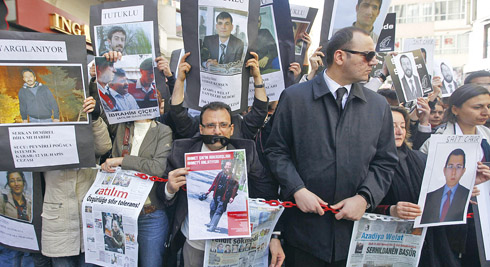
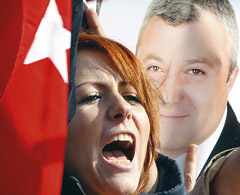
Istanbul. Turkish journalists protest against the arrests of colleagues
Islamism-Light. From 49.95% of the vote in Turkey for the third time in a row, the parliamentary elections were won by the Party of Justice and Development (PSR) of Recep Tayyip Erdogan. PSR in power since 2002. In the history of Turkey, where the multi -party system was introduced in 1945, this is a record. Why in a secular country the prime minister-Islamist is so popular-the New Times found out
"Mosques are like soldiers, and their minaretians are like bayonets." For public citation of the lines of Ziya, Ryculp, the Pantyurk activist of the beginning of the 20th century, Recep Erdogan paid in 1998 by the post of mayor of Istanbul - this was regarded by the authorities as a criminal offense against the state policy of Kemalism. The court gave Erdogan 10 months of prison, and at the same time made it, as is usually the case, from it.
Own in the board
Since 1923, when the republic was proclaimed in Turkey, “kemanism”, named after the founding father of the modern Turkish state, Mustafa Kemal Ataturk, became an official ideology. The war was removed from Turkish women, and the joint training of boys and girls was allowed in schools. However, in the early 1990s, society wanted something new. “With the collapse of the USSR, a lot of things have changed in the world, including Turkey: our bosom allies and associates - the USA and Western Europe - turned their backs to us,” Turkish journalist Ahmed Aidun expresses his opinion in an interview with The New Times. - The country had to choose a new path - and she chose Erdogan. And the first thing his party began, having gone to the parliament, with the cleansing of the country from "kemalism." PSR considered that he was harmful to Turkish society. Now from Ataturk in Turkish politics remained only his portraits on the walls. ”
| Recep Tayyip Erdogan was born on February 26, 1954. In 1976, he began a political career with the post of chairman of the youth cell of the Party of National Salvation in the Istanbul district of Beioglu. In 1994-1998 - mayor of Istanbul. In 2001, he creates a party of justice and development, which wins the parliamentary elections in 2002, gaining 30% of the vote. Due to the presence of a criminal record, Erdogan could not immediately become the Prime Minister, but he headed the government in 2003, as soon as appropriate changes were made to the legislation. Married, four children. |
As a person, the new national leader of Turkey is the exact opposite of Ataturka. Erdogan is a native of a simple but religious family. The boy from the sleeping Istanbul district Beyoglu-an analogue of the Moscow Biryulev-earned his first money-earned on the sale of lemonade and Bublikov-“Simits”. Even having received a higher economic education and having made his way to the highest echelons of power, Erdogan carefully supported the image of a “native of the people”. And did not lose. “He portrays a typical Turkish man who loves justice and does not throw words into the wind,” Ahmed Aidun shares his observations. - His relatives are not involved in any scandals. The image of his family is a properly living Turkish family. ” 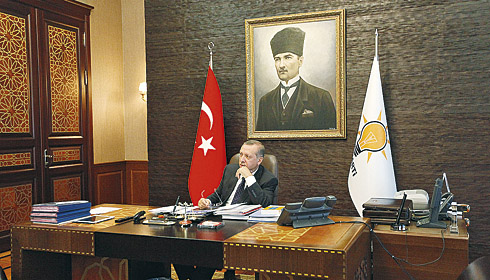
The inhabitants of large cities and Istanbul, in general, are voted for the “right” Turk, but the bulk of its electorate are the residents of the eastern province of Anatoly or immigrants from it. This is no accident. Since 2002, when Erdogan only came to power, the new elite poured out of the hinterland to the big cities to conquer her “place in the sun” and received from the prime minister what she wanted.
Barry with Europe
Erdogan never hid his active emergency position. “All his political career is saturated with religious motivation,” Ahmed Aidun assures. In 1994, Erdogan became the mayor of Istanbul and even then elected the party of prosperity - the organization of frankly Islamist. “And then, by the way, he did a lot of things: he set up a water supply system in the city and dealt with traffic jams,” recalls The New Times. In general, “Islamization of the country performed by Erdogan is rather a means, not a goal,” says the interlocutor of The New Times: “We have no one in private life now. He who wore mini-skirts continues to wear them: Türkiye is not Iran and not Saudi Arabia. ”
Nevertheless, even such a sluggish Islamization of the country, still claiming membership in the European Union, scares off officials in Brussels: the process of integration of Ankara has been dragged on for more than 10 years. Brussels constantly exhibits new conditions, and it is worth fulfilling Ankara and they again expands the list. Despite the good economic indicators of Turkey *** inflation - 5.7%, a record low in the last 39 years. Unemployment has decreased to 11%., Brussels is clearly in no hurry to accept Ankara in a “big European family”. “Erdogan is offended, even angry on the EU,” said Francois Anelli, an expert at the European Studies in Brussels. He recalls how, in 2009, Erdogan, during one of the press conferences in his hearts, threw Brussels: “Do not want to accept us, so tell me! Why pull the bagpipes. ” But in the soul, Erdogan is still ready to fight for the laurels of the prime minister, who brought his country to the EU, the expert is sure: “He will pull this strap until the European Union says“ no ”first. Erdogan does not want to admit that the main obstacle is himself, he himself, the prime minister-Ismist, albeit in the Light version. ” However, in addition to the policy of Islamization of Turkey, Brussels have other claims to the PSR and its leader. According to the OSCE, published in the spring, 57 journalists are serving a sentence in Turkish prisons. Türkiye, according to this indicator, was overtaken even by Iran, China and Belarus. The prosecutor's office assures that the arrests are in no way connected with the professional activities of journalists. Ten arrested in March of this year, for example, are accused of inciting “hatred and enmity” and relations with the secret organization “Ergenecon”, which allegedly planned a military coup in 2003.
By the way, shortly before the June elections, Erdogan publicly promised to “figure out” with two more journalists - Nuraz Merth, who wrote about the Kurdish problem, and Abbas Gid, who informed about violations in colleges. “The electorate forgives such attacks to Erdogan, again because he is his own man. And everything can be, even publicly threatened. He has something in his head, then in the language ” - this is how the prime minister Ahmed Aidun interprets the condescending attitude of the average Turk to the undemocratic behavior. But one way or another, Brussels skepticism in relation to Erdogan's personality is not soundly founded.
Again - a referendum? *
The parliamentary elections on June 12 were not an absolute triumph for Erdogan: the PSR did not reach the constitutional majority in the parliament of only 5 votes and will now be forced to form a coalition with a secularist (secular) folk resort party, which received 25% of the vote in the elections. Perhaps it is for this reason that the prime minister has changed the tone in recent days. He promised that the ruling party would become “less arrogant” and will begin the dialogue “with everyone who has something to say”. True, there is another explanation for the updated discourse: Erdogan, they say, was frightened by the “Arab spring” and now this recurrence in Turkey is in this way. “Its main goal - to turn Turkey from a parliamentary republic into a presidential one - has not yet been achieved,” explains Ahmed Aidun. “Therefore, it is important to release a pair of discontent.”
On the way to achieving the main goal, much is already behind. For the sake of the capital redevelopment of the Constitution adopted after the 1980 military coup, Erdogan has already held a number of referenda. According to the advantage of the penultimate, in October 2007, amendments were adopted, according to which the president in Turkey is now elected popular voting (and not by parliament, as it was earlier) for a period of 5 years with the possibility of re -election for a second term. The last referendum in September 2010 changed the previous procedure for the formation of the Constitutional Court - on the basis of a secret vote, but most importantly, finally selected the arbitrator from the army in any political dispute of the country. “The army now only protects the borders of the country and performs gendarme functions in the province, where there are not enough police officers,” Aidun explains. “With the adoption of these amendments, the last two bastion of lightness - the Constitutional Court and the army - fell.” What now? The minimum program is to be corrected to the Constitution of the Presidential Republic.
In order to introduce another amendment to the Constitution-about the presidential republic-Erdogan will have to seek support for the coalition partner-the People's Republican Party. But more likely, the option of the next popular referendum. By the way, under whom the presidential chair is being strengthened - also the question is also controversial. Erdogan himself recently stated at the party meeting that if "the project passes, he will not be the first plenipotentiary president." But in politics, words are often designed to hide genuine intentions.
The most famous journalists * * in dungeons:
Nedim Shener, The correspondent of the Milliyet newspaper was imprisoned on charges of disseminating false information about police officers. Shener wrote the book “The Murder of Dink and the Lies of the Secret Service”, which accused Turkish security for not preventing the murder on the national grounds of the Turkish-Armenian journalist Grant Dink in 2007. | | | | --- | --- | | 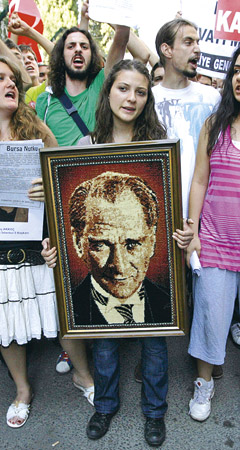 A rally in support of the leading journalist of the newspaper "Jumkhuriet" Mustafa Balbai |
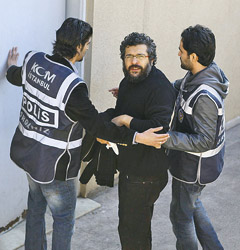
Accused of relations with the secret organization "Ergenecon":
- Mustafa Balbai, the former chief of the capital's bureau (in Ankara) of the daily newspaper Cumhuriyet. - Tunkai Ozkan, founder of the Kanalturk television channel. - Ahmet Shik, an independent journalist. - Soner Yalchin, owner of the Odatv television channel. - Muisser Yildiz (woman), editor of Odatv. * - Mehmet Khaberl, the founder of the hospital in Ankara and the owner of the Kanal B.