
Translated material
Property or freedom?
In the opposition
 Property or freedom?
February 21, 2017 Sergey Mitrofanov
A purely theoretical dispute came out here. Not even a dispute, but an exchange of views. And it would be possible to save him exclusively for internal use, if in the end he did not lead to the most burning: what is Russia, where is it, why is it all the time and what to do so that it was different. And somehow all this rested on Trump, and how to interpret the “dashing 90s”, and where to start a new perestroika.
The dispute rises to such universally recognized historians and philosophers as Pipes and Ahizer. Moreover, it turns out that it is quite possible to become a doctrine, having read them. The essence of the problem is this. Pipes rightly believes, and Akhizer vividly agrees with this that Russia diverged with the West due to different historically established property relations. At the same time, Ahizer adds that, inscribed in culture, these relations are constantly reproduced.
In Russia, the government creates property (distributing it to its guardsmen, servants and favorites and taking it away from the “dissidents”). And in the West, on the contrary, for many centuries, property has been generating power. Sovereign or relatively sovereign owners make their kings and create a contractual relationship with them, and when the kings get out of control, they are killed without any regrets and change on other kings.
This makes an important conclusion that Russia is doomed to reproduce totalitarian (authoritarian) power all the time, because this culture is inscribed in the worldview of the people and because there are never and never there were normal owners who could turn this away: that is, to insist on the supremacy of the set of agreements between the autocrat and owners over the power of the autocrat.
Even worse is that Russia lags behind the West in this understanding of the right of years by a thousand. Moreover, behind the lower border of this “1000” there is generally a hazy of centuries, there is nothing left there, nothing has left to our time, there is a black hole, while in the West - and this is documented - there were already right, court, theater, literature, etc. And inside this “1000” there was also a great Asian occupation, which some now consider the Eurasian Union of the complimentary peoples-Russians and Mongols, while others are still iga, but in any case, modern Russia got the behavioral and worldview archetypes, which gave rise to water and clan (mafiose) sociality.
That is why the future liberal revolution, the right doctrines believe, should not be for law, human rights - they hang in the air - but for property, owners ...
All this seems true. And Irina Pavlova, a translator and ideological follower of the pipe, writes on his blog “On Russia for Smart and Serious People” : “Russia's experience shows that freedom cannot be established by a legislative act, it must grow gradually, in close collaboration with property and right.” She in this way meets one of the first owners of the new Russia-Mikhail Khodorkovsky, who, oddly enough, was noted by the next almost social-democratic maximum:
“Talking about the protection of private property as the foundation that needs to be“ poured ”before erecting the rest of the building is, in my opinion, the approach is somewhat orthodox. Yes, it was in Western Europe, but hundreds (if not thousands) were gone for it. In Russia, the sacred property of private property does not exist for historical reasons (in any case, the last half a thousand years). To rely on what was not and was not, it is impossible; Wait until this sacredness is formed, we do not have time (and the formation process is very bloody). Therefore, it is proposed to look at the end of the task and try to create a legal democratic state through the consent of the elites ... "
“By the consent of the elites” - the thesis, of course, is strange (“the wheel agreed that it would rotate”), but the problem of pointed, in my opinion, is extremely accurate: what is primary - property or freedom? And if Russia has a chance to change its sociality without living 1000 years in a different socioeconomic paradigm?
***
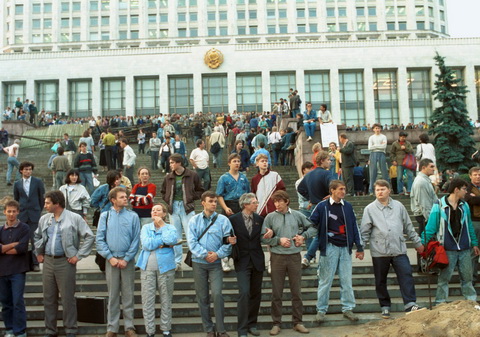
How does this purely theoretical question concern us today? In fact, in the most direct way. Moreover, not only us today, but also of the period of the “August Revolution”, which has not found its specific place in the historical context. They still talk a lot about her, they hold conferences, but clarity seems to be only reduced. “August” seems to fall deep into the decades, without giving a satisfactory version “What was it?”.
Relatively speaking, in relation to August 1991 there are three large worldview groups.
The first believes that “three days in August” were the apogee of the Great and Heroic Democratic Revolution (perhaps the phase or counterfase of February 1917), which, however, suffocated as it moves forward. Supporters of this point of view are worried only for her decline and are ready to repeat her again and again in the new conditions. Undoubtedly, they are the right contingent of Bolotnaya Square and the White tape, a living ring around the Isaac's Cathedral. The contingent "Perestroika-2,3,4,5 ..." and so on.
The second group considers August 1991 as a great and tragic mistake made by the leadership of the country and its people. It was necessary to do everything wrong, they believe, go to the Chinese way, not to destroy the economy and not to ruin the USSR, perhaps even not to dissolve the CPSU. In any case, not to demolish the Berlin Wall (at least for nothing), not to let the Baltic states and Georgia be released, and Ukraine from the very beginning call for order. This group of pro -Soviet nostalgia and nostalgia for imperial power, a group of resentment to the west. Convicted anti -liberals, conservatives, the so -called statesmen, in short, are recruited from it, the entire Posoputinskaya Klaka. And she also supplies volunteers to the Donbass, fuels a global conflict between the East and the West and signed by blood under the “Munich speech”.
The third group is complex. Belonging to it is considered “August 1991” the result of the conspiracy. Some are American, others - Russian KGB committed in order to legitimize the statuses of the current owners of life. Or, perhaps, a conspiracy of the story itself that cursed Russia. Divorced by the poles of nihilism, these adherents of the theory of infinite walking in Russia in a circle “from thaws to frost” (Ahizer), coincide in unbelief in the democratic revolution (Pavlova: “I belong to the narrow circle of those who believe that there was no revolution in 1991, all the more democratic and liberal”, there was no ignorance in ignorance ”). The liberal “university” progress, the ideals of the “naked” freedom, and force them to “disinterestedly” to fight for democratic liberalism (even if they did not like the KGB, Stalin and disagree with the new Russian expansion). But they all understand the property, they understand that the “August Revolution” divided it incorrectly (unrighteously endowing it with irregular people), and believe that in any case it should be divided again in the future if we want to bring the situation in the country in a relative order. In the international plan, they support the right populists: Trump - as a leader not limited by any framework of entrepreneurship, Le Pen - this Jeanne d'Arc common sense and national benefit. Not romantics, but “rationalists”, they can be allies of “liberals” when it comes to economic efficiency (if we come to a common denominator according to its parameters), and opponents, when it comes to irrevocable costs of human rights, especially in relation to “worthless” migrants.
I myself am far from giving some comprehensive answers in this text. The scales according to the horoscope, I am inclined to see in that August a window of opportunities in which all scenarios were implemented at the same time. And today I am tormented by the problem with whom and with what will we have to leave tomorrow, what will we offer political youth? But it is important, however, that the theory of Russia's unpreparedness for liberal democracy is primarily at the hand of developed Putinism, which, on the one hand, also grew out of August, but, on the other, denies the significance of the liberal decade, when the revolution was actually made by the owners, but the liberal intelligentsia on the salary. Like the right populists, Putinism can now say: yes you will never succeed, there are no prerequisites. First, we will capture everything, ripen as capitalists, scroll through our “hell on wheels” , and after two or three generations our children may reach understanding the rights and rights of a person, will learn the game on piano. And you are still silent.
Indeed, we, the generation of the “dashing 90s”, are mostly not owners and we will never become the owners. When we grew up, property simply did not exist, and then it flowed into other hands. Which, however, did not prevent us from going out to the White House and write laws and the Constitution, which opened the way for the new Russian capitalism. Nevertheless, the process divorced us with the “collective Chubais”, which ceased to seem “ours”. Only in a terrible dream can we imagine that the front -line detachment for legal liberal relations in Russia will again lead the organizers of the collateral auctions. Or that for a hundred years the “Wild West” will unfold with a shooting of elephants for the sake of tusks, that is, with a predatory attitude to nature and man. Nevertheless, it is we who are mentally that modern West that has already passed all this. We spied on the end of the task book. Of course, it would be better if “property and freedom” is written there, but if the question arises “or-or”, then we choose freedom. With all due respect to capitalism as the highest stage of Soviet socialism, we will obviously be from the very beginning only for the property that is limited by the civilizational framework of modern law. And for this, from the very beginning, one must be disinterestedly beaten for the “naked” human rights and the humanization of our society ...
As if arguing with his own fans, the same pipe in the book “Two Ways of Russia” wrote:
“Thus, the history of Russia shows that private property is a necessary, but insufficient prerequisite for freedom. In the last one and a half centuries of its existence, the tsarist regime strictly observed property rights first to land, and then to capital. So, the Decembrists, nobles who belonged to a number of the most noble aristocratic families of Russia, after the uprising they raised in 1825, were subjected to executions and links, but their estates remained untouched, which could not happen a century earlier. Alexander Herzen, an emigrant who, on what the light stands, Tsarism in the Western European press, did not experience any difficulties with receiving a decent income from its estates in Russia that came through European banks. And the mother of Lenin, in whom one son was executed for the attempt on the king, and other children visited prison and exile, received a pension appointed to her as a widow of a state official until her days. Nevertheless, with all due respect, which tsarist government showed to the property of Russian subjects, it was considered little with their civil rights, but with political - at all. The serfs before their release in 1861 were simply living property, and the landowners could put them, send them to Siberia to hard labor or give them to the soldiers for life. Others, including nobles, could be administratively detained and (in violation of the letter of 1785) are deprived of freedom on suspicion of a political crime. Society was not able to turn its increased economic force in the guarantees of personal freedoms, because all the leaders of the management were in the hands of the autocracy. ”
This dispute is far from finished. I put an ellipsis, not a point. But what I know for sure: the first group will come to the march of Nemtsov’s memory, the second will not come out at all and maybe some of the third will come out.