
Translated material
Aberratration of the perception of Crimea
In the opposition
 Aberratration of the perception of Crimea
October 21, 2014 Alexander Osovtsov
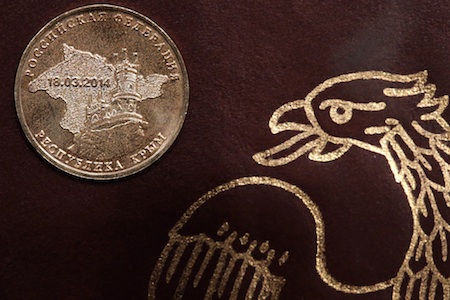
Everyone who read, saw or heard “Woe from Wit”, remembers that the times of conquering Crimea, even for the heroes of Griboedov, were distant past. Of course, it’s a shame that this past overtaken us in the 21st century. It is even more offensive that this did not happen in the framework of the fight against the traditional and old enemy and not with the aim of strengthening the safety of Russia and protecting its inhabitants from literal enslavement, and as a result of a disgusting, vile aggression against a neighboring fraternal country at the time of its weakness.
However, I did not expect anything else from Putin and therefore was indignant, but surprised - no. I was surprised, and very unpleasant, much later, when many colleagues in the Russian opposition declared that it was impossible to return Crimea to Ukraine, yes, in essence, it is not necessary. Here I am going to argue with this, if possible without demonstrating emotions.
Before moving on to the essence of the question, I will make preliminary remarks. Firstly, the question of the return of Crimea is, from my point of view, it is not a question of today's practical policy, but rather a kind of test that can become an relevant case after not only the liquidation of the current regime, but also the appearance of revised democratic institutions in Russia. Secondly, even on the basis of a discrepancy in such an important issue, I do not feel needs and are not going to declare any of my like-minded people in assessing the need for changes in Russia by enemies, or traitors, or anyone else. Thirdly, I do not know how to read thoughts and therefore I am not going to build assumptions about why someone said what he said, but I will proceed from what everyone said sincerely and everyone said what he thought, guided by his considerations not conjunctural, but rational.
It is clear that I am talking, first of all, about Navalny and Khodorkovsky, although not only about them, but also about many who supported them from among the critics of the regime. Supporters of the regime are not interested in me now. My arguments can be divided into 4 groups: ethical, logical, legal and political. I will try to express them in such a way as not to provoke the initiation of a criminal case for calls to violate the integrity of the Russian Federation, if possible, in a degree that does not change the meaning of my arguments.
The ethical aspect is the most obvious. Both Navalny and Khodorkovsky admit that Crimea was annexed in the most unscrupulous, categorically unreasonable way. To preserve the acquired in this way - it is a shame for those who make decisions and to everyone who agrees with them in assessments of initial actions. It is no less important that the country, a nation with such a skeleton is not even in the closet, but in the living room is simply not capable of updating the degree necessary for indigenous, deep transformations in politics, economics and public life. Considering that both people respected I answered the question of their hypothetical actions in the hypothetical situation of the future presidency, it turns out that they both think, apparently, by inertia, in many respects, if not a successor, then the successor of the functions of the current president in the framework of the current political structure, and therefore they probably think that priorities and the degree of sensitivity to most of the Russians will remain Today for an indefinite long time. I believe that it is much more important not to insult the moral feelings of that minority that differs for the better in an ethical sense, that is, those who, from the first minute, condemned aggression against Ukraine. Many interpreters attribute to the two popular leaders of the Russian opposition about the same logic that B. N. Yeltsin adhered to, when he, according to some memoirs, taking the decision unpopular among the liberal intelligentsia, told his close associates that "she was not going anywhere." I hope that this interpretation is far from reality, because it is not only extremely cynical, but also pragmatically similar actions led Yeltsin reforms to what we have today.
The basic logical arguments are that in the country where the current situation will be preserved - economic, political, psychological, electoral, neither Navalny, nor, Khodorkovsky have no chance of being elected to the first position in the state. For this, such changes must occur that either the annexation of Crimea will cease to seem to most Russians a positive event, or such trifles as Crimea will not worry them at all. In the conditions of an inevitable crisis - and, unfortunately, I am sure, like many, that the end of the Putin regime will occur in the conditions of a severe crisis and well, if not a disaster, it will be a great success for Russia to preserve all its territories indisputable to date, and it will be better not to think about Crimea as Crimea. At the same time, again, in a crisis, among other things, the role of an active minority increases sharply, which is unlikely to consist of supporters of the annexation of Crimea by 84%. As the practice of mass events has shown, the minority more often demonstrates much greater cohesion and determination. In 1991, the White House also had only tens of thousands of people, like on the marches of the world. They were quite enough to turn the course of events, primarily because no person went out to support the State Emergency Committee. When Putin ends with money, in a crisis situation, the level of his support, I think, will be approximately the same.
Of course, everyone, including Navalny and Khodorkovsky, know and say that Crimea was attached with gross violations of law - both Russian, international, and Ukrainian. It is obvious that in the disassembled case, it should first be recalled that the Russian Constitution was violated, for example, regarding the priority of international obligations over national legislation. And what, the future guarantor of the Constitution - doesn’t matter, Khodorkovsky, Navalny or any of our like -minded people - will not consider it necessary to return to the constitutional field? I do not want to believe in it ... I also note that from the point of view of law, the will and the desire of the Crimeans has nothing to do with it. Yes, Crimea, of course, is not a sandwich, including because it is not a private or collective property of the inhabitants of Crimea. This is the territory of the sovereign state, namely, actions in relation to the territory are determined by international law, and the affiliation of the territory can change only if both interested countries are consent. I am sure that now the chances of this kind of consent of Ukraine are zero, and to explain to the Ukrainians that the situation looks like “Win-Win”, that is, they are also “Win”, is no longer possible. Yes, in Canada, a referendum on the self -determination of Quebec is possible, in the UK referendum on self -determination of Scotland is possible. And in Spain, a referendum on self -determination of Catalonia is still impossible. And in Ukraine, a regional referendum on the self -determination of regions, including Crimea, is impossible, is needed by nationwide. And in Russia, any referendum is possible on any similar issue, only a criminal article is possible. And if it will be different and, as proposed, a hypothetically honest referendum on the future of Crimea will be held, then you can expect similar events in other regions of Russia. Whether it will be possible to deal with a similar parade of sovereignty at least it is at least unknown. The Crimeans, of course, can live, where they want, in any country, ready to accept them, each separately or even everyone together. But this does not mean that they can move to another country with the peninsula.
As for politics, I absolutely do not understand how a similar position in Crimea can be combined with commitment to European values and movement towards Europe, and even with Ukraine, as well as an expression of all sorts of sympathy for the Ukrainian people. It is obvious to me that a significant number of Ukrainians, probably a majority, and absolutely - mostly an active minority in such a situation, these sympathy will not be mutual. Moreover, it is very highly likely that in the case of the above crisis in Russia, Ukraine will try to return Crimea by force, because thanks to Putin’s policy the idea of a war with Russia no longer seems wild to anyone in Ukraine, and the Ukrainian army has become much more combat than it was only six months ago, and there are no particular doubts that its strengthening will be among the main priorities of any Ukrainian leadership in a visible future. So there is a probability of a Serbo-Korvat scenario of a sample of the first half of the 90s. By the way, I remind you that the question of the entry of Serbia into a united Europe itself, this Europe considered it possible to consider only after all the territories occupied by Serbia were, at least de jure, liberated. I have no doubt that Russia can not have any way to Europe and even any convergence to Europe at least until Europe considers the issue of Crimea solved. And I can’t imagine that she will make any decision, except for the opposite of what was proposed by Navalny and Khodorkovsky. Any attempt to negotiate on real convergence will begin with this issue and, with this position, it will end up.
The format does not allow me to state all the available arguments, so finally there are two comments a little outside the framework of the topic under discussion. Supporters of the position criticized by me, as a counterargument, love to say that it is technically impossible to solve the issue of Crimea in the way I propose. I do not see anything impossible here and I will try to offer, as it is now customary to say, a roadmap in the next column.
Finally, I want to emphasize once again that I still want to see Russia not by dictatorship, but by the parliamentary republic, and from the current politicians is ready to see Khodorkovsky as the prime minister, and Navalny, at least as one of the leaders of the coalition. Yes, I do not agree with them in this matter, but I hope that my and many considerations will be taken into account before the expression “the times of the Ochakov and conquest of Crimea” will again mean the same as two hundred years ago.
Photo TASS