
Translated material
Analogies and hyperboles
Around Russia
 Analogies and hyperboles
November 13, 2014 Alexander Osovtsov
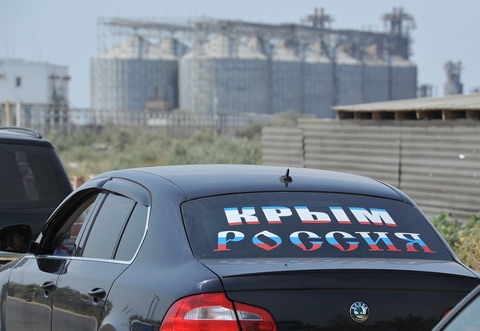
They say that between two opposites
The truth lies. In no way, a problem between them lies.
I.V. Goethe
Not so long ago, I promised to write about how technically, from my point of view, it should be solved the problem of Crimea after the collapse of the Putin regime. Since the discussion about principled carts continued after my column, before moving on to the very technical aspects, I will allow myself a few comments about the arguments sounding.
One of them consists in the fact that there are a number of similar difficult cases that have not been in their solution for several decades - Falkland, East Timor, Northern Cyprus, Kosovo, Karabakh. Of course, all analogies are arbitrary, which in itself does not mean that they do not have the right to exist. Nevertheless, in this case, from the point of view of a possible solution, the degree of convention is so great that none of the above examples proves anything at all. Nagorno -Karabakh (Artsakh), Kosovo and Eastern Timor are cases that significantly differ in the degree of bloodness of the conflict. In Karabakh and Kosovo, between the Armenians and Azerbaijanis, between the Serbs and the Albanians-Cosovars, bloody clashes occurred before frozen conflicts. In the disputed territories and abroad, pogroms and ethnic purges took place, and no matter how you relate to the current state of affairs, the frozen conflict has at least that is an explicit advantage over not frozen, which freezing stops bleeding.
The occupation of Turkey of the Northern Cyprus occurred as a reaction to an attempt by the Greek military dictatorship, supported by part of the Greek community of Cyprus, to annex the entire island. Yes, this attempt failed, the reasons for the actions of Turkey in 1974 have long become the property of history, as well as the regime of “black colonels” (there were several colonels in Greece), but the roots of the emergence of this situation are just that. It is also worth noting that neither Karabakh, nor Kosovo, nor the northern Cyprus were annexed by anyone, and there were no attempts, there were bloodshed in all three cases.
Falklands and Eastern Timor were annexed just for some time. But the fact is that in both cases the troops of the countries that carried out this act were expelled and the initial sovereignty was restored in both territories. The British coped with the troops of the Argentine military dictatorship themselves, the East Timor was freed from the Indonesian troops that shed by the contingent of the International Coalition, which was mainly also consisted of units of the British Commonwealth - Australia and New Zealand. So although Timor is also not a sandwich, and folklands are not a bag of potatoes (this image was used by Andrei Zubov in relation to Crimea), it was quite possible to return them to legal owners quickly and effectively.
Thus, it was the annexation that in modern history did not succeed. And the fact that the ANSHLUS of Crimea was carried out by very little blood, in my opinion, is just a significant prerequisite for the fact that it can be returned with a relatively easily easily achievable understanding of the parties in all other issues. And even if it’s not as easy as we would like, it does not prove anything except the lack of will. In the end, the bag of potatoes can be very heavy, but the argument of the one who stole it, that he could not drag such a load back into the closet of the rightful owner, can hardly be regarded as significant.
Another argument in favor of the impossibility of the return of Crimea is the thesis that since the majority of the population of both Crimea and Russia will react to this negatively, such a step will have a dictatorial nature. In fact, I already wrote that in the conditions of inevitably crisis post -Putin Russia it is far from obvious that most citizens will think about the Crimea that way, moreover, it is not obvious that they will think about it at all. But the point is that any power in the described period will inevitably encounter the need to revise a large number of unlawful and illegal acts of Putin's times. Many of them have to be canceled with the need.
Let me remind you that we analyze the option of the future in which the supporter of the values of European civilization becomes a hypothetical president, for example, relating to their number of Khodorkovsky or Navalny. This means that any of them will be obliged to achieve the abolition, for example, of all unlawful sentences for political and other cases, including the swamp business, the Pussy Riot case, the affairs of the "media-bridge", the case of Yukos, the case of "Kirovles" and the like. It will be obliged to seek the abolition of the “law of scoundrels”, anti -Giyan laws, laws limiting the freedom of the press, freedom of political and social activity.
This seems to me absolutely natural, necessary and the only possible. And I can’t imagine how it will be possible not to cancel the even more unlawful acts of Putin’s power over the Crimea during this process, especially since Navalny and Khodorkovsky themselves recognize them precisely as such. But imagine, Alexei Anatolyevich and Mikhail Borisovich, as in the process of rapprochement with Europe and establishing European civilization principles in Russia, as president, explains to colleagues and partners that Yuganskneftegaz is a sandwich, Kirovles is a sandwich, orphans and political arrangements are a blessed booter, NTV, NTV, NTV, NTV, NTV, NTV, NTV, NTV “Lente.ru” and “foreign agents” - completely sandwiches and only Crimea - not a sandwich at all.
Thus, the first, necessary and forced step in the after -Putin authority regarding Crimea is the abolition of non -legal acts on its inclusion in the Russian Federation, on the formation of the authorities of the Crimea as a subject of the Russian Federation and all other non -legal acts. I believe that the cessation of their action and their declaration invalid may not coincide in time. They must be declared invalid from the moment of adoption, and the cessation of their action should occur through some period, so as not to create a legal vacuum and a vacuum of power instead of lawlessness. Probably, the duration of this period should be the subject of negotiations. With whom? It is clear with whom: after recognizing the annexation illegal, and the authorities of the future Russia will be obliged to recognize Crimea as part of the territory of sovereign Ukraine in accordance with the international law and the Constitution of the Russian Federation. And the first to do this will be the president who, regardless of the volume of power and administrative powers, is primarily a guarantor of the Constitution.
The president will have to do this even in that unlikely, in my opinion, if the majority is against it. Because regularly breaking the will of the majority is a dictatorship, but always following it is populism. And I really hope that after Putin there will be neither a dictator nor a populist, because otherwise it will immediately wait for us not only Crimea, but, for example, a return of the death penalty, which the majority wants all the time.
Thus, the terms and details of the actual restoration of the sovereignty of Ukraine over its temporarily occupied territory should be established by negotiations with the Ukrainian authorities in priority accounting for the wishes of the latter. Perhaps with the participation of acceptable international intermediaries. Since we are considering the option of having pro -European leadership not only in Ukraine, but also in Russia, it can be representatives of the EU. I think that the act of goodwill from Russia described above and the similar composition of the participants will create a good basis for mutual understanding.
What, besides the time of the change of authorities, will need to agree? Most likely, about the issues of property, including financial, and humanitarian. Touching upon the first, we must not forget that some commentators consider the best way out of the situation to buy Crimea from Ukraine. I think that the option is almost incredible. As I have already indicated, Russia will be ready to consider the issue of belonging to the peninsula within the framework of international law only in a situation where its required amounts will be absent. And the chances of the readiness of Ukraine to act as a seller I would appreciate as close to zero. So this option is rather theoretical.
The question of property will be absolutely practical. It is clear that if something is simply captured, then this will just have to be returned. But what to do with bona fide purchasers, to whom, what and in what terms will be paid compensation in this case - this is a question for negotiations. Probably, the question of the property that belonged to the Russian Federation before the annexation will probably be quite difficult. A separate topic is an agreement on the basing of the Russian fleet in Sevastopol. Today, there is a somewhat strange situation when it is denounced by Russia, and as far as I know, Ukraine is not. On the one hand, it will be quite natural if Ukraine no longer wants to see him in its ports. On the other hand, Russia will most likely have nowhere to bring it to Russia. In principle, of course, Ukrainians can say that this is not their problem, although it is possible that the manifestation of goodwill from the Russian leadership will arrange them in some way to meet.
No less, or even a more complex complex of problems, will have to be solved in the humanitarian sphere. Here is the question of those Crimeans who want to move to Russia, and the status of Russians who moved to Crimea during the occupation, and the situation with young men, drafted from Crimea to serve in the Russian army, and much more. The most important question is the status of the Crimean Tatar people and their language. With all the understandable attitude to the annexation of Crimea, I believe that the decision to introduce three official languages was correct. I do not quite share the opinion of Andrei Illarionov that the fate of the Crimea should decide precisely and only autochthonous peoples, but I am sure that their rights, primarily the long -suffering Crimean Tatar people, who again, again, is subjected to pressure, turning into repression and murder, must be recorded separately.
The question of the legal assessment of the actions of those who were in senior positions before the annexation will be very difficult and switched to the Russian authorities. I would like to be able to agree with Ukraine on an amnesty for all these people, except, of course, guilty of violent crimes.
Returning to the thought of Goethe, put into the epigraph, it must be said that in order to guide Crimea, who returned to the civilized path of Russia, he will certainly be a problem. But the problem is not what needs to be described, but what needs to be decided. Let sometimes not even in the most popular way. Because when solving complex problems, momentary popularity is not the most important thing. Once General de Gaulle became the president of the French Republic with the support of supporters of the preservation of Algeria and the war for him. When he announced the need to admit the independence of Algeria, some of his past sympathizers arranged for him a real hunt, fortunately, unsuccessful.
Does anyone have any doubts that de Gaulle was right? And even more so that he had enough wisdom and will to correctly solve the most important problem of his country?
Alexander Ryumin /TASS