
Translated material
The free of Metropolitan Eusebius
In society
 The free of Metropolitan Eusebius
August 15, 2012 Boris Kolymagin
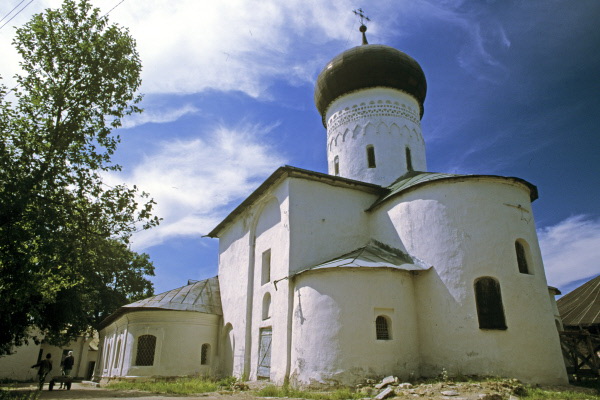 The Moscow Patriarchate is gradually cleaning the centers of sacred tourism. And while museum workers wave their hands from indignation, Vaska listens and eats.
The last glass of sour cream turned out to be the Cathedral of the Nativity of the Virgin of the Saltorsky Monastery with frescoes of the XIV century. The decision on its transfer of the Pskov diocese was made by the administration by a quiet, and the public was stated before the failed fact. Alas, the law “On the transfer of religious property to religious organizations” allows officials not to listen to the opinion of the museum community, which once again indicates its insufficient elaboration. While the employees of the Pskov State Museum-Reserve, in whose jurisdiction the cathedral was located, prepared official notes to regional officials, the director, not informing them, with one stroke of the pen terminated the security contract. The keeper of the monumental painting of the Cathedral of Taisiya Kruglova suggests that repair and restoration work has not yet been completed in the temple, and the future of a unique painting in question. She refused to transfer the keys to the cathedral to the officials of the Federal Property Management Agency. But how long can a lonely woman be able to resist the powerful woman?
Pskov claims to get into the list of cultural heritage of UNESCO in the nomination "Big City". However, the fathers of the city are doing everything possible so that this does not happen. Otherwise, why erect glossy remakes in the historical center and concrete the cultural layer, give unique monuments to the restoration of illiterate businessmen and trust the local diocese storage of the national heritage is a matter that it clearly cannot cope with.
Pskov Metropolitan Eusebius became famous for his vandal actions in the Cathedral of Trinity Cathedral. His persecution of the truly church people, such as Archimandrite Zinon and Father Pavel Adeelheim, once again testify that the lord wanted to sneeze both the church, which in the ribs and the church, which is in logs. It seemed that in the current situation, the church department for culture could show concern for the preservation of monuments transferred by the Russian Orthodox Church MP. But the archimandrite of Tikhon (Shevkunov), who heads him and did not move his finger. And it will not move. Yes, and why on earth: Vladyka Eusebius - the old friend, helped the honest father to expel the “renovation” community of Father George Kochetkov from the Moscow Sretensky Monastery. The raven of the crow will turn off the eye.
So the metropolitan rubs his hands: good money on tourists can be done. And not only on tourists. According to the order of the Government of the Russian Federation, 10 million rubles are allocated for the restoration of the cathedral. And the diocese, of course, will not remain in the lining.
Now, while the cathedral has not yet passed to the ROC MP, there is a collection of signatures under the appeal to the president with a request to return the temple to use the Pskov State United Historical, Art and Architectural Museum-Reserve. By the way, everyone can sign a signature under this appeal.
It would seem that to write, especially Putin. But still, a drop is sharpening a stone and you can’t give up completely without a fight.
In the Soviet years, museum workers saved the church antiquity from the commissioners. They were charged with that they turned the museum into a nursery of religious moods. Today, “Commissars in the cassors” accuse them of “captivity of the shrines”. And museum workers again have to enter into an unequal battle with ideology.
It is necessary to regret once again that for the sake of ideology in modern Russia, conversations about the joint use of temples by the church and the museum remained in the past. Nevertheless, it is the joint use of ancient monuments that remains the most promising - from the point of view of preserving cultural heritage. This is evidenced by the Church of St. Nicholas in Tolmachi, located on the territory of the Tretyakov Gallery. The state, when it wants, decides the resulting contradictions between the “churchmen” and “museum workers” and does not pushes their foreheads. The experience of the temple St. Nikolai shows that the inclusion of church structures in the system of social relations, their subordination to the norms of secular culture is beneficial for the whole society. Unfortunately, the practice of the Tretyakovka did not find widespread. But it remains as a sample: museum control over the state of antiquity monuments is backed up by the state status of a cultural institution.
Will the authorities go to the cultural community? Time will show. In the meantime, Vaska eats sour cream and purrs: freebie, freebie ...