Date
Author
Алексей Яшунский; Надежда Замятина
Source

Preserved copy
Translated material
"North" as a growth zone of the Russian province
Print Alexey Yashunsky , Nadezhda Zamyatin

* [1]
In the later Soviet era, a trip to the north was perceived as an opportunity to earn money. In the post -Soviet years, the possibilities of earning “in the capitals” increased sharply, in the north - decreased. Nevertheless, the Russian North is still the focus of a complex network of migration routes. What is happening in the north now?
North as an alternative Moscow
In the famous short story, O. Henry “the roads that we choose” (the very one in which “Bolivar cannot demolish two”) the hero discusses the identity of roads to New York and to the West: regardless of the chosen road, the result would be the same [2] . Moscow and the North are not more like New York and the Wild West-and yet there is a similarity here. Both Moscow and the North open up new opportunities in front of a young man from the hinterland; For the north, it is more correct to clarify: "It still opens."
The possibilities of earnings in the north with the transition to a market economy narrowed greatly. In this sense, the work in the north is attractive to very few, and even then about flying to Rostov “for a weekend to drink beer, because beer in Rostov is better”, as it happened during the period of “mastering the oil wealth of Western Siberia” in the 1970-80s, we have not been talking for a long time. High earnings are more or less preserved among experts in the oil and gas sector, occupying high posts-but first this post must be occupied. The thesis that “on Earth you can get the same money with smaller efforts” refrain is repeated on the Internet forums of the northern cities. Previously, wealthy northerners stereotyped by the workers of the raw materials industries (where, we repeat, for some specialists, but not ordinary bulkmen [3] , the North is still a place of earnings) and employees of the budget sphere and small business, where earnings are no longer a factor in attraction.
... more than 70 thousand only energy with the highest categories receive, officials in the rank of directors of deposits and their deputies, well, watchmen [4] .
Nevertheless, they continue to go to the north. Why? Nothing is so scarce in the north as qualified personnel - except that is warm. As economists express, the north is a laborious region. Therefore, having ceased to be a place of long money, the North largely remained a place of great career capabilities; Specialists are valued literally for its weight in gold.
-In Salekhard, you have to go with one or two higher education. Still, the capital of the Yamalo-Nenets Autonomous Okrug and the demand here is special.
- I agree with Sergey, having a good education, you can earn enough and without the so -called “gold mines” [5] .
It is worth going if you consider yourself promising specialists [6] . Young specialists are open everywhere. The old people are not delayed. And this is right [7] .
Of course, there are exceptions in the north. I will not forget the former chapter of one of the small towns of the Yamalo-Nenets district, a cheerful local king for about 15 years, who tightly closed the career stairs for everyone except his close associates. The Internet forum gives his statement regarding the possibilities of the social mobility of the young inhabitants of the “its” city (according to personal feelings-quite reliable):
When I studied at the TUMU branch, our respected mayor taught us at the 2nd year, he told us a phrase that I can’t forget “leave from here, you have nothing to do here, we don’t need you and my people to work in the administration, we need workers and oil workers” !!!! And these are the words of the mayor, interested in the development and prosperity of the city !!!! ?? [8]
Here, the North seemed to have lost its generic northern, front -line features and managed to "squash" into the Deaf Province over the 25 years of the city’s existence. Perhaps, in addition to the personality of the head, to a large extent contributed to the strong organizational dependence of the town on too close - as it turned out - the regional center: the town turned out to be too periphery than it is in the north. However, even in this town, many solid posts occupy young people; In the conversation, many of these guys themselves are surprised at their powers.
And it’s just typical: in the northern cities it is easy to meet young people - literally recent graduates - as head of the department of the city administration, chief architect of the city, chief editor, director, etc. In the north, a young specialist can often take a post, which would be more difficult and longer in Moscow, and in Moscow it is almost impossible.
The flip side of the northern variant of career growth is the fact that, having received a place, to work hard on it, as a rule, has to be in three.
It is necessary to work not only for themselves, but also for those guys on whom they saved the ZP Foundation, that is, you will pay 80 for you for the same work that two or three should have done, but for 60 each, here is such hard arithmetic in northern industries. Moreover, this practice is very common in both oil workers and gas workers [9] .
In oil and gas companies, there are fewer vacancies, the struggle for them is tougher. About the most successful, sitting at the winning deposits of the company, they say that it is almost impossible to get in them from the side. The main factor here is still a high salary; Career (and housing) - as additional, but very important “bonuses”. As a result, the classical formula for the attractiveness of the North for those employed in the oil and gas industry today consists of three components: high salary, housing and career growth prospects. A characteristic example of the logic of moving an employee of an oil and gas company:
... so tempting ... they offer ZP more than right now ... and the office pays for housing. Then the prospects for growth with the move to Noyabrsk [10] .
As additional factors of the attractiveness of the North, two more can be called. The first is a specific cultural environment. The economist and geographer Richard Florida who studied the attractiveness of American cities for the creative class identified low entrance barriers in the community as one of the main factors of attractiveness: the most creative, interesting people choose for the residence of the city in which they would not feel like strangers. In this regard, apparently, the modern north begins with Krasnoyarsk:
Arriving in Krasnoyarsk, a person becomes “his own”, in other cities there is no such thing ... When people from any land of Russia come here, they become Siberians. There are no nationalist sentiments in Krasnoyarsk - those who love this territory become full masters of the city, and this is very important [11] .
Of course, the situation differs from the city to the city: in the most “leased” northern cities, the inertness of the environment, the inability to accept new trends and a new person-quite at the level of some Pskov region (again a chapter, who “expelled” youth from his city). Nevertheless, in general, the tolerance of the northern communities, of course, is higher than in the old communities of the European part of Russia. The typical judgment of the North:
... There are no people like it anywhere else - on earth everything is tougher and more cynical in relation to the neighbor ... [12]
One of its most striking manifestations can be recognized as a rather high interethnic tolerance: many interethnic problems in the north “freeze”, seem artificial. So, for example, on Yamal, not only the holidays of the Tatar-Bashkir culture are held, but also teach in schools and kindergartens the so-called Tatar-Bashkir language-an unthinkable business in observing the “ritual cleanliness” of the ethnic group of Tatarstan and Bashkortostan.
Unlike the “tears of the non -believing” Moscow, the North is famous for the mutual assistance. Tips are easily given to a stranger here, suggest, help. On the city forum, you can easily find out a personal cell phone of a taxi driver chasing a minibus from the airport to the city (in fact, how else should it be if there is another way to overcome the city and airport of 200 km, in general, and there are no ... however, they can be lifted). The sincerity of people is called among the main factors that “hold” in the north.
- I knew that in the north there are very friendly people, but I did not even think that I could find such warm reviews and comments on the forum. I really really want you to you !!!)))
- Elya, yes, we are so friendly! And how else? After all, we must coexist in the community, so we are friends, so to speak. We love newcomers on the forum, we help in everything, so come, we will be happy to help something else [13] .
The times when people went north behind a long ruble have long passed. The people are also slowly changing - kindness, cordiality and responsiveness, which the North was so famous for is so glorified. Although of course, an order of magnitude more calmer than on Earth, for example, our children calmly, from six years old, cause a taxi and go alone, which is a lot of shocking visitors. You can still say in the same taxi that you forgot the money and give it another time, and they will believe you - for they really give it up [14] .
The second factor that makes an attractive northern career is the relatively large budgetary capabilities of many raw materials. Cities with a population of 20-30 thousand inhabitants in the north often have their own television, sociological service, chicly equipped schools, hospitals, and museums. Not every state employee has such opportunities for a creative experiment as his colleague in the north-therefore, enthusiastic professionals in the north are often more interesting than somewhere in Borisoglebsk.
It all depends on what to go here ... If the impressions are interesting here, if for money, then like everywhere - they need to be earned ... [15]
For managers, a large budget and the “All -Russian” significance of the city -forming industry also repeatedly discovered unprecedented opportunities: the northern cities became personal creations of their leaders. First of all, this is Norilsk, created by the decision of the head of the norillah Avraamia Zhenyagin, contrary to all plans of the State Planning Commission on the transportation of the extracted raw materials to large Earth-as a triumph of Soviet man over polar nature-and, perhaps, as a personal, career va-bank project of Zhenyagin himself. Also, outside the state plan, in the 1980s, the more modest city of Muravlenko in the north of Western Siberia was laid in the 1980s-from funds allocated for housing construction in Noyabrsk, a new city was founded 100 km from the “base”. It is easier for leaders who can widely, widely, in a naval, “steering from a city” are easier to give further steps of the career staircase; The brightest here is the career of the mayor of Moscow Seversyanin Sobyanin.
Not only the experience of northern work, but also the birth in the north in some cases gives career advantages. Children of rich oil and gas cities, as a rule, visit many high -class circles (northern mothers, like the capital, with mixed pride and pity, indicate that the day of their young children is painted in a minute) and “eat” the most modern educational technologies [16] . Many go to good universities; It is just right to talk about the north as a forge of highly educated personnel [17] .
The third - and he could become a decisive - a factor in the choice of a northern career could become housing. Talk about the problems of the northern cities is constantly reduced to two interconnected issues. First: there are not enough specialists. Economists, music teachers, surgeons, cosmetologists, cultural project managers ... The North wants to live a decent life, and for it - as Cat Matroskin said in the cartoon about Prostokvashino:
“We have funds, we don’t have enough mind.”
Mind - that is, human capital, personnel. Second: for attracting specialists, official housing is necessary. It is very likely that for the sake of a normal apartment to the north, we would go somewhere “on the ground” on the dormitories and communal services of a music teacher and surgeons. It already turns out that there are not enough funds: a lot of northerners - not only in the darkness of the polar night - live in terrible “beams” and “barrels”, dormitories and cramped “wood”. It is characterized by the paradox of the separation of “Neftegazova” and municipal power: oilmen and gas workers produce oil and gas - while they would like to live in well -maintained cities. The improvement of cities, as well as apartments to teachers and doctors serving the families of oil workers, provide municipal authorities with budget money; Between the teeth of this budget fork and the "official housing" fails ".
Nevertheless, people go to the north without budget housing; The cost of renting apartments in some Yamal cities is comparable with the cost of renting housing in Moscow. For some, not Moscow, but the North turns out to be a more real springboard. As a rule, these are guys from the most complex, depressed areas [18] , for which Moscow is too expensive.
North - to the Motherland
Unlike Moscow, the North is a refundable migration area. From Moscow (St. Petersburg, regional centers) they rarely return to the so -called historical homeland. The “Center - Periphery” model works here.
It is more difficult with the north. From the north - they return, carrying not only money earned in oil fields (by the way, ensuring “on earth” solvent demand and thereby contributing to the development of its economy), but also experience and specific cultural skills of northerners.
The “Buildings” model of the north into the social fabric of Russia is quite complicated and covers at least two generations. Unique data on personal migration to the north can be traced from their “traces” in the youth social Internet network “VKontakte” [19] .
We have chosen data on all the two Yamal cities (Muravlenko and Gubkinsky) who have ever studied in all schools registered users of the network aged 20 to 29 years. The corresponding search query (June 2012) gave 3263 accounting cards of students in the city of Gubkinsky [20] (under the population of the city 23.5 thousand people) and 5221 account card of former schoolchildren of Muravlenko (with the city population 37.3 thousand people). For the analysis, the data presented by the network participants in the City category, which were considered as an indication of a modern place of location, were used.
Both the total number of people registered in the network of this age, and the number of those who left the city (at least 40 % of all youth) approximately correspond to the official data on the age structure and dynamics of the population of cities.
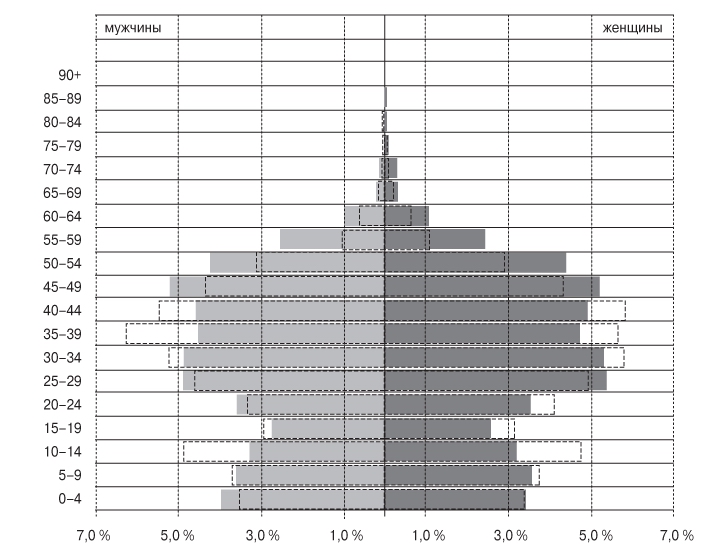
Currently, both cities are characterized by a sharp outflow of the population at young ages, clearly visible on gender and age pyramids (for example, consider the sexual age pyramid of the city of Gubkinsky - see Fig. 1).
Rice. 1. The dynamics of the sexual age structure of the population of Gubkinsky since 2002 (dashed) for 2010.
Source: Strategy for socio-economic development of Gubkinsky until 2020.
A very low population aged 15-19 years is striking on the gender age pyramid; The share of youth aged 20-24 years is also reduced. In 2010, a similar situation was characteristic of Russia in 2010-however, in the country, the proportion of children aged 8-16 years (that is, the cohort of children born in the late 1990s) was reduced, the all-Russian situation is associated with the so-called echo of war (a low birth rate in 1941-1945 was reflected at the level of birth, respectively, after two generations), aggravated by an additional addition of the birth rate in the birth rate in The 1990s in connection with a difficult economic situation. In Gubkinsky, however, a decrease in the birth rate in the 1990s is not as noticeable as in Russia as a whole (where the number of generations born in the 1980s and in the 1990s is almost half). Literally in Gubkinsky literally disappeared in 2002-2010 almost a third of the cohort of children born in 1992-1997, which in 2002 was 10-14 years old, respectively. In 2010, these children should have turned 18-24. However, the number of young people aged 15-19 years and 20-24 in 2010 is significantly lower than the number of the same generation in 2002. Thus, literally “leaching” of young people from the city, mainly associated with leaving to the place of study, occurs.
The analysis of accounting cards showed that at the time of the study in the city of graduation, no more than 60 % of city school graduates lived (38 % of graduates of Muravlenko schools and 39.4 % of graduates of Gubkinsky schools) - which is generally consistent with official demographic data. Out of half the departments are concentrated in cities that adopted more than three graduates of the schools of this city. The most significant part of the youth of both cities ended up in Tyumen (5.6 %of young people from the sample to Muravlenko and 6.9 %in Gubkinsky), Moscow (2.6 and 5.4 %), St. Petersburg (3.6 and 3.0 %), Yekaterinburg (2.7 and 2.3 %).
The bunch hit of graduates of schools of Muravlenko and Gubkinsky to the settlements that were very remote from these cities (see Appendix) is noteworthy. Some of these heap hits are reliably connected with childhood cities of first builders of the corresponding cities. So, Gubkinskaya youth (unlike Muravlenkovskaya!) Often migrates to Belarus: it is known that Gubkinsky was built, in particular, by the forces of the Belarusian Komsomol detachment “Young Guard”, whose former commissar has been the head of the city of Gubkinsky since 1996. Муравленковская молодежь в большей степени концентрируется в Западной Украине — факт, необъяснимый вне гипотезы возврата к «родине предков».
Районы, в наибольшей степени притягивающие ямальскую молодежь, это помимо столичных городов — Татарстан и Башкортостан (в меньшей степени — Удмуртия). Западный Татарстан и Башкортостан (Белебей, Октябрьский и др.) — районы, давшие значительное число мигрантов в период освоения Тюменского Севера в 70—80-х годах XX века (здесь к тому времени стали истощаться собственные нефтяные запасы, и нефтяники в массовом порядке переводились в Тюменскую область). Проведенные в городе Муравленко экспертные интервью показывают: поддерживаемые с земляками диаспорные связи являются одним из факторов воспроизводства рынка рабочей силы на Севере (так, например, предприниматель, уроженец Башкирии, предпочитает не нанимать рабочую силу в городе, а «выписывать проверенных людей» с родины; в нефтегазовые компании также устраиваются в значительной степени «по знакомству»).
Немалые потоки северян направляются и в районы традиционного оттока населения. В нашем исследовании к таковым относятся некрупные областные центры Киров и Пенза; здесь также можно уверенно говорить о возвратной миграции. В качестве доказательства приведем следующие рассуждения. 12 человек из выборки указали Киров в качестве родного города в Губкинском, 5 — в Муравленко; Пензу соответственно 5 — в Губкинском и 1 — в Муравленко. Часть из них по окончании школы уехала на родину, часть осталась на Севере. При этом в Киров и Пензу по окончании школы в Губкинском направляется часть уроженцев самого Губкинского. С большой степенью уверенности можно утверждать, что эти люди родились на Севере у родителей, в свое время уехавших из Кирова и Пензы, и теперь, по окончании школы, они возвращаются «на историческую родину». Возможно, ребята поступают в знакомые родителям вузы (и, очень вероятно, едут в ждущие «на земле» квартиры).
Особого внимания заслуживает высокая концентрация молодых северян в южных районах (Краснодар, Ставрополь, Ростов-на-Дону, Белгород, Курск и др.). Она также сочетается с большим количеством жителей города, которые указали эти города в качестве родных. Так, в частности, в изученной выборке 13 человек, окончивших школу в Муравленко и 8 — в Губкинском, указали в качестве родных города и станицы Краснодарского края (часть из них в итоге оказалась в Краснодаре, часть осталась по месту окончания школы). В качестве «родного города» указали Белгород 7 человек в Губкинском и 3 — в Муравленко (также часть из них уехала на родину, часть осталась; при этом в Белгород переехали и многие родившиеся на Севере), Курск — соответственно 4 и 1 Ростов-на-Дону и Ростовская область — 3 и 17, Ставрополь и Ставропольский край — 16 и 7. Иными словами, имеет место встречная миграция: многие родились в Краснодарском крае или Белгородской области, но пока остаются на Севере; в то же время немало северян перебирается именно в Краснодарский край и Белгородскую область (явно предпочитая их, допустим, Астраханской, Воронежской или Калужской областям). Предпочтение для миграции городов, ставших в свое время крупными центрами диаспор, позволяет считать социальные сети ключевым фактором выбора места миграции. Едут туда, где или есть родственники (тогда это возвратная миграция «через поколение»: родители — на Север, дети — обратно, к бабушкам), или заодно с друзьями (более вероятно: с мужем, женой) — на их родину или к их родственникам.
Таким образом, высокий отток молодежи на Кубань и на юг Черноземья связан не только с климатическим, но и с «диаспорным» фактором. Наряду с известной тенденцией северян поселяться по возвращении с Севера в южных районах страны имеет место не просто движение на юг, но возвратное движение на юг детей тех, кто в свое время уехал из трудоизбыточных южных регионов, в рамках сложившихся и поддерживаемых землячествами каналов миграции. Что характерно, диаспорные связи четко проявляются не только среди представителей национальностей, для которых характерно сохранение традиционных институтов (народы Кавказа, в меньшей степени — башкиры), но и среди земляков русских территорий (Кировская, Пензенская, Курская, Белгородская области и др.), а также среди белорусов и украинцев. Тем самым диаспорные (земляческие) институциональные каналы оказываются практически универсальным российским фактором регулирования миграционных потоков.
Главный вывод, который можно сделать из анализа миграций северной молодежи, таков: отток с Севера — отнюдь не беспорядочное бегство в районы с благоприятными условиями проживания. Это довольно жестко локализованная возвратная миграция! Молодежь с Севера едет поступать в вузы (или работать) в регионы, в свое время покинутые их родителями ради «покорения Севера». Особенно важна роль данного фактора в отношении наиболее теплых южных районов типа Белгородской области и Кубани (Краснодарский край), которые традиционно считаются местом «оседания северян в теплых краях» — дело здесь не только в тепле, но и в личных историях северян: сюда возвращаются те, кто в свое время уехал из этих трудоизбыточных регионов с большой долей сельского населения, или их дети. Северяне и южане оказываются родственниками [21] .
Таким образом, не только Краснодар или Татарстан снабжают Север трудовыми ресурсами. Через поколение, наоборот, Север оказывает снабжающим Краснодар и Татарстан населением. Причем приезжающее с Севера население, можно сказать, «улучшенного качества». Молодежь получила в нефтегазовых городах хорошее образование (см. выше). Многие северяне «повидали мир», поскольку имели возможность ежегодно ездить в отпуск (в отличие от многих «сидевших на месте» жителей Татарстана или Краснодара) — и имеют более широкий кругозор. Приезжающие имеют опыт жизни в гетерогенном, многонациональном и толерантном сообществе северян. Наконец, бывшие северяне включены в широкие социальные сети (заметим, что сети земляков, как и вузовских сокурсников, в современном мире считаются важнейшим ресурсом в бизнес-взаимодействиях).
Далее логично предположить следующее:
- Каждый северный город снабжает «человеческим капиталом» более широкие социальные сети, чем аналогичные по населению города основной зоны расселения.
- В обычной российской «глубинке» именно Север является одним из важнейших (в современных условиях — наряду со странами СНГ) источников разнообразия человеческой среды местных сообществ.
Для проверки данных выводов мы провели аналогичное исследование размещения молодежи из нескольких среднерусских городов, аналогичных по населению Муравленко и Губкинскому: Бежецка (3,2 тыс. учетных карточек; население города 24,5 тыс. чел.) и Конаково (5,6 тыс. учетных карточек; население города 41 тыс. чел.) в Тверской области и Городца (3,5 тыс. учетных карточек; население города около 30 тыс. чел.) в Нижегородской.
Из этих среднерусских городов уезжают реже, чем с Севера: в туристическом Городце достоверно осталось почти 60 % местной молодежи, в более «захолустном» Бежецке — чуть менее 50 %, в по сути подмосковном Конаково — 60 %.
Однако миграции «среднерусской молодежи» действительно оказались значительно более концентрированными. В первую очередь население малых городов оттягивают региональные «столицы»: целых 18 % городецкой молодежи оказалось в Нижнем Новгороде, 13 % бежецкой — в Твери (еще 7 % — в Петербурге и чуть меньше процента — в Ярославле). Конаково, по сути вошедший в состав московской агломерации и соединенный с ней прямой электричкой, «питает» Москву уже в большей степени (11,7 %), чем свою областную столицу Тверь (3,5 %). Москва оттянула также 1,5 % молодежи из Городца и 4,7 % — из Бежецка (здесь характерно, что для уроженцев маленького Бежецка, расположенного примерно между Москвой и Санкт-Петербургом, Петербург оказывается более привлекательным или более доступным, чем столица).
В итоге малые города основной зоны расселения оказываются жестко «впаянными» в двухуровневую систему «центр — периферия» (один уровень — региональный центр; в наших примерах — Нижний Новгород, Тверь; второй — ближайшая из «столиц», то есть Москва или Санкт-Петербург).
«Перемешивание» населения ограничено небольшой близлежащей зоной (Городец — Заволжье — Балахна — Богородск — Дзержинск; Конаково — Дубна — Клин — Химки — Зеленоград). Такое локальное перемешивание практически не увеличивает разнообразия культурной среды данных городов; заметим, что культурное разнообразие рассматривается как один из важнейших ресурсов, стимулирующих креативность городской среды.
Лишь единицы выходят здесь за пределы модели «в столицу или соседний город». Едут, опять же, в города Севера и Сибири, создавая базу для возвратной миграции (а судя по данным о местах рождения земляков, воспроизводя миграционные потоки «туда — обратно» уже в третьем поколении). Так, заметны слабые (2—4 человека) двухсторонние диаспорные связи Городца с Владивостоком и Магаданом, Бежецка — с Мурманском, Конаково — с Владивостоком. Единицы уезжают также в Калининград, в какой-то мере играющий роль Севера (возвратная миграция здесь, однако, не обнаружена).
В итоге в малых городах европейской части России живут преимущественно местные уроженцы — и, следовательно, не может не формироваться довольно консервативная среда. Небольшое разнообразие вносят уроженцы стран СНГ (Душанбе, Баку и др.), а также названные двухсторонние миграции в рамках «диаспорных» каналов на Север и обратно.
Напротив, каждый северный город служит «отправной точкой» для широкого «веера» миграций. Примерно столько же молодежи, сколько из провинциальных городков средней части страны, отсюда отправляется в «тупиковое» путешествие в Москву; большая же часть молодежи по сути рассредоточивается по стране. При этом сохраняется некое братство, связь с городом своего детства, а также с товарищами-северянами, даже если они уже давно разошлись по разным городам страны (в этом легко убедиться, зайдя на любой из многочисленных «земляческих» форумов в Интернете).
Если следовать западным моделям оценки социального капитала, то именно Север следовало бы признать важнейшей «кузницей» социальных сетей России — при том что именно социальные сети считаются экономистами одним из мощнейших ресурсов распространения инноваций в современном мире. Развивая эту мысль, можно было бы рассматривать «прокачку» человеческого ресурса через Север как элемент повышения конкурентоспособности России. В России качество человеческого капитала с точки зрения жизненного опыта и его роль в экономическом развитии до настоящего времени почти никто не оценивал [22] .
Не надо бороться с дверью
Разговоры о Севере, как правило, крутятся вокруг дилеммы: бросить или осваивать, заселять или расселять. На самом деле существует третья альтернатива. Вместо того чтобы выбирать какой-то один вариант, было бы целесообразно осознать и использовать подвижность его насельников. Отношение к Северу можно проиллюстрировать на примере многим знакомой борьбы со стеклянными дверями на входе в московское метро. В зависимости от того, приходит на станцию поезд или отправляется в тоннель, двери то сами открываются, то с силой бьют заходящего в вестибюль — и, чтобы открыть их в такой момент «от себя», надо приложить немалые усилия. Лишь немногие находчивые пассажиры понимают, что вместо того, чтобы, прилагая все силы, толкать дверь от себя, легче пропустить ее, открыв «на себя» — она открывается сама, надо лишь посторониться. Аналогично и с Севером. Его нельзя бросить, чтобы не получить по лбу энергетическим, геополитическим или иным дефицитом. Но и не следует заселять его, прилагая титанические усилия для закрепления людей на Севере. Необходимы мягкие стратегии, идущие по течению потоков социальной мобильности. Необходимо облегчать путь на Север для молодежи — понимая, что для многих это шанс карьерного роста, — но и способствовать встречному потоку желающих выехать. Необходимы механизмы, увязывающие эти потоки на благо и тем и другим. В первую очередь необходимо урегулирование и, возможно, увязка вопросов со служебным жильем на Севере и жильем для заслуженного отдыха «на земле». Очень перспективной представляется тема «вахтового» обеспечения Севера не только нефтяниками, но и редкими специалистами-консультантами (хирургами, музыкантами, косметологами...).
Необходимо осознать Север как специфический, сложившийся и устойчивый элемент социальной системы страны — как одну из возможных «точек роста» персональных карьер, точку мужания, точку обучения. Нередко транслируемый образ Севера как некой «прорвы», выкачивающей человеческий капитал из исторических районов страны, — в корне неверен. Реально Север снабжает эти районы более качественным человеческим капиталом: в них возвращаются люди с опытом, уверенные в себе; приезжает хорошо образованная и повидавшая мир молодежь.
В США принято утверждать, что фронтир (Запад) сделал американцев более деловыми, практичными, открытыми к эксперименту и демократичными. Российский Север, возвращая стране мощные потоки прошедших через него людей, делает Россию в целом более опытной, уверенной, толерантной. По сути Север — российская зона роста и обучения.
Application. Города проживания выпускников школ городов Губкинский и Муравленко (в возрасте 20—29 лет) по данным сети «ВКонтакте», июнь 2012 г.
City | Количество выпускников, указавших данный город при регистрации в сети ВКонтакте | City | Количество выпускников, указавших данный город при регистрации в сети ВКонтакте | ||||||
Муравленко | Gubkinsky | Муравленко | Gubkinsky | ||||||
Чел. | % | Чел. | % | Чел. % | Чел. % | ||||
По всем городам учтено в исследовании | 5221 | 100 | 3263 | 100 | Губкинский — для выпускников школ Муравленко, Муравленко — для выпускников школ Губкинского | 12 | 0.2 | 2 | 0.1 |
Указали на местонахождение в городе, где окончили школу | 1984 | 38.0 | 1284 | 39,4 % | |||||
Указали на местонахождение в других городах В том числе: | 2227 | 42.7 | 1332 | 40.8 | Kirov | 3 | 0.1 | 9 | 0.3 |
Kursk | 10 | 0.2 | 2 | 0.1 | |||||
Lviv | 9 | 0.2 | 2 | 0.1 | |||||
Tyumen | 290 | 5.6 | 226 | 6.9 | Magnitogorsk | 6 | 0.1 | 3 | 0.1 |
Moscow | 135 | 2.6 | 175 | 5.4 | Nizhnevartovsk | 6 | 0.1 | 3 | 0.1 |
Saint Petersburg | 190 | 3.6 | 98 | 3.0 | Tver | 6 | 0.1 | 3 | 0.1 |
Yekaterinburg | 143 | 2.7 | 76 | 2.3 | Kishinev | 3 | 0.1 | 6 | 0.2 |
Ufa | 124 | 2.4 | 54 | 1.7 | Волгодонск | 8 | 0.2 | 2 | 0.1 |
Omsk | 74 | 1.4 | 43 | 1.3 | Новый Уренгой | 8 | 0.2 | 1 | 0.0 |
Samara | 70 | 1.3 | 23 | 0.7 | Салават | 8 | 0.2 | 2 | 0.1 |
Chelyabinsk | 62 | 1.2 | 22 | 0.7 | Khmelnitsky | 5 | 0.1 | 3 | 0.1 |
Ноябрьск | 68 | 1.3 | 15 | 0.5 | Липецк | 4 | 0.1 | 4 | 0.1 |
Салехард | 68 | 1.3 | 6 | 0.2 | Barnaul | 1 | 0.0 | 8 | 0.2 |
Krasnodar | 38 | 0.7 | 31 | 1.0 | Нефтекамск | 7 | 0.1 | 1 | 0.0 |
Kazan | 47 | 0.9 | 19 | 0.6 | Миасс | 3 | 0.1 | 4 | 0.1 |
Novosibirsk | 50 | 1.0 | 15 | 0.5 | Ulyanovsk | 3 | 0.1 | 4 | 0.1 |
Belgorod | 25 | 0.5 | 27 | 0.8 | Харьков | 2 | 0.0 | 5 | 0.2 |
Kyiv | 17 | 0.3 | 23 | 0.7 | Astrakhan | 6 | 0.1 | 0 | 0.0 |
Volgograd | 22 | 0.4 | 17 | 0.5 | Baku | 6 | 0.1 | 2 | 0.1 |
Togliatti | 27 | 0.5 | 7 | 0.2 | Днепропетровск | 6 | 0.1 | 1 | 0.0 |
Permian | 19 | 0.4 | 15 | 0.5 | Pyatigorsk | 6 | 0.1 | 0 | 0.0 |
Surgut | 25 | 0.5 | 8 | 0.2 | Syzran | 6 | 0.1 | 1 | 0.0 |
Voronezh | 21 | 0.4 | 9 | 0.3 | Taganrog | 6 | 0.1 | 2 | 0.1 |
Sterlitamak | 22 | 0.4 | 6 | 0.2 | Тобольск | 6 | 0.1 | 2 | 0.1 |
Nizhny Novgorod | 18 | 0.3 | 9 | 0.3 | Engels | 6 | 0.1 | 0 | 0.0 |
Stavropol | 18 | 0.3 | 8 | 0.2 | Simferopol | 3 | 0.1 | 3 | 0.1 |
Minsk | 8 | 0.2 | 17 | 0.5 | Bryansk | 5 | 0.1 | 2 | 0.1 |
Rostov-on-Don | 14 | 0.3 | 9 | 0.3 | Мукачево | 5 | 0.1 | 0 | 0.0 |
Izhevsk | 12 | 0.2 | 11 | 0.3 | Odessa | 5 | 0.1 | 1 | 0.0 |
Naberezhnye Chelny | 19 | 0.4 | 3 | 0.1 | Reflected | 5 | 0.1 | 0 | 0.0 |
Orenburg | 13 | 0.2 | 8 | 0.2 | Ternopol | 5 | 0.1 | 0 | 0.0 |
Tomsk | 8 | 0.2 | 9 | 0.3 | Sochi | 2 | 0.0 | 3 | 0.1 |
Надым | 16 | 0.3 | 1 | 0.0 | Makhachkala | 4 | 0.1 | 0 | 0.0 |
Donetsk | 10 | 0.2 | 6 | 0.2 | Nevinnomyssk | 4 | 0.1 | 0 | 0.0 |
Penza | 5 | 0.1 | 11 | 0.3 | Туймазы | 4 | 0.1 | 0 | 0.0 |
Mound | 4 | 0.1 | 12 | 0.4 | Ust-Kamenogorsk | 4 | 0.1 | 0 | 0.0 |
Almetyevsk | 15 | 0.3 | 1 | 0.0 | Khanty-Mansiysk | 4 | 0.1 | 0 | 0.0 |
Ивано-Франковск | 15 | 0.3 | 1 | 0.0 | Черновцы | 4 | 0.1 | 0 | 0.0 |
Пурпе | 0 | 0.0 | 14 | 0.4 | Shadrinsk | 4 | 0.1 | 0 | 0.0 |
Saratov | 8 | 0.2 | 5 | 0.2 | Novomoskovsk | 1 | 0.0 | 3 | 0.1 |
Gomel | 5 | 0.1 | 8 | 0.2 | Novorossiysk | 1 | 0.0 | 3 | 0.1 |
Cheboksary | 5 | 0.1 | 8 | 0.2 | Ryazan | 0 | 0.0 | 4 | 0.1 |
Note. В таблицу внесены все города, которые отметили в категории «город» не менее трех выпускников школ либо Муравленко, либо Губкинского.
[1] Работа подготовлена на основе материалов, собранных в рамках проекта РГНФ № 11 -02-000443-а (руководитель А. Н. Пилясов, которому авторы признательны за содержательное обсуждение идей работы).
— Я родился на ферме в округе Олстер. Семнадцати лет я убежал из дому. И на Запад-то я попал случайно. Шел я по дороге с узелком в руках, хотел попасть в Нью-Йорк. Думал, попаду туда и начну деньги загребать. Мне всегда казалось, что я для этого и родился. Дошел я до перекрестка и не знаю, куда мне идти. С полчаса я раздумывал, как мне быть, потом повернул налево. К вечеру я нагнал циркачей-ковбоев и с ними двинулся на Запад. Я часто думаю, что было бы со мной, если бы я выбрал другую дорогу.
— По-моему, было бы то же самое, — философски ответил Боб Тидбол.
О. Генри. Дороги, которые мы выбираем. 1904.
[3] Помощник бурильщика.
[4] Из обсуждения перспектив переезда на Север на салехардском форуме: http://drahelas-forum.ru/forum/topic/490-stoit-li-ehat-zhi/page_view__findpost_p_121201
Заметим: вахта хорошо оплачивается далеко не во всех компаниях и не во всех районах.
[5] http://drahelas-forum.ru/forum/topic/490-stoit-li-ehat-zhi/page__view_findpost__p_1326 и http://drahelas-forum.ru/forum/topic/490-stoit-li-ehat-zhi/page_view__findpost_p_1153
[6] http://rabota55.ru/forum/board/job55/tree/1880131561/?vc=1&sort=5&period=#Post1880131561
[7] http://rabota55.ru/forum/board/job55/tree/1880131581/?vc=1&sort=5&period=#Post1880131581
[8] http://www.muravlenko.com/forum/topic_193#post-2450
[9] http://forums.drom.ru/86-89/tll51355103-p2.html#postl084734795
[10] Из обсуждения на форуме перспективы переселения в Губкинский и Пурпе. http://forums.drom.ru/86-89/tll5l355l03-p6.html#postlll6460l96
[11] «Мы засиделись в Москве». Депутат Госдумы Виктор Зубарев объяснил, почему он предлагает перенести столицу в Красноярск // Взгляд. Деловая газета. 2011. 11 февраля. http://vz.ru/society/2011/2/11/468065.html
[12] http://forums.drom.ru/86-89/t1151355103-p4.html#post1085057990
[13] http://drahelas-forum.ru/forum/topic/490-stoit-li-ehat-zhi/page__view_findpost__p_24747
[14] http://drahelas-forum.ru/forum/topic/490-stoit-li-ehat-zhi/page__view_findpost__p_120975
[15] http://drahelas-forum.ru/forum/topic/490-stoit-li-ehat-zhi/page__view_findpost__p_7951
[16] В качестве небольшой иллюстрации: инновационный проект внедрения в школе электронных учебников тестировался в четырех школах страны. Помимо московской и челябинской — в двух сибирских: на юге Сибири, в Томске, и на Севере — в 23-тысячном городке Губкинский в Ямало-Ненецком округе.
[17] Разумеется, это не относится к детям депрессивных районов Севера, и особенно — к детям коренных малых народов Севера.
[18] Мы располагаем, в частности, данными о том, кто поехал на Север в 2005—2010 гг. после окончания химического (Норильск, Сургут) и физико-технического (Когалым, Нижневартовск) факультетов ТГУ (по регистрациям в сети «ВКонтакте»): это ребята из Казахстана, Алтайского края и Кемеровской области.
[19] Подробнее об использовании данного источника см.: Замятина Н. Ю., Яшунский А. Д. Межрегиональные центры образования // Отечественные записки. 2010. № 3 (48). С. 74—84.
[20] Учитывались все обучавшиеся в школах города Губкинского и Муравленко и зарегистрированные в сети «ВКонтакте» молодые люди, которым на момент исследования было 20—29 лет. Для краткости далее будем называть их выпускниками школ Губкинского и Муравленко; в подавляющем большинстве случаев это так и есть, но отдельные люди могли уехать из данных городов до окончания школы.
[21] Подобное допущение разъясняет кажущееся противоречие, отраженное в следующем диалоге на форуме:
— А как же северная мета — накопить на коттедж в краснодаре и срулить?
— Идиотизм а не мечта, не примут "местные" северянина, проверено и не раз.
http://forums.drom.ru/86-89/ t1151355103-p3.html#post1084788820
— Почему же не примут? Судя по южным форумам там уже полно северян и сибиряков! Да и я знаю людей уехавших в Краснодар.
http://forums.drom.ru/86-89/t1151355103-p3.html#post1084842373
[22] Исключение: Пилясов А. Н., Колесникова О. В. Оценка творческого потенциала российских региональных сообществ // Вопросы экономики. 2008. № 9. С. 50—69.
Цена успеха в советском кино Отходничество в современной России