
Translated material
New racism in Russia
The words made in the title of the article can cause bewilderment and even indignation. How? Racism in Russia? In the country with a centuries -old tradition of interethnic marriages and active mixing of cultures and languages? Where for decades, the Soviet ideology of internationalism has been vaccinated for people, which affirmed the equality of races, nationalities and cultures? Where is Alexander Pushkin considered the greatest national poet with his Ethiopian roots?
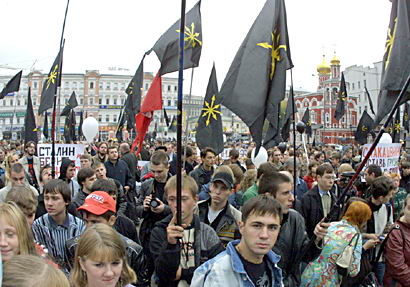
Nevertheless, no matter how sad it is, today we must admit that racism has already come to Russia. He at a terrifying speed conquers a media space, seduces some scientists, enters the household language, leads the actions of skinheads and affects public moods.
Racism did not suddenly appear. The roots of racial attitudes go, oddly enough, in the Soviet era, but a favorable climate for the growth of their popularity arose in the last ten to fifteen years. The Soviet Marxism had its own specifics. Keeping in words devotion to the class approach, in fact, over the last Soviet decades, he paid more and more attention not so much to the class as the ethnic division of society. It was not only about identity. Ethnic groups were perceived as separate integrity with their original cultures and languages, as well as attention! - With their "national characters." They could be kind or evil, show nobility and goodwill or, on the contrary, differ in revenge or treachery. Ethnic groups were attributed strictly defined stereotypes of behavior, with an iron sequence perceived as properties that are immanently inherent in any member of the ethnic group.
Such ideas were not just widely existed among the peoples of the USSR, but caused sympathy and artificially cultivated by local intellectuals as a powerful means of protection against universal Russification. For their own purposes, they were also used by the authorities, which did not cost nothing to blame entire nations of treason and deport them, despite the fact that many representatives of these peoples honestly defended their homeland on the fronts of the most bloody war of the 20th century. It came to the point that the heroes of the war were removed from the front and sent into exile after their punished relatives. So a complex of collective guilt was pierced, pursuing people even after they returned home. Behind all this was a faith in the “national character” with its stable set of features. This became possible as a result of the perception of an ethnic group as a closed organism. Indeed, in the 19th century, in the bowels of German nationalism, “organic theory” has gained extraordinary popularity in science in recent Soviet decades. She entered the Soviet theory of an ethnic group in the form of an “ethno-social organism”. The last step in rehabilitation of the racial approach was taken by historian Lev Gumilev, who endowed the ethnos with a biological beginning.
Let me remind you that in its classical form, the racial theory asserted, firstly, the discreteness of mankind, consisting of racial categories clearly delimited from each other, and secondly, the inextricable connection of the physical appearance with the spiritual world-the racists loved to talk about the "racial shower". And, if the “scientific racism” suffered a crushing defeat in the West, then in the USSR he was actually revived in the theory of Gumilyov ethnogenesis, appealing to the allegedly unchanging “ethnic stereotypes of behavior”, which restore us all to the same concept of “national character”, rightly rejected by Western science by the beginning of the 1960s. Today, when many intellectuals with heat quote the works of Gumilyov, and some even eager for him to erect monuments, it is unharmed to remind him that his theory containing the provisions of “bad peoples” (“chimera”) and “non -depth” interethnic relations actually justify both Stalin's deportations and modern ethnic conflicts.
In the late 1980s, Gumilev turned into a “ruler of thoughts” from Marginal. His books began to be produced by huge circulations, his ideas were picked up by the figures of the education system and began to enter school textbooks, and his “ethnogenesis theory” was constantly quoted both by politicians and the leaders of ethno -national movements. This is explained simply - after all, declaring ethnic groups with biological integrity, it fits perfectly into the paradigm of ethnic nationalism, not only legitimizing it, but also supplying paracacchound argument. Therefore, the "ethnic revival" of the turn of the 1980-1990s. Gumilyov perceived many ideas with enthusiasm, the benefit of the extreme inconsistency and inconsistency of his constructions allowed any nationalism to interpret them in their favor. The Russian popular, general and even scientific literature was filled with as small -containing as attractive terms “superethnos”, “civilization”, “passionarity”, “phases of ethnogenesis”, which allowed any author to interpret them at all, filling the information space with new pseudo -scientific arguments.
Meanwhile, breaking through the media and even school textbooks, such concepts are far from harmless. After all, they teach the fact that there are not only “passionaries”, but also “subpassionaries”, that ethnic groups not only bloom, but also fall into decay, which, in addition to “civilizations of continuous development”, is also “civilizations of the non -aggressive form of existence”. Moreover, from the idea of ethnic groups as closed integrity with a special worldview and stereotypes of behavior, the idea of their cultural incompatibility follows, and the doctrine of different “phases of ethnogenesis” inevitably leads to the idea of real inequality and even the “conflict” of civilizations. All such ideas are characteristic today by the “new racism”, which some scientists call “cultural”, others - “differential”. In contrast to old racism, he focuses not so much on the principle of blood as on culture, considering a person not as an individual who is able to creatively adapt to a rapidly changing environment, but as a member of the ethnic group (or even civilization!), Passively assimilating its imperishable values and mechanically reproducing the stereotypes of behavior. From this point of view, the individual is not of much interest; It is enough to know his ethnic (or “civilizational”) belonging to penetrate his thoughts and predict his behavior. So the terms of the “face of Caucasian nationality” type appear.
It was this simplified approach to the surrounding reality that was laid down in the theory of Gumilyov, who, calling himself the “father of ethnology,” he never conducted ethnographic research, and whose experience of close communication with people of other nationalities was limited to staying in the Gulag. Therefore, he did not know that ethnic identity (ethnicity) could be floating, situational, symbolic. It is not necessarily related to linguistic affiliation, as Soviet people are used to thinking. Sometimes it relies on religion (grunted, or baptized Tatars), economic system (deer cliffs-focused and settled Koryaki-Syllans), Rasu (Afro-American), historical tradition (Scots). People can even change their ethnicity, as happened in the 19th century in the Balkans, where, moving from rural life to trade, a person turned from Bulgarian into Greek. Moreover, the language factor did not serve this obstacle, because people well mastered both languages.
Even more paradoxical today is a traditional culture, which public consciousness considers decisive for ethnicity. It is difficult for people who have lived in a homogeneous cultural and linguistic environment all their lives to imagine the phenomenon of polyculture and multilingualism. Meanwhile, this is exactly what is found in many regions of the world. In the distant past, the same was also characteristic of the Russians who lived on the outskirts of their ethnic area with the neighborhood with the Tatars, Yakuts or the peoples of the North Caucasus. That is why a lot of Turkic borrowings are found in the Russian language.
The traditional culture looks even more paradoxical today, which public consciousness allows a number of ethnicity. However, the role of such a culture in a modern ethnopolitical context is radically changing. After all, traditional culture is difficult to maintain competition with the current mass culture. Therefore, in modern society, traditional culture is forced to lose its inextricable connection with the way of life. However, people fighting against discrimination, it is traditional culture that seems to be the most important resource that makes this struggle legitimate. The paradox of the situation is that in order to obtain an equal position in a modern society, such a group has to turn to a resource that does not correspond to such a society. Therefore, losing its former functionality, traditional culture becomes a source of the most important symbols, and it itself turns into a sign symbol, which allows the outcast to demonstrate their originality and, based on it, to demand public recognition. But, becoming a symbol, traditional culture inevitably loses its authenticity and opens vast expanse for folklore innovations and interpretations that provide its users with a wide freedom of choice. That is why the vorial view of the specialist immediately notes a violation of ritual norms, the departure from the traditional custom, entirely observed in modern folk rituals and holidays. All this is quite natural, because today the ethnopolitical symbolism becomes perhaps the only function of traditional culture.
In the modern world, ethnicity generally appeals, first of all, to symbols. Say, a person can call himself a Kazakh and consider the Kazakh language to the family, but speak only in Russian. In general, we all live today not in one, but in several different cultures at once. Yes, we speak Russian, but we look at American militants, wearing Chinese clothes, buy Japanese cars ... And what does the image of traditional Russian culture make up? A samovar who came from Iran, a nesting doll, brought from East Asia, and potatoes that came to Russia from South America! All this proves that ethnicity is based not so much on realities as on images. In fact, the so -called ethnic cultures are hybrid and heterogeneous. There is nothing biological in them. Only such an approach is able to overcome the legacy of the Soviet theory of ethnic groups, refute the pseudo -scientific constructions of Gumilyov and resist the cultural racism.
The author is the main researcher at the Institute of Ethnology and Anthropology of the Russian Academy of Sciences, Doctor of Historical Sciences