
Translated material
Nechaev is a destroyer
In society
 Nechaev is a destroyer
November 28, 2012 Anatoly Bershtein
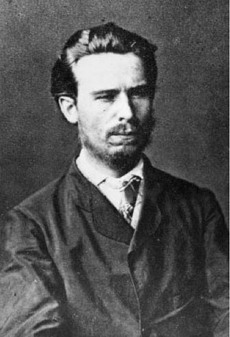 Not so long ago, one of the politicians branded the actions of Sergei Udaltsov, calling them Nechayevchina. How fair is the leader of the Left Front awarded such a branded label - a separate conversation. But the prototype of the brand itself, Sergey Nechaev - the date: it turned 130 from the date of his death in the Alekseevsky Ravelin of the Peter and Paul Fortress.
Sergey Nechaev is a legendary revolutionary, the main “demon” and a household anti -hero. How did he deserve his "Herostratov Glory"? Kohl and today, after many years, his name is not forgotten, and his criminal ideology is perhaps in demand?
At one time, it was precisely in connection with Nechaev, including several myths at once: the main thing that the revolutionary is a crystal -pure, sacrificial figure, that the revolution is the only means of developing society and that the people, if not always ready, will certainly crave it.
Nechaev lived a very short (35 -year) life, of which he spent almost ten in prison. What did he manage to do this before his imprisonment in the Peter and Paul Fortress? And why was his fame not limited to antenumic time?
In the late 60s of the XIX century, young Nechaev created a small revolutionary organization “The Society of Popular Reprisals”, which immediately managed to give mythically grandiose features. Having visited 1869 abroad, he was able to get acquainted with Bakunin and Ogarev and convinced them to begin to provide assistance to supposedly a mass, strictly conspiracy organization, which was about to raise and lead a folk riot against the autocracy. At the same time, even from the strongly doubtful Herzen, he thought out to get a thousand pounds to support the revolution.
Nechaev did not hesitate to shift the venerable associates. For him, this was in the order of things, this was part of his revolutionary worldview, his ideology, which he set out in the program document “Catechism of the Revolutionary”. The Catechism was written personally by Nechaev, but using the ideas of Bakunin and Peter Tkachev. Forced then to make excuses, Bakunin called the creation of Nechaev with the "Catechism of the Abrek."
The odious, shocking immoral document. The revolutionary in him is ordered to despise and hate public morality, devote himself entirely to the cause of the destruction of the social system, and abandon any affection. Everything is allowed for the work of the revolution, in particular the use of robbery people. The cynical gradations of people in society on those who need to either be destroyed, or use for the work of the revolution.
Nechaev emphasized that he was a destroyer, not a creator. He did not have a positive program. He understood that there would be no time to make time, and there were no illusions on this score, then we must have time to destroy as much as possible. “We consider the matter of destruction to be so enormous and difficult that we will give him all our forces, and we do not want to deceive ourselves with the dream that we have enough strength and ability to create. Therefore, we take on exclusively the destruction of the existing social system; It’s not our business to create, but others, followed by the following, ”wrote Nechaev in the summer of 1869.
The main principle of the revolutionary for Nechaev is the worse, the better. The norm of organization is the strictest conspiracy and sacrifice.
But the first victim of the “reprisals” was a member of the organization, student Ivanov, who decided to leave the community, for which he was indicatively killed by his comrades. That's what they tried Nechaev, and before that separately his accomplices in the murder.
Nechaev himself ran immediately after the crime. And he was arrested in Switzerland in October 1872 and extradited to Russia as a criminal. This was the first case in the 60-70s, when the European authorities decided to extradition. But in this case, they gave out the killer.
The court was open. The figure of Nechaev was so odious, and what he did is monstrous that the authorities wanted to use the process in order to finally discredit the revolutionary nihilistic movement. In part, she succeeded. An example - written at the behest of the heart and in the wake of the events "Demons" of Dostoevsky.
True, it is necessary to pay tribute to the personal qualities of Nechaev - his courage, charisma, fanatical devotion to the idea. Being in a single chamber in Petropavlovka, he was able to defeat the security, create a secret organization from it, contact free with the "people's will", develop his escape, but postpone it because of the preparation of the people's volumes for the murder of the tsar (which he considered it more important). And only because of the betrayal of one of the prisoners, the conspiracy was disclosed, the entire protection of the prison changed, and Nechaev was placed in such conditions that he fell ill and died a few months later.
Leaving behind an ambiguous memory and a common concept - non -citizen as personification of the spirit of destruction, complete permissiveness and absolute immorality in the means of revolutionary struggle.
Photolography of the site HacienDapubling.com