
Translated material
Türkiye without sultanate and caliphate
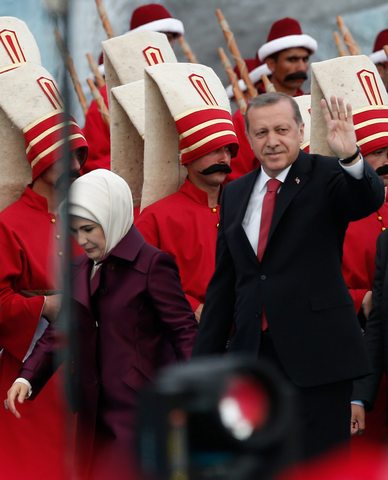
In 1922, the Anatolian army led by Kemal Ataturk entered Istanbul - this event marked the end of the Ottoman Sultanate. However, the Caliphate continued to exist in the country - earlier the Sultan was a caliph, that is, he had spiritual and secular power. Ataturk made a caliph of the cousin of the former Sultan who left the country. A year and a half passed, and in the spring of 1924 the Caliphate was abolished, and the caliph went on forced emigration after the Sultan.
Recep Erdogan - formally not Sultan and not a caliph. Since last year, he is the first popularly elected president of the Turkish Republic - starting from Ataturkov’s times, the head of state was chosen in parliament. However, Erdogan is compared by the scale of ambitions with the Sultan - especially since after the parliamentary elections constitutional changes were expected that would sharply expand the powers of the president. And they would turn Turkey from the Presidential Parliamentary Republic to the presidential.
As for the caliphate, Erdogan is the founder of the Islamic Party of Justice and Development (PSR), which is focused on a slow, cautious, but indispensable revision of one of the basic principles of Ataturism - Laicism (secular state). The residents of the Anatolian hinterland like the prospect in which the clergyman has considerable authority, despite the Ataturkovsky westernization. At the same time, urban modernist layers relate to Islamization extremely negatively - they fear that this process will take an irreversible character and directly affect their interests.
However, the results of the parliamentary elections showed that the Turks do not want the power of the new Sultan-Khalifa. Although the PSR received the relative majority, it will not be enough not only for constitutional changes, but also for the formation of a one -party government. None of the parties competing with the Islamists is in a hurry to announce the desire to create a coalition with them. Even if the PSR manages, in the end, to agree on an alliance with nationalists (they were considered the most likely partners of the Islamists before the elections), the new office is unlikely to be stable - the interests of the parties are too different. In particular, nationalists defend the inviolability of another Ataturkovsky principle - nationalism, which provides for the identity of ethnic and civilian (that is, all citizens - Turks). The Islamists went quite far towards the Kurdish community, recognizing the right to “non -Turkish” identity.
What is the failure of the PSR? Firstly, as noted above, with the fear of many residents of the country to receive an authoritarian Islamist regime in the near future. In the year before last, they already went to Taxim Square in protest against Erdogan politics - or supported the rally participants. Then Erdogan was able to bring down the protest wave, but his success was temporary.
Secondly, with the moral wear of the party, fatigue from its reign of an increasingly larger part of society. The PSR still has a margin of safety, but it weakens due to accusations of corruption and immodesty. Erdogan’s new Presidential Palace has become one of the serious arguments to vote against his supporters.
Thirdly, with the departure of the 90s, which were characterized by unstable and ineffective coalitions-an alternative to them was a single-party office of the PSR, which was able not only to stabilize the economy, but also to ensure its successful development for many years. Fears of changes have decreased significantly. In addition, in Turkey, even during the complete political dominance of the Islamists, there was still a real opposition-both nationalists and the main opponent of the PSR, the political force founded by Ataturk People's Republican Party.
Fourth, with a Kurdish problem. The PSR softened it, but did not solve - the majority of the Kurdish community consider the Islamist policy in the national question as half measures that are profitable at a certain stage, but no longer arranging it now. The further concessions of the Kurds, which provide for some form of autonomy, are not ready to go (and the other two parliamentary parties are tuned to such a prospect even more negatively). Therefore, the Kurds made a bet on their own political power - the Democratic Party of Peoples (DPN). At the same time, they were able to find the only true format of the campaign, which allowed them to overcome the “prohibitive” 10%barrier, which was just introduced against the Kurdish party. DPN nominated the maximum liberal program, which made it possible to create a “minority coalition”, which was not yet in modern Turkish history. It included not only the Kurds, but also representatives of other national minorities (for example, Islamized cryptoarmans, for some of which their roots are of considerable importance), as well as sexual minorities, to which the DPN also promised equality. As a result, the Kurds overcame the barrier with a considerable margin, receiving almost 13% of the vote.
Fifthly, the foreign policy factor played a role. A few years ago, during the Arab Spring, it seemed that the Turkish “moderate-Islamist” model would be attractive to the post-revolutionary countries. Time passed, and it turned out that Erdogan suffered a number of foreign policy defeats. In Egypt, the Muslim Brothers were overthrown as a result of a military coup, in Tunisia they are now not possessing either presidential or premier posts. In Syria - directly near the Turkish border - there is a civil war, and the Turkish authorities could not find the best option of actions - they entered a strict conflict with the Assad regime, but did not dare to direct military interference. And the expansion of terrorist IG in Turkey and Iraq is an extremely unpleasant factor for moderate Islamists (whom IS does not consider “real Muslims”).
What now? PSR can either make significant concessions to nationalists, or bet on new elections. But in the first case, as noted above, the government will most likely be unstable and ineffective. This can also affect the fate of the “Turkish stream” in conditions when negotiations and under a one -party government went very difficult. And in the second case, the PSR positions can even weaken more compared to the past elections, including because of the internal disagreements that were previously mixed in connection with the successes of Erdogan, but now they may intensify.
Author-First Vice President of the Center for Political Technology
Photo: Sedat Suna / Era / Tass