
Translated material
Refusal of the language
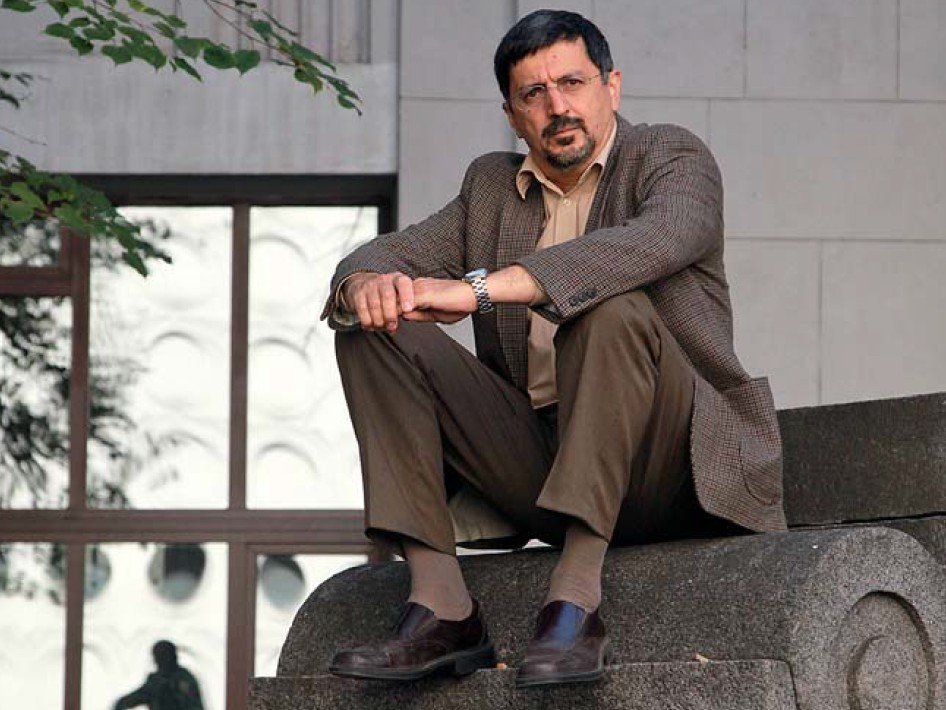
 Hasan Huseynov. Photo by Pavel Smertin (part of speech. M, 2012. No. 2)
We continue the publication of the materials “Parts of Speech” - the journal of the publishing house “Education” dedicated to humanitarian subjects and their teaching at school. The chief editor of the publication is the author and the once permanent employee of Polit.ru Philologist, journalist and teacher Leonid Klein . The doctor of philological sciences, director of the Center for Humanitarian Research of the RANEPA under the President of the Russian Federation Hasan Huseynov , is talking with him about the modern views of society on the humanitarian education, its significance and basic tasks at the school.
I will start with a common question. What is not enough structurally and, perhaps, ideologically in school humanitarian education? Is there any inferiority that must be corrected?
The main conceptual and structural problem is the idea that, on the one hand, there are some fundamental sciences - natural sciences, mathematics - and is the “side of the bow”. Humanitarian science seems to be necessary for that, so that all this has a decent look - it is customary. And this is a common attitude.
I understand correctly: in society, do we have an idea of the humanities as something unprofessional and side?
Yes, it is. The second common judgment is associated with the first. Like, abstract intellectual work and in general the intelligentsia in the broad sense of the word-not only as a social layer, but as the procedure for understanding reality not in technical and economic relations-these are all Mura and lies. This is the opposition of humanities and people of business, firmly standing on their feet, people whose hands are a real profession, not a trepology.
As Gogol said, people who are engaged in direct business.
Yes, there is, they say, a direct business, and everything related to the language is empty -back. One person silently does his job, and the other talks. This idea is like a glacier from which streams flow, and from these streams of a river that cannot be crossed.
What needs to be done so that society realizes that the humanities are the basis for the survival of society?
There are two ways for this. The first is to act by analogy. You just need to look at countries such as Finland, Canada, France, and try to imitate them.
The second method - there should be a serious internal discussion of this problem in all its severity. A number of requirements should be put forward under which representatives and other sciences will subscribe. All teachers: physicists, chemists, mathematicians, genetics - everyone I know say the same thing: "Our students are not able to retell the simplest task in the subject that we give them." It is, not to note, not about humanities.
Do you know the famous picture of A. A. Plastov “The Nazi flew”? A familiar teacher after a lesson in the Great Patriotic War shows this picture in the classroom and asks the children: "What is depicted on it?" One girl replies: “The boy is probably Nazik. Something he probably did not stick up there. ” She realized it so that the Nazi boy was preparing a bomb and was blown up on it. She understands the word "flew". There is a rejection of the cognitive abilities of the language, the rejection of the humanitarian component of education. And on its basis - mutual understanding.
What happens in France, Finland, Canada?
Do you say the situation is different?
There is a tradition that is about two and a half thousand years old. This is a European tradition. It is based on two things. The first thing: Education strives for the most possible for a given society, often even ahead of rationalization. In many cases, the education system at universities in the West is more advanced than the system of organizing firms or concerns.
The European tradition began with seven free arts, and it still holds on them. But these seven free arts, as we recall, are made of trivium and quadrivium. And Trivium - hence our idea of the trivial - these are three purely linguistic disciplines: a letter, that is, the ability to read and write so that it is clear to you; Rhetoric - to speak so that your thought is clear to the interlocutor; Logic is a set of thinking rules that create a universally significant platform for communication.
The problem is that we have a language at our school, but there is no rhetoric and logic?
We don’t even have a language. Because a language without rhetoric and logic is a meaningless thing. Torment in order for children to learn to read and write.
Can you explain how this could be changed?
In any tradition, native speakers know what exist in this tradition here and now. For them, there is a set of generally significant texts in which the main values of this society are presented in the form of a detailed narrative. There are a lot of these texts. Your task as a teacher of history, literature, Russian language is to give a student a guide to the student for movement within these texts. You cannot and should not drive them to someone in the head, but you must give the key to their understanding.
It is necessary to make them available for understanding, right?
Yes, sure. But not only. Why do children teach excerpts at school by heart, for example, from "grief from the mind"? Then, that our language does not consist of words, but of sentences. In the huge sea of these proposals, there are some formulas that accompany us all our lives. For example, the phrase “Love for a native ashes // Love for fatherly coffins” is considered an example of respect for their dead. In the Russian language, it is expressed in this particular poetic line. In another tradition, it can be different. This is an extremely convenient tool for entropy resistance. But you need to use it skillfully.
The student has very little time - only a few years. During this time, milestones are driven into his head with gold cloves, by which he will later recognize his own. This kind of milestone has a dangerous side. If you turn all the education into clogging such golden nails, it turns out in the end such an accountant that will have some kind of joke or sacred quote on any story, which itself will drive the other to others.
Yes, the teacher goes between Scylla and Haribda. On the one hand - a language consisting of several tens of thousands of memes and close structures dating back to canonical precedent texts. And on the other hand, the requirement of clarity, modernity, the ability to express their new thoughts and meanings. The key thing is to recognize your own in history and recognize your own in your generation. This is what unites our children, ourselves and our grandparents.
And where is the falling link? I want to tell you a small story as a detailed question. I recently talked with a little ten -year -old girl. She is very smart, smart. She wanted to read out loud the poem that she learned at school - “Memory of a friend” by A. Akhmatova. She asks: "With or without expression?" Then she reads with an expression, even almost with an anguish. “And how do you understand the words“ the widow of the grave of the nameless // Tratus the Belated Spring ”?” - “What spring? This is not there. " I say: "Can you read it again?" She reads again. And on that line, when the word “spring” appears, her eyes suddenly expand, and I understand that only now she thought about the meaning of what she reads.
The story is beautiful. She illustrates the desire to take this set of texts, to the national hypertext as a canon, which must be thoughtlessly learned by heart and keep in my head, as in a closet. This is really a practice that existed in old gymnasiums and which was not ridiculed only lazy. And the meaning of teaching texts should be that a person receives a set of tools for constant rethinking what is in this hypertext. But in order to teach to critically handle this array, you still need to find out the rules of reading, understanding, analysis, the rules of asking. The main thing is that the meeting of the child with - let's say highly - the mentor occurred on time to turn on the signal light: yeah, I chose it thoughtlessly. It is necessary to critically think through even the basics.
It turns out that we have lost a culture of questions?
Culture of dialogue, education as a dialogue. There is a word that, in connection with the Orthodoxy of our society, everything pronounces, but no one understands. This is "catechesis." The word comes from the verb κατηχέω, which means to answer the question that you are asked. That is, without a teacher, reading a textbook is pointless. Catechization is a conversation about important, significant. In a religious context, as the norm is perceived by the fact that you have a mentor, a confessor with whom you have a conversation. And even in our secular tradition, the teacher gives a task, the student teaches a lesson, comes and reports on this lesson.
The meaning of humanitarian disciplines is that the teacher at the very early stage explains why it is important to do this. Why do I talk with a baby, as a reasonable person? Because he, rejoicing, is just beginning to find out what is written here “Mo-Lo-ko”, “Near”, “Kol”, “Lom”, “Eye”. When playing, he begins to realize that letters are needed in order to understand what is written around. Then he understands that he needs words to explain himself with his parents. But as soon as he comes to school, instead of the freedom of dialogue with his parents, a person with a stick comes, says that you should know this, why you should know this, does not say.
And he does not speak, because often he himself does not know this.
That is, the problem is not even in the methodology, but in the format of communication?
Exactly! The format of communication with children is very important. The teacher tells students that there is a certain essence. This essence is our language with which we can do four things: we can express ourselves; We can communicate with another and understand what he says; We can know the world - that is, read and think silently; We can control others with the help of language. With these four functions of the language it is necessary to begin education.
I always had a feeling at school that the Russian language is taught as a foreign language. Even then, I had the question of what these conjugations and declens are generally, why we should memorize them.
There is the main task of the teacher. When a child is brought to him, he says to him: “Look, there are two points. You come from above because you are small. You will live when I will not live. There is a line between you and me. My task is to show the line that connects me now-with you-and with Aristotle, who lived many, many years ago. "
“Widespread” and “declension”-these remarkable words are present in the language, but they were once discovered, in the case of our culture-ancient Greeks. And we all know this because Aristotle “invented” these words for us. They were created by one person. We seem to tell the story of our family. And one of the family members is Aristotle.
It is not enough to name the name of Aristotle. It needs to be introduced into use, make a part of a cultural family.
This requires compressed reader. Roughly speaking, "Aristotle for beginners." No need to be shy. Newton somehow compared our knowledge with the ball. Everything that we find out can be represented in the form of a ball that is inflated all the time, but at the same time ignorance of exponent increases even more. We do not know more than we know. We always know less than we know.
The school gives us the illusion that if we took possession of the program, then we took possession of knowledge.
We took possession of the instructions for using some set of disciplines, and we must acquire skills on our own.
There is an essay of Aristotle, which is called "categories". When we read this text, we understand what grammatical categories are: what is a noun and verb, subject and predicate, application, addition. And the mental effort that a person must make in order to understand this then pays off during the first year for both the teacher and for the student. We understand that these are not unusual properties of the language, but the instrumentation of our ownerless consciousness yesterday.
This forms not only knowledge of linguistics and humanities, but also a worldview, because a person learns to ask questions.
The child still knows how to do this, the teenager already ceases to do this - to ask. This is the missing link. In our country, this is often written off on puberty. In fact, in the elementary grades of the school, he was driven into his head: "Do not ask stupid questions." From his instruments of handling life, this open, naive was excluded. Mandelstam said that the sign of civilization is naivety, and the savage is always malicious, gloomy and distrustful. To many adults, when they do not know or do not understand something, it is inconvenient to ask again. There is no need for violence, but the effort is necessary. The roots of the teachings are bitter, but its fruits are sweet.
What are the words and concepts that are meaningful to culture come from Greek, but we do not think about it and do not remember?
In the word "history" there are two components of meaning. The first is what happened, what happened. The Germans have the word geschichte, and it is etymologized as a stratum, that is, “what happened” and “deposited”. But in the Greek word “history” there is another component that we learn through Etruscan mediation in the Latin language. Latin "Historia" of one root with the word "Histrio" is an actor. That is, history is not only what happened and not so much that it once was, but the theatrical performance, which every new generation plays and shows others. Therefore, in the Russian language, the word is so often used in this meaning, as in the phrase "this is another story." History is how we tell about it and what we show.
That is, in a sense, such a "holiday that is always with you."
And which is constantly returning. This is constantly rethought. This is more than once and for all this, and by each new generation the past of the world. And this accommodation takes place at school with everyone. It is impossible to approach any event so that it was appreciated once and for all, they said that the Holocaust was like that. The generation that has a number on the hand is one experience. And when all the witnesses will die, it will be necessary to figure out how to talk about it convincingly, believable so that the next generation is even remote, but to the same extent understanding the horror of what happened. You need to be an artist - not in the sense of a lying, a deceiver, and you need to think through a strategy, how to make a story that understands them. Even obvious historical events need not only documentary, but in constant literary, artistic - narrative rethinking.
Who should do all this?
A new generation of prepared historians-historians.
Preparation of teaching staff is a colossal expensive program. It seems to me that now we have such an incredibly difficult situation, because a whole generation has been missed. Massively missed.
There is no real competition for the replacement of the vacancies of teachers, because the profession is not valued. Further - the principle of dominoes.
You can stop the process at the level of teachers for elementary school. Here we must study with the Germans, from the Finns ...
There are outstanding examples in Russia! But here they are not systemic, but exclusive, and therefore it turns out that even harmful. Historical narrative, rhetorical science, law and other fundamental humanitarian disciplines should be given to everyone at the equally high level. If this is not, the elite school will not save education.
See also: Humanitarian landmark Humanitarian education in three national educational systems Vitaly Leibin great closing of education and science