
Translated material
Competitive advantage
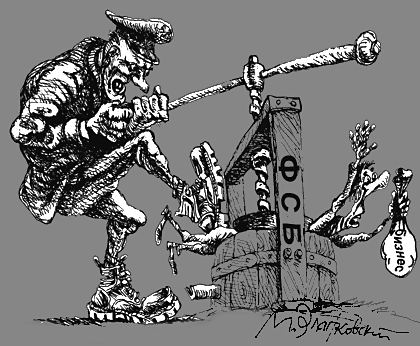
A month and a half was a vacant post of the head of one of the structures of the Federal Security Service. Not a director, not even a deputy - just the head of one of the services.
Nevertheless, a failure in the country's economic life has already occurred: for unknown reasons, the exclusion of Rosgosstrakh is delayed from the list of strategic enterprises, news agencies said. In fact, the delay occurred due to the fact that the project does not endow the FSB.
It is difficult to get rid of the feeling that these two events are directly related. The fact is that the FSB (SEB) economic security service of the FSB (SEB) was not a leader - since the previous head of the service Alexander Bortnikov was appointed director of the entire FSB. Last week, the long-awaited appointment occurred-the SEB was headed by the former first deputy Bortnikov Yuri Yakovlev (not from St. Petersburg, oversaw industry and defense industry, advanced in the career in fact Vadim Sinsov, the director of a metallurgical enterprise, who received a deadline for espionage in favor of Great Britain). And, apparently, now the country's economic life will return to the previous tense pace.
The failure with Rosgosstrakh seemed to be the first demonstration of a new system of relations between special services and business, which has been built since the fall of last year. Systems in which special services are given the role of a business agent in a hostile or competitive environment, and the FSB economic security service will play the first violin.
But in new circumstances, a complex managerial problem arises. If the special services from the state of the state turn into a business tool, then it is not very clear how the relations of the customer-executor will be built.
In Soviet times, the system of relations between special services and industry was, like everything in the USSR, centralized. There was always some committee or commission that collected applications for industrial espionage from enterprises and transferred them to spies.
In Russian times, it has been partially preserved-and today there is a military-industrial commission under the government, which includes the deputy director of the foreign intelligence service and the deputy director of the FSB. This system has one plus - special services do not contact directly with the business and remain under state control. But she also has disadvantages - she will always be late. It is impossible to predict in advance the crisis between the shareholders of the oil company and to find spies there by the beginning.
Meanwhile, in the Putin period, an alternative communication system of special services and businesses appeared, simpler and more mobile. This system was created within the FSB economic security service, where since 1999 there have been three management: on counterintelligence support for industry, transport and credit and financial sector objects. And if the word “counterintelligence” over the years has increasingly went into the shadows, then “provision” acquired a new weight. Employees of these departments are directly in contact with the corporations that they are designed to “provide”.
This scheme has every chance of success: the special service will be able to quickly respond to the requests of selected corporations (for example, bring down the price of the company before buying it by discovering spies there), and those have resources to equally promptly stimulate useful bodies of organs.
True, in this case you will have to forget about the interests of society and the state itself. But, it seems, the Kremlin is ready to make such a sacrifice for the sake of possessing such an effective weapon of competition.